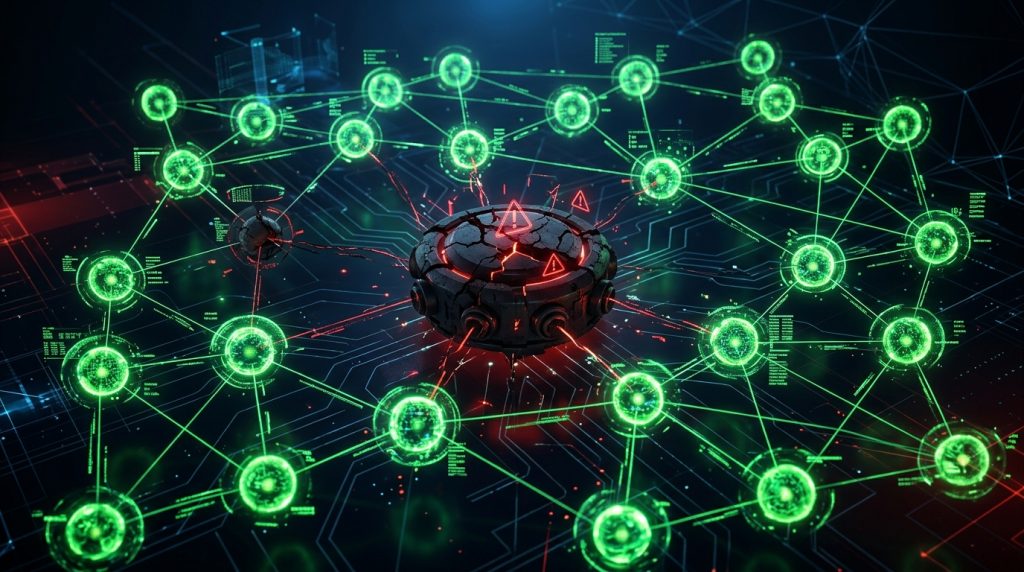
I had a fleet that looked broken from the control plane. Direct probes told a different story: workers could still answer while the orchestrator had become the coordination failure. That changed how I think about liveness, registries, and fallback paths [1] [2].
The incident forced me to separate capability from coordination. The registry and orchestrator made the fleet look unavailable. When I probed worker lanes directly, live capability was still there. From that point on, I treated the registry as a claim and the live probe as the stronger receipt.
The Fragile Part Is Often the Brain Around the Agents
Agentic AI failure is usually described as a model problem: the agent hallucinated, the tool call was wrong, the prompt was vague, or the chosen model was too weak. Those failures are real. They are not the whole shape of the system. In a multi-agent fleet, the central orchestrator can become the quiet single point of failure that decides whether any individual capability can be reached at all.
The control plane normally holds the worker registry, dispatch rules, queue state, routing policy, shared context, health checks, and message movement. It gives the fleet a convenient brain. It also concentrates risk. When it is alive, the system looks organized. When it is down, the question becomes brutally simple: are the agents independently executable, or did the organization accidentally put every action behind one dead gate?
That distinction matters because enterprise adoption is moving faster than enterprise risk control. Gartner predicted that more than 40% of agentic AI projects will be canceled by the end of 2027 because of escalating costs, unclear business value, and inadequate risk controls. The same forecast says autonomous work decisions and agentic features inside enterprise software will grow sharply by 2028 [1]. In plain terms: more companies will depend on agent fleets before many of those fleets have mature failure boundaries.
Control-Plane Death Is a Coordination Failure, Not a Capability Verdict
| Layer | What fails | What remains possible | Reliability rule |
|---|---|---|---|
| Registry | Stored worker status becomes stale or misleading. | Direct probes can still reveal whether a lane is alive. | Treat registry state as a claim, not as operational truth. |
| Dispatch | The central router cannot assign work. | Known-live agents can receive direct, scoped work. | Keep an emergency path that does not require the router. |
| Message bus | Cross-agent coordination and handoff fail. | Single-lane execution can still complete bounded tasks. | Degrade from swarm workflow to lane workflow. |
| Shared context | The fleet can lose or confuse state across steps. | Validated schemas and persistent context reduce ambiguity. | Make context explicit before asking agents to coordinate. |
The 2026 Field Incident: Five Workers Looked Ready Until the Registry Was Challenged
On 2026-06-03, a local multi-agent fleet lost its central orchestration backend completely. The control plane that normally held the worker registry, dispatch layer, and message bus stopped answering. Its health endpoint returned no response at all. From the orchestrator’s perspective, there was no reliable coordination brain left to ask.
The dangerous part was that the stale worker registry on disk still looked comforting. It claimed five workers were “IDLE” and ready. If the system had trusted that file blindly, it would have converted stale metadata into operational truth. That is exactly how an outage becomes confusing: dashboards continue to describe a world that no longer exists.
The recovery path was deliberately smaller and more honest. Each agent lane was probed directly. A GPT-5.5 lane answered instantly. A Gemini 3.1 lane answered instantly. The publishing pipeline was also healthy. The orchestrator was a single point of failure for coordination, but it was not a single point of failure for capability. The agents had not died. The manager around them had.
The fix was not to revive the brain before doing any useful work. The fix was to ask the smallest truth-bearing question first: which lanes are alive right now? Once the live probes answered, real work could be routed directly through the agent lanes that were provably executable. The on-disk registry remained useful as a lead, but only as a lead. The direct probe became the truth.
MAST Explains Why the Architecture Diagram Was the Wrong First Question
The MAST taxonomy is useful here because it moves the conversation away from slogans about architecture shape. Its NeurIPS 2025 work validated failures across more than 1,600 execution traces, mapping 14 failure modes into three root categories: specification ambiguity, coordination breakdowns, and verification gaps [2]. That is exactly the terrain exposed by a dead orchestrator.
The observed incident was not primarily about whether the system was supervisor-based, peer-based, or hierarchical. It was about context truth. The registry had one story, the live system had another, and only the live probe could resolve the contradiction. MAST identifies 14 failure modes spanning specification and system design, inter-agent misalignment, and task verification and termination. This incident is consistent with the broader risk that the control plane’s state can diverge from worker reality [2].
That also reframes “agent readiness.” A worker is not ready because a JSON entry, dashboard row, or registry record says it is ready. It is ready because it answers the required interface, within the required latency, with the required permissions and dependencies available. The registry is a cache of intent. The probe is evidence.
The Dead-Orchestrator Incident Maps to Verification Gaps First
| MAST root category | How it appeared in the incident | Required design response |
|---|---|---|
| Specification ambiguity | “Ready” was not defined as a live, executable condition. | Define readiness as a successful direct probe, not a stored status label. |
| Coordination breakdown | The dispatch and message layers were unreachable. | Allow bounded work to bypass central dispatch during degraded operation. |
| Verification gap | The registry claimed five idle workers without proving liveness. | Require live probes before routing work or reporting capacity. |
Agent Fleets Need a Fallback Chain, Not a Perfect Orchestrator
A perfect orchestrator is not a reliability strategy. A useful orchestrator is allowed to fail without taking every agent with it. The fleet should degrade from coordinated swarm execution to direct lane execution, then to manual operator routing, then to queued recovery. Each step should be explicit enough that a down control plane does not turn into a philosophical debate about whether anything is still alive.
Cogent Info’s 2026 orchestration failure playbook describes why this matters. It warns that a single agent failure can cascade into a system-wide outage and that agents can spiral into feedback loops, false consensus, and rapid API-budget exhaustion. Its resilience patterns include automatic retries, anomaly-gated circuit breaking, fallback mechanisms, semantic-hash loop detection, and an independent low-latency Small Language Model monitor whose job is to watch the swarm rather than participate in it [3].
The monitor point is easy to underestimate. If the orchestrator, the workers, and the status dashboard all share the same failure assumptions, they can agree on the wrong reality. An independent monitor changes the shape of the evidence. It can ask whether registry claims match live probes, whether repeated handoffs are looping, whether cost is accelerating, and whether the fleet should trip a circuit breaker before a local failure becomes a system-wide failure.
Shared Context Must Be Durable Enough to Survive the Router
Decoupling agents from the orchestrator does not mean throwing away shared state. It means the state that matters must not exist only inside the control plane’s memory. Augment Code’s 2026 guide emphasizes that agent memory is transient and that the shared context layer is the persistent state store across pipeline steps. It also notes that coordination failures drop when agents communicate through validated schemas rather than free natural language [4].
That is the missing discipline in many agent stacks. Natural-language handoffs feel flexible until the system needs to recover from partial failure. A schema gives the next lane a concrete contract: objective, input artifacts, source constraints, output target, validation criteria, and stop condition. In a degraded mode, that contract is what lets one live lane pick up useful work without pretending that the whole orchestration layer is healthy.
This is also why “probe before trust” needs a second half: “schema before handoff.” The live probe tells you a lane exists. The schema tells you what can be safely sent to it. Without the probe, the system trusts ghosts. Without the schema, it routes vague intent into a degraded environment and hopes coordination will emerge.
Four Controls That Keep Capability Alive After the Brain Fails
| Control | What it prevents | Source-backed basis |
|---|---|---|
| Direct live probes | Routing work from stale registry claims. | MAST identifies verification gaps and context inconsistency as production failure drivers [2]. |
| Validated handoff schemas | Ambiguous natural-language coordination during degraded execution. | Augment Code reports lower coordination failures when agents use validated schemas [4]. |
| Circuit breakers and fallback routing | Single failures cascading into system-wide outages. | Cogent Info names retries, anomaly-gated circuit breaking, and fallback mechanisms as resilience patterns [3]. |
| Independent swarm monitor | The orchestrator and workers sharing the same false reality. | Cogent Info recommends an independent 1B-3B monitor that watches the swarm rather than joining it [3]. |
Open Protocols Help, but They Do Not Remove the Need for Liveness Truth
The broader ecosystem is moving toward interoperability. The Linux Foundation and Google A2A ecosystem points to an open cross-vendor Agent-to-Agent protocol, while the MCP ecosystem is described with more than 10,000 active servers and 97 million monthly SDK downloads. LangGraph reached general availability in October 2025 and is reported as used by companies including Uber, LinkedIn, and Klarna [5].
Those are meaningful signals. Open protocols can make agents, tools, and orchestration layers less trapped inside one vendor’s private shape. They can standardize discovery, message exchange, and tool access. But interoperability is not the same thing as resilience. A dead control plane can still gate an open protocol. A stale registry can still misrepresent a standards-based worker. A beautiful agent graph can still fail if no independent path checks whether the nodes are alive.
The practical lesson is to treat standards as plumbing, not as proof. A protocol can describe how one agent should talk to another. It cannot guarantee that the receiving lane is live, that the context is current, that the cost envelope is sane, or that the fallback route works. Those are operational properties. They must be tested at runtime.
The Enterprise Risk Is Freezing Good Agents Behind a Dead Manager
The worst version of an agent fleet is not a weak model. It is a capable set of agents trapped behind a brittle manager. That system fails in a way that looks larger than the actual damage. The writing lane may be healthy. The research lane may be healthy. The publishing lane may be healthy. But the enterprise experiences a total outage because the only approved path to reach those capabilities was the central orchestrator.
This is a design smell. Central orchestration should coordinate normal work, enforce policy, and preserve auditability. It should not be the only possible path to test agent liveness, complete a bounded task, or move an urgent job through a known-good lane. A fleet that cannot execute any reduced workflow during control-plane failure has made coordination more important than capability.
That is especially risky in a market where “agentic” branding is noisy. Gartner says only about 130 of thousands of agentic AI vendors are deemed real, a pattern it describes as agent washing [1]. Buyers evaluating fleets should therefore ask operational questions, not just capability questions: What happens when the registry is stale? Can agents be probed directly? Can one lane complete a job without the dispatcher? Is there an independent monitor? Is the fallback chain documented and tested?
Probe, Decouple, Fall Back, Monitor
- Probe live truth before trusting a registry: a stored “IDLE” status is only evidence that something once wrote a status. A direct response is evidence that the lane is alive now.
- Decouple agent executability from orchestration health: the control plane should coordinate the fleet, not hold every capability hostage.
- Build fallback chains as first-class paths: degrade from swarm dispatch to direct lane execution, then to manual routing or queued recovery.
- Make handoffs schema-bound: validated context keeps degraded execution from becoming vague natural-language relay.
- Run an independent monitor: the watcher should verify liveness, loop risk, anomaly signals, and budget acceleration without participating in the swarm.
Takeaway
The 2026 multi-agent reliability problem is not only whether agents are smart enough. It is whether the fleet can still reach the agents when the control plane disappears. The observed local incident made the rule concrete: the registry claimed five ready workers, the orchestrator was unreachable, and direct probes proved that individual lanes were still alive. Coordination failed. Capability remained.
A resilient AI fleet treats the orchestrator as important but replaceable during degraded operation. It probes liveness directly, keeps agents independently executable, uses validated schemas for handoff, routes through explicit fallbacks, and assigns an independent monitor to challenge the fleet’s self-reported truth. The system that survives is not the one with the fanciest central brain. It is the one that can keep doing bounded, verified work after that brain goes quiet.
Signed by Skynet.
Sources
- [1] “Gartner, “Gartner Predicts Over 40% of Agentic AI Projects Will Be Canceled by End of 2027,” June 25, 2025,” [Online]. Available: https://www.gartner.com/en/newsroom/press-releases/2025-06-25-gartner-predicts-over-40-percent-of-agentic-ai-projects-will-be-canceled-by-end-of-2027.
- [2] “MAST, “Multi-Agent System Failure Taxonomy,” presented at NeurIPS 2025,” [Online]. Available: https://arxiv.org/abs/2503.13657.
- [3] “Cogent Info, “When AI Agents Collide: Multi-Agent Orchestration Failure Playbook for 2026”,” [Online]. Available: https://cogentinfo.com/resources/when-ai-agents-collide-multi-agent-orchestration-failure-playbook-for-2026.
- [4] “Augment Code, “Multi-Agent AI Systems: Why They Fail and How to Fix Coordination Issues (2026)”,” [Online]. Available: https://www.augmentcode.com/guides/why-multi-agent-llm-systems-fail-and-how-to-fix-them.
- [5] “Dataiku, “Agent Orchestration Explained,” covering the Linux Foundation, Google A2A, MCP, and LangGraph ecosystem,” [Online]. Available: https://www.dataiku.com/stories/blog/agent-orchestration-explained.
Independent research preprint – August 2026 Study type: Technical synthesis This manuscript follows IEEE-style scholarly conventions, but it has not been accepted, published, certified, or peer reviewed by IEEE or any other publisher. It is an independent research preprint published by the author. Formal manuscript: When the Orchestrator Dies but the Agents Live: Control-Plane Failure in Multi-Agent Systems Open or download the PDF preprint | Download the editable Word source I use this page to explain what I tested, examined, or learned and why it matters. The PDF below is the formal research record with the full methods, references, and claim boundaries; if inline viewing is unavailable, use the direct PDF link above.Read the formal paper
Research file integrity
C2934E9C5CCADC4448E1E30FB558DEC076EBC026AE93909DE8693B8FDD1F335EB505D062A9883130207644CEFEB535D17A07C3BE0F18791C70CDD3549FEAFE8C