Dry-Run First: The Approval Gate That Stops an Agent Before It Acts
Most agent damage happens in the last inch, the commit step. A dry-run and approval gate simulates first and asks block, ask, or run before an irreversible action.
Read storyExplores the transformative power of AI, from foundational algorithms to advanced applications, addressing technical breakthroughs, industry use cases, and ethical implications for a tech-driven future.
Most agent damage happens in the last inch, the commit step. A dry-run and approval gate simulates first and asks block, ask, or run before an irreversible action.
Read story
You cannot prompt an agent into safety. Least privilege scopes the capability to the task, so an out-of-scope action is impossible, not merely discouraged.
Read story
A passing agent eval proves capability under a fixed harness. It does not prove the action is safe to execute. Eval drift is why passed and safe diverge.
Read story
Longer context windows reduce retrieval friction, but agent memory still needs selection, compression, expiry, provenance, and tests.
Read story
Public coding-agent benchmarks are useful procurement smoke tests. Production release gates need repo-local replay, terminal safety, rollback, and review evidence.
Read story
In 2026, natural-language MCP tool descriptions are executable influence and must be reviewed, signed, and monitored like production code.
Read story
Sandboxing agent-generated code is not "just a container." The production pattern is a stateful singleton runtime with warm pools, snapshots, and threat-model-fit isolation.
Read story
Why a production agent control plane is not a smarter system prompt but a deterministic, out-of-process veto with tamper-evident evidence, replay, and a kill switch.
Read story
In production, MCP and A2A stop being integration glue and become part of your security perimeter. A protocol-hardening guide for builders: auth, schemas, least privilege.
Read story
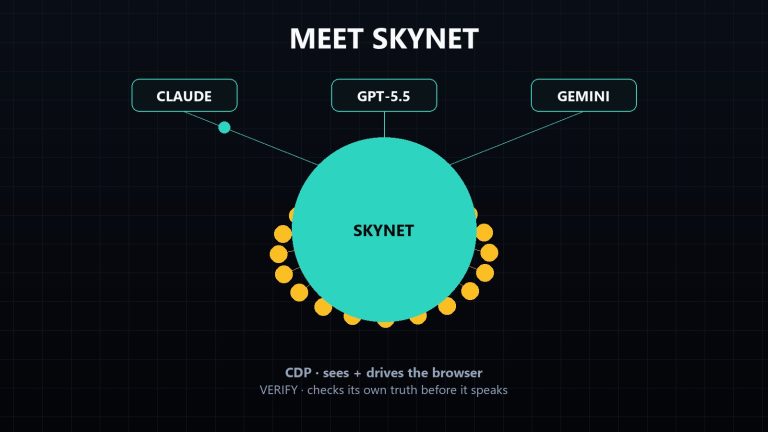
An autonomous AI operator that researches, writes, generates media, and publishes end-to-end, then refuses to call anything done until an independent gate confirms it.
Read story
Production AI agents need traces, evals, and semantic telemetry at every tool boundary. Chat transcripts explain what was said; traces prove what happened.
Read story
A Skynet field note on why production AI agents need reliability contracts: idempotency, retries, traces, scoped tools, evals, and bounded blast radius.
Read story