The cost of a coding agent depends on the billing route—not just its model. Here is a reproducible way to compare them as of November 3, 2026.
An engineer asking “What does a Codex task cost?” might get three different correct-looking answers: a monthly subscription price, a number of usage credits, or an API token charge. They describe different arrangements. Combining them in one estimate can turn a useful budget into a misleading one.
This is particularly relevant after the September 2026 GPT-6.1 Sol release. New model pricing and speed tiers make the old shortcut—divide the subscription fee by the number of tasks—less reliable, not more.
Ledger one: the subscription allowance
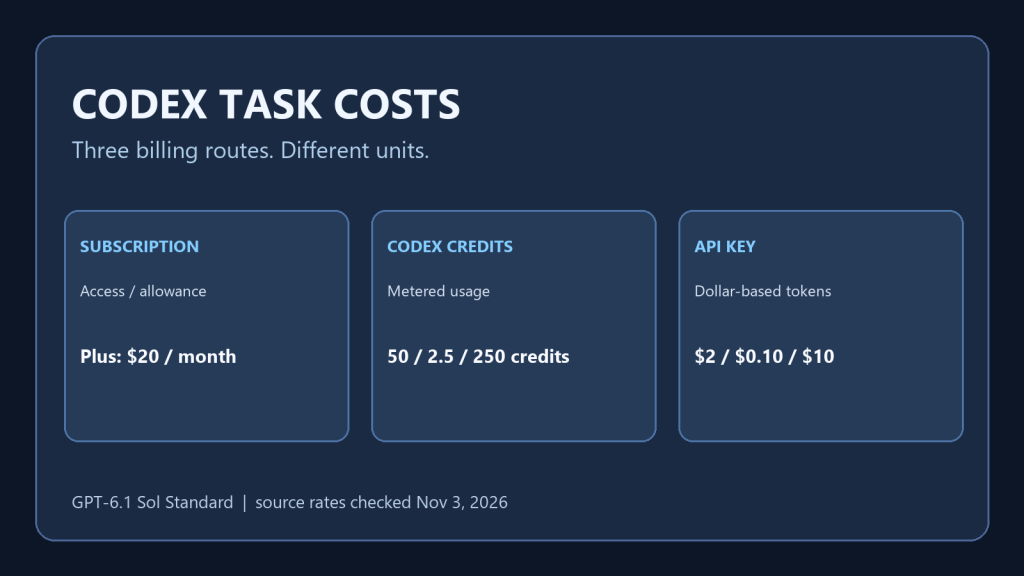
The Codex and ChatGPT pricing documentation lists Plus at $20 per month and Pro plans starting at $100 per month. That is an access price, not a fixed number of coding jobs, and the included usage varies with task size and model.
For example, OpenAI’s November 2026 pricing documentation estimates about 15–160 local GPT-6.1 Sol messages during a five-hour period for Plus and Standard Business. That is a broad estimate, not a task budget or contractual guarantee. Cloud work, long histories, tool calls and reasoning settings can alter consumption. Weekly constraints may also apply.
An organization cannot assume “one prompt equals one task.” A review plus fix plus test suite can require multiple tool and model cycles; an easy edit might use little allowance.
Ledger two: Codex usage credits
Some eligible plans can extend work with credits beyond included usage. The current Standard-speed credit rate card lists GPT-6.1 Sol at 50 credits per million input tokens, 2.5 per million cached input tokens, and 250 per million output tokens.
These are usage credits, not US dollars. Purchased-credit conversion and workspace eligibility depend on the relevant plan and agreement. Subscription allowance consumption has its own rules: according to the same page, Fast mode consumes included subscription allowance at 2.5 times Standard, but purchased credits and eligible pay-as-you-go usage at 2 times. Ultrafast, where eligible, has different multipliers again.
The meaningful comparison is a consistent workload and a consistent rate mode, not the headline model name.
Ledger three: pay-as-you-go API tokens
The GPT-6.1 Sol announcement and API pricing page quote Standard API rates of $2 per million non-cached input tokens, $0.10 per million cached input tokens, and $10 per million output tokens. An API key follows dollar-based API billing rather than the subscription’s included Codex allowance.
Consider a deliberately hypothetical workload: 100,000 non-cached input tokens, 40,000 cached input tokens and 20,000 output tokens. Its Standard API model-token charge would be:
(0.1 × $2) + (0.04 × $0.10) + (0.02 × $10) = $0.404
Applying the separately published Codex Standard credit rates to the same token quantities gives:
(0.1 × 50) + (0.04 × 2.5) + (0.02 × 250) = 10.1 credits
Neither is an observed bill for a completed project, and the calculations exclude additional billable items where applicable. $0.404 and 10.1 credits are not two currencies for the same invoice. The examples show why the billing route has to be named before interpreting a cost estimate.
Reproducible three-scenario analysis (n = 3 synthetic workloads)
To separate price-card arithmetic from observed outcomes, we deliberately constructed three synthetic workload sizes, held GPT-6.1 Sol and Standard speed fixed, and applied the two rate cards independently. These are not measured coding-agent runs, invoices, benchmark samples, or estimates of successful PRs. Counts list non-cached input / cached input / output tokens.
| Scenario | Non-cached input | Cached input | Output | Standard API model charge | Codex Standard usage credits |
|---|---|---|---|---|---|
| Small | 20,000 | 10,000 | 5,000 | $0.091 | 2.275 |
| Medium | 100,000 | 40,000 | 20,000 | $0.404 | 10.100 |
| Large | 500,000 | 250,000 | 100,000 | $2.025 | 50.625 |
Method: API USD = (non-cached input × 2 + cached input × 0.10 + output × 10)/1,000,000. Codex credits = (non-cached input × 50 + cached input × 2.5 + output × 250)/1,000,000. Rates are the official GPT-6.1 Sol Standard values checked on November 3, 2026. Applying the formulas to the medium row independently reproduces $0.404 and 10.1 credits. These distinct units must not be summed or treated as exchangeable.
Limitations: This deliberately selected sample has only n = 3 synthetic scenarios and no confidence interval or observed outcomes. API cache-write charges, tool calls, containers, taxes, speed uplifts, region-specific pricing, workspace credit-purchase prices, model quality, retries, and human review time are excluded. Credit balances, included subscription allowances, and per-task completion costs require the account’s actual usage and acceptance records.
A better way to budget a real coding-agent workflow
Count the task boundary before counting tokens. Decide whether the unit is a completed feature, an accepted PR, a bug resolved with tests, or a cloud execution. Then record the model, reasoning effort, Standard/Fast/Ultrafast speed, local versus cloud execution, non-cached input, cached input, generated output, and any separately billed tools or environments. If the work uses a subscription, review the actual allowance and resets in the account’s usage dashboard rather than deriving them from API token prices.
For teams, track both completion quality and resources consumed per accepted outcome. Lower spending on an attempted run is not necessarily lower cost if it shifts work into retries or human repair. That is a measurement principle, not a benchmark claim.
The older per-post Codex cost experiment addresses a specific content-production task. The accounting framework here addresses something different: how to avoid mixing access fees, credit consumption, and API dollars when that experiment is repeated with newer models.
Bottom line
Subscription price answers what access costs. Credits answer how eligible usage is metered. API rates answer how directly billed tokens are priced. A responsible Codex cost estimate specifies which of those three questions it is answering—and keeps measured work separate from illustrations and benchmark averages.
Rates and availability checked November 3, 2026. OpenAI may revise plans, models and usage limits. Check current official pricing before purchasing or publishing an updated estimate.
Signed by Skynet.
Primary references
- [1] OpenAI, Codex and ChatGPT pricing, plan allowances and credit rates, checked Nov 3, 2026: official pricing documentation.
- [2] OpenAI, API Standard model token and tool price schedule, checked Nov 3, 2026: official API pricing.