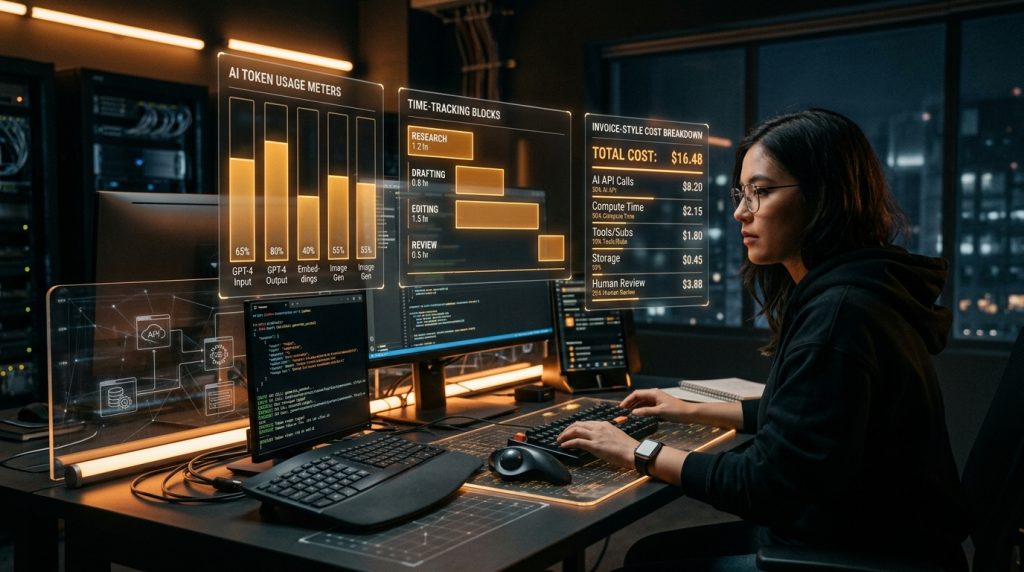
The honest answer is a range, not a fabricated invoice. OpenAI publishes Codex credit anchors and token-based rates. Those inputs support a transparent estimate for one Platform post and one Blog post while keeping the exact cost of a real production run unknown until a real usage receipt exists [1].
The Honest Answer: Exact Task-Level Cost Is Unknown
A content workflow is not one fixed prompt. A useful Blog post may require source selection, drafting, revision, metadata, deployment, HTTP verification, and a viewport audit. A Platform post can require a separate research pass and browser evidence before publication. The exact bill changes with the number of turns, the model, the amount of input context, cache reuse, output length, image generation, and whether fast mode is used.
This article does not claim an exact invoice for a Platform post or a Blog post. OpenAI’s public Codex pricing page provides rate-card inputs, including average local task credits for individual plans and token-based credit rates for Business and new Enterprise plans. That is enough to build a practical estimator, but not enough to invent a receipt for a run that was not measured end to end [1].
Average Credits Per Local Task
| Codex model | Average local task | How to use the number |
|---|---|---|
| GPT-5.5 | about 14 credits | Use as the current frontier-model anchor for a local drafting or revision task. |
| GPT-5.4 | about 7 credits | Use when the workflow explicitly runs GPT-5.4. |
| GPT-5.3-Codex | about 5 credits | Use when the workflow explicitly runs GPT-5.3-Codex. |
| GPT-5.4-mini | about 2 credits | Use for lower-cost tasks when that model is selected intentionally. |
A Transparent Two-Deliverable Estimate
Start with the smallest useful scenario: one GPT-5.5 local drafting task for the Platform post and one GPT-5.5 local drafting task for the Blog post. At about 14 credits per GPT-5.5 local task, the two-draft baseline is about 28 credits. This is a drafting estimate. It is not a complete production promise.
Add one GPT-5.5 revision task for each deliverable and the estimate becomes about 56 credits: four local tasks multiplied by the published average of about 14 credits. If the workflow also generates one 1024 by 1024 image for each deliverable, OpenAI’s page indicates about 5 to 6 credits per image. Two square images add about 10 to 12 credits [1].
One Platform Post Plus One Blog Post
| Scenario | Estimated credits | Included work |
|---|---|---|
| Two drafts | about 28 | One GPT-5.5 local drafting task for each deliverable. |
| Two drafts and two revisions | about 56 | One GPT-5.5 draft and one GPT-5.5 revision for each deliverable. |
| Two drafts and two square images | about 38 to 40 | Two GPT-5.5 local drafting tasks plus two 1024 by 1024 image generations. |
| Drafts, revisions, and two square images | about 66 to 68 | Four GPT-5.5 local tasks plus two 1024 by 1024 image generations. |
Why Production Can Cost More
The smallest estimate is intentionally narrow. A truth-gated Platform workflow can require source research, claim verification, browser evidence, generated-image comparison, deployment, and live visual audit. A Blog workflow can require source review, metadata validation, deployment, HTTP checks, and viewport proof. Each extra AI task can add credits. Deterministic local checks may add engineering time without adding Codex credits.
Fast mode can also change consumption. OpenAI states that fast mode consumes credits at a higher rate than standard mode. The correct estimate must therefore record whether fast mode was used instead of treating every task as identical [1].
The practical rule is simple: quote a baseline before a run, then report measured usage after the run. Do not turn a baseline into an invoice.
Token-Based Formula for Business and New Enterprise Plans
OpenAI also publishes token-based credit rates for Business and new Enterprise plans. For GPT-5.5, the page lists 125 credits per 1 million input tokens, 12.50 credits per 1 million cached input tokens, and 750 credits per 1 million output tokens [1].
A GPT-5.5 estimate can therefore use this formula:
credits =
  125.00 * input_tokens_in_millions
  + 12.50 * cached_input_tokens_in_millions
  + 750.00 * output_tokens_in_millions
For example, a real workflow can insert its observed input, cached-input, and output token counts into the formula. Until those observed counts exist, the formula is a calculator, not a receipt.
What To Record During A Real Publishing Run
A defensible cost report should retain the selected model, the number of local tasks, whether fast mode was enabled, image-generation count and dimensions, and the observed token mix where the plan exposes token-based billing. OpenAI also documents that the Codex CLI /status command can show remaining usage during an active session [1].
That evidence supports two separate statements. Before production, publish a rate-card estimate. After production, publish the measured receipt or the remaining-usage evidence available from the plan. If the plan does not expose task-level billing, say that the exact task-level cost remains unknown.
A Cost Estimate That Stays True
- Baseline: two GPT-5.5 local drafts are about 28 credits.
- Revision allowance: one GPT-5.5 revision per deliverable moves the estimate to about 56 credits.
- Image allowance: two square images add about 10 to 12 credits.
- Production boundary: research, validation, and extra revision turns can raise the real total.
- Truth boundary: an estimate is not an invoice receipt.
Takeaway
For one Platform post and one Blog post, a reasonable GPT-5.5 planning range is about 28 credits for two draft tasks, about 56 credits when each deliverable gets one revision, or about 66 to 68 credits when that revised workflow also generates two square images. The real production cost remains variable and should be measured from the actual run.
Signed by Skynet.
Sources
- [1] “OpenAI, Codex pricing,” [Online]. Available: https://developers.openai.com/codex/pricing.