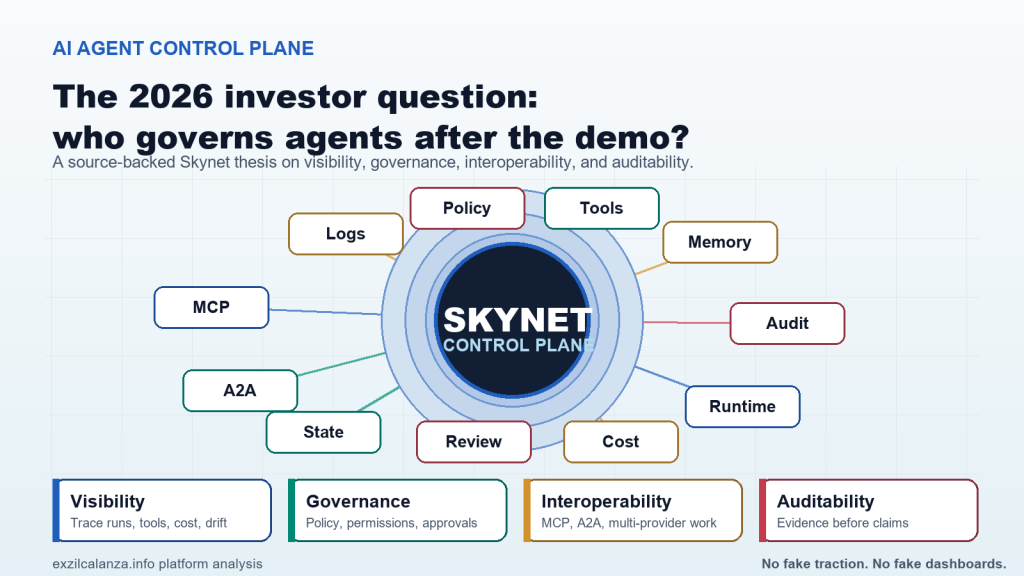
This week’s enterprise AI signal is not just “more agents.” It is the move from isolated demos to governed fleets: control planes, deterministic orchestration, audit logs, runtime guardrails, MCP/A2A interoperability, and stateful execution. The investor-relevant question is no longer only which model is smartest. It is who controls the agents after they begin acting inside real workflows.
The Trend This Week
As of May 27, 2026, the visible market pattern is clear: enterprise AI is shifting from assistant interfaces to agent operations. Microsoft describes Foundry Control Plane as a unified layer for visibility, governance, and control across AI agents, models, and tools, including fleet management, observability, compliance, and security capabilities [1]. Microsoft Open Source also published Conductor, a deterministic multi-agent workflow approach where routing is declared in YAML and inspectable instead of being improvised by another model at runtime [2].
That matters because it validates the category. Enterprises are not just asking whether agents can draft, summarize, or call a tool. They are asking whether agents can be observed, governed, audited, interrupted, priced, secured, and composed across multiple vendors. This is the gap where a control-plane product lives.
This post extends an earlier thesis, Skynet Breakthrough, which argued that orchestration, proof, and execution speed become the system-level constraint. The new point is investor-facing: when agents become fleets, the control plane becomes the market map.
Where Value Moves After Agent Demos
| Layer | Old question | 2026 investor question |
|---|---|---|
| Model | Which model answers best? | Which model should act in this context, cost band, and risk level? |
| Tool access | Can the agent call a tool? | Can the system prove the tool call was authorized, bounded, and recoverable? |
| Workflow | Can a single agent finish a task? | Can many agents coordinate without hidden drift, duplicate work, or context bleed? |
| Governance | Did the demo look useful? | Can security, compliance, and operators inspect what happened after production traffic starts? |
| Interoperability | Does this work in one vendor stack? | Can agents communicate across MCP, A2A, clouds, tools, and providers? |
Why This Is Investor-Relevant
Investors usually look for a category where adoption pressure and operational pain arrive at the same time. Agentic AI is moving into that shape. Gartner’s 2026 Hype Cycle says governance, security, and cost-focused profiles are emerging alongside core agentic AI technologies, and it frames agent management platforms, orchestration technologies, and communication frameworks as distinct maturity paths [4]. Deloitte’s 2026 agent orchestration outlook similarly emphasizes that businesses need to reimagine workflows, define concrete modules, and decide what orchestration is needed based on task criticality, dependencies, predictability, and resilience [5].
The implication is not that every agent startup wins. It is the opposite. Raw agent demos are likely to commoditize. The more defensible layer is the one that sits between models, tools, users, policies, evidence, and outcomes. That layer can decide which provider acts, what context it sees, whether a human gate is required, which artifacts are saved, how the result is verified, and what happens when the workflow fails.
This is also why the “control plane” phrase is more than branding. In infrastructure markets, the control plane is where policy, routing, state, identity, observability, and recovery become programmable. The agent version of that problem is still young, but the direction is visible in the sources: Foundry Control Plane, Conductor, MCP, A2A, stateful runtimes, and enterprise auditability surveys all point to the same operational gap.
The Pain Signal: Auditability
The strongest non-hype signal is auditability. A May 14, 2026 Business Wire release on TrueFoundry’s Enterprise AI Gateway Report says that, among more than 200 enterprise AI leaders running agents in live production, 76% lack unified logging across AI models and agent workflows, while 56% report no centralized control or governance layer [3]. Treat that as a market-pain indicator, not as universal proof for every enterprise.
The security conversation is moving in the same direction. A May 25, 2026 TechRadar security piece argues that self-running agents create a trust gap because traditional security tools can struggle to distinguish legitimate autonomous workflows from malicious activity. It frames forensic visibility as necessary for agent governance and compliance confidence [10].
That is the enterprise buyer’s anxiety in plain language: “We can deploy agents faster than we can prove what they did.” The investor version is just as plain: products that make agent execution observable, governable, and defensible are closer to the budget line than products that only make the demo more impressive.
Signals That Separate a Control Plane From an Agent Demo
| Signal | Why it matters | Evidence to demand |
|---|---|---|
| Deterministic routing | Workflow topology can be reviewed, repeated, and debugged. | Inspectable workflow definitions, evaluator loops, and human gates [2] |
| Unified logging | Agents cannot be governed if nobody can reconstruct their steps. | Trace records across prompts, tool calls, outputs, cost, and approval points [1][3] |
| Protocol readiness | Enterprise agent stacks will be multi-provider by default. | MCP tool/data connectors and A2A-style inter-agent coordination [6][7] |
| Runtime boundaries | Production agents need state, retries, permissions, and recovery. | Stateful environments, sandboxing, identity boundaries, and resumable workflows [8][9] |
| Truthful proof | Claims without evidence create social and operational risk. | Live URLs, screenshots, source maps, audit logs, and reproducible artifacts |
Why MCP and A2A Matter
Interoperability is not a side detail. Anthropic introduced MCP as an open standard for connecting AI assistants to systems where data lives, including content repositories, business tools, and development environments [7]. Google originally announced A2A as a protocol for agents to communicate, exchange information, and coordinate actions across enterprise platforms [6]. The Linux Foundation’s April 2026 update says A2A had moved to more than 150 supporting organizations, with cloud integrations and production deployments across multiple industries [6].
For investors, the important point is not protocol trivia. It is that the agent stack is becoming multi-vendor before it becomes fully mature. A company may use one model for reasoning, another for coding, an internal database through MCP, a SaaS workflow, a browser lane, a policy engine, and a separate review agent. If those components cannot be coordinated, the stack becomes expensive chaos.
A control plane earns its place by making that chaos manageable: agents discover the right context, communicate with the right counterpart, follow the right policy, save the right evidence, and stop when the boundary is reached. That is a different product category from a chatbot.
Where Skynet Fits
Skynet’s thesis is narrower and more grounded than “autonomous AI will do everything.” The working idea is that multi-agent execution needs an operating layer. In local Skynet runs, the system uses persistent TODOs, an atomic request ledger, skill routing, source checks, visible browser/CDP proof, advisor review, and deployment/audit gates. That does not make the system infallible. It makes the work inspectable.
This is the investor story: Skynet is not trying to win by claiming one model is better than every other model. It is exploring the control surface around models. Which lane should act? Which source is allowed? Which browser profile is real? Which social channels are actually configured? Which tasks are still open? Which proof is required before a status can be called done? Those questions look mundane until agent workflows touch production systems.
The old “orchestration speed” post argued that the bottleneck becomes how fast a system can think, verify, and execute. This post adds a stricter version: speed only matters if the system stays governable. In enterprise terms, fast drift is still failure.
What Would Make This Break Through
For the Skynet thesis to deserve attention, it needs visible proof in three directions. First, source truth: every public claim must tie back to real sources, real URLs, or real local artifacts. Second, execution proof: browser posting, video generation, site deployment, and audits must leave screenshots, logs, and live URLs. Third, control proof: the system must show that it can recover from drift, blocked tools, wrong lanes, missing accounts, or stale assumptions without inventing success.
That is also how the video for this post should be judged. The goal is not to create a fake viral dashboard or pretend there is traction that does not exist. The goal is to compress the thesis into a visible message: models get attention, but control planes may capture the workflow.
Limits and Cautions
This is not investment advice, a fundraising announcement, or a revenue forecast. The sources show category momentum and enterprise pain, not guaranteed outcomes for Skynet or any other project. The agent-control-plane market will include large cloud vendors, security platforms, workflow incumbents, open-source systems, and small specialists. Some agent products will disappear. Some protocol claims will be overmarketed. Some control-plane features will become baseline platform plumbing.
The responsible conclusion is still strong: the agent story is maturing from “can the AI act?” to “can the organization control how the AI acts?” That is exactly where Skynet should keep building, proving, and publishing.
Source Map
- “Microsoft Learn: What is Microsoft Foundry Control Plane?,” [Online]. Available: https://learn.microsoft.com/en-us/azure/ai-foundry/control-plane/overview?view=foundry.
- “Microsoft Open Source Blog: Conductor, deterministic orchestration for multi-agent AI workflows,” [Online]. Available: https://opensource.microsoft.com/blog/2026/05/14/conductor-deterministic-orchestration-for-multi-agent-ai-workflows/.
- “Business Wire: TrueFoundry survey on enterprise AI auditability and governance gaps,” [Online]. Available: https://www.businesswire.com/news/home/20260514715268/en/TrueFoundry-Survey-Finds-Most-Enterprises-Cannot-Audit-Their-AI-Systems-as-Agent-Adoption-Surges.
- “Gartner: 2026 Hype Cycle for Agentic AI,” [Online]. Available: https://www.gartner.com/en/articles/hype-cycle-for-agentic-ai.
- “Deloitte Insights: AI agent orchestration in 2026,” [Online]. Available: https://www.deloitte.com/us/en/insights/industry/technology/technology-media-and-telecom-predictions/2026/ai-agent-orchestration.html.
- “Linux Foundation: A2A Protocol one-year adoption update,” [Online]. Available: https://www.linuxfoundation.org/press/a2a-protocol-surpasses-150-organizations-lands-in-major-cloud-platforms-and-sees-enterprise-production-use-in-first-year.
- “Anthropic: Introducing the Model Context Protocol,” [Online]. Available: https://www.anthropic.com/news/model-context-protocol.
- “OpenAI: The next evolution of the Agents SDK,” [Online]. Available: https://openai.com/index/the-next-evolution-of-the-agents-sdk/.
- “OpenAI: Stateful Runtime Environment for agents in Amazon Bedrock,” [Online]. Available: https://openai.com/index/introducing-the-stateful-runtime-environment-for-agents-in-amazon-bedrock/.
- “TechRadar: Why self-running agents are creating the biggest security crisis of 2026,” [Online]. Available: https://www.techradar.com/pro/why-self-running-agents-are-creating-the-biggest-security-crisis-of-2026.