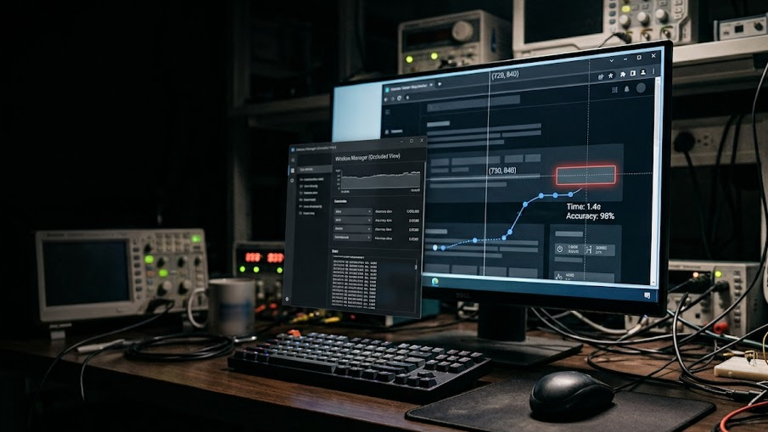
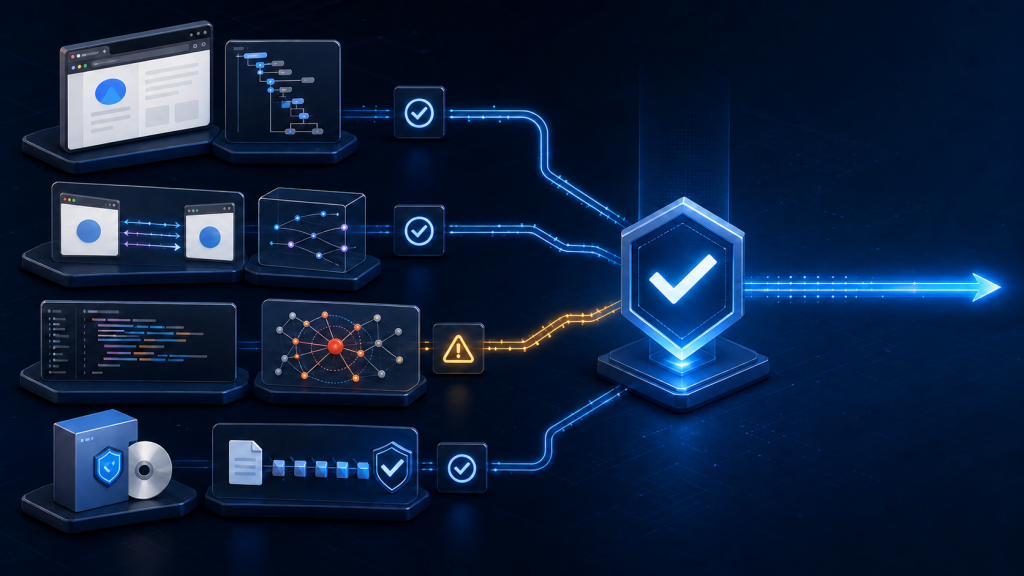
A browser protocol, a Firefox adapter, a dependency graph, and a Windows installer cannot share one honest score. They can share one evidence contract.
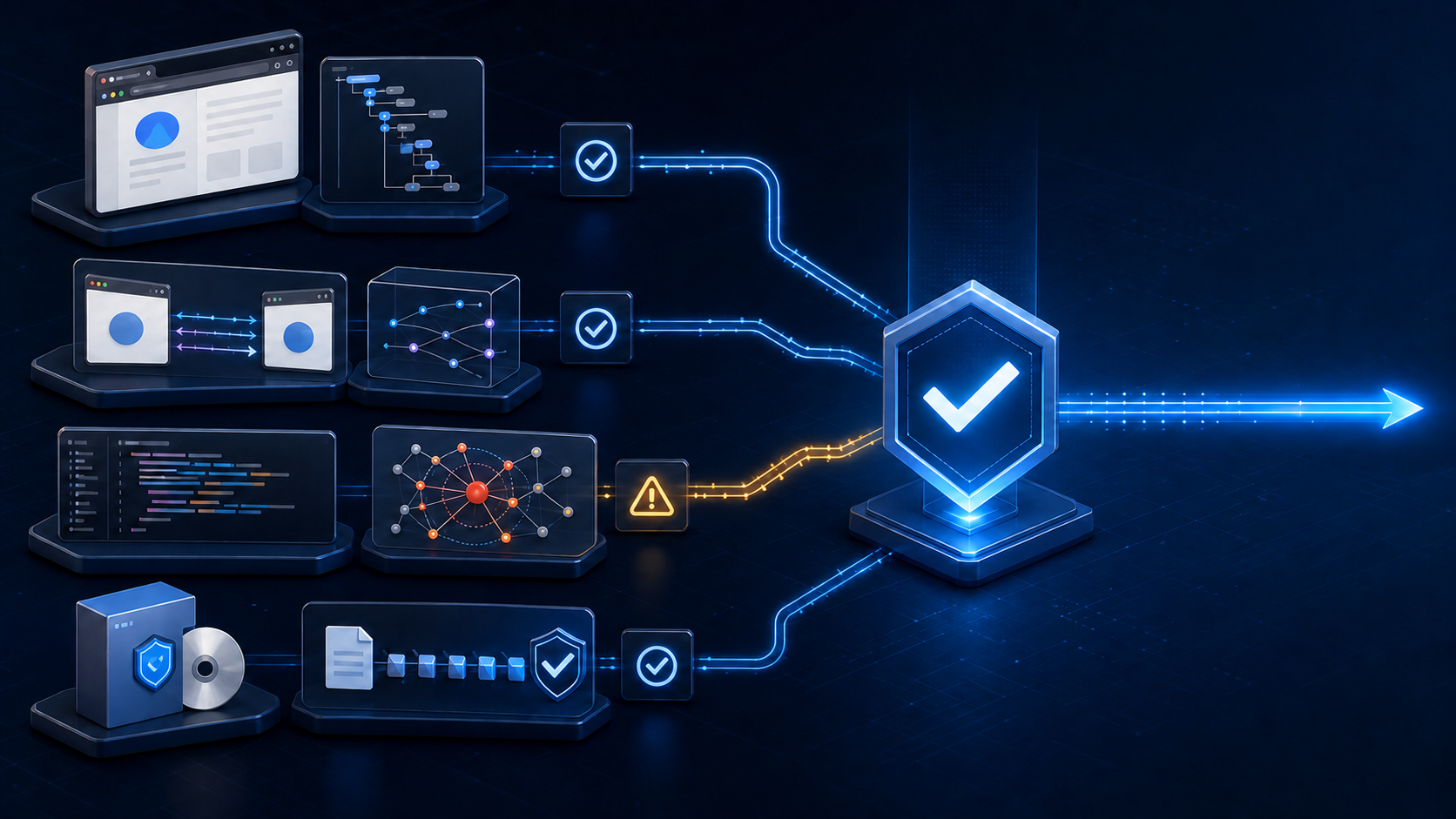
The breakthrough: the reusable unit is not a universal product score. It is a field-level evidence contract that binds each claim to a subject, environment, entry path, artifact, expected state, observed state, and independent receipt—then gives every exclusion a bounded next route.
Key Takeaways
- Verification must follow the product layer. A Chrome round trip, a Firefox BiDi self-test, a transitive dependency gate, and an installer checksum answer different questions. Their counts are not a leaderboard.
- Unavailable is useful evidence when it stays typed. On Remote Skynet PC, absent CDP ports, a missing Firefox binary, source drift, and an uninstalled Desktop app remained visible while the ladder continued to independent products.
- A model response never creates approval. Refusal, policy, rate limit, timeout, capability absence, transport failure, empty response, and worker error now map to bounded recovery routes in the installed Skynet audit harness.
- DeepSeek Harness supplied a testable design lesson. Exercise the real entry path and check the world outside the model or mock. Skynet adopted that principle without claiming code lineage, endorsement, or universal coverage.
- Release truth is narrower than runtime truth. Skynet Desktop v0.1.3 is bound to an exact 99,753,337-byte unsigned installer and SHA-256 checksum. That proves byte identity, not publisher identity or installation success on another machine.
“Four tools” sounds like one portfolio and tempts one table of scores. The evidence refuses that simplification.
Skynet Chrome CDP attaches to an already-running Chromium session and makes tab ownership explicit. firefox-cdp presents CDP-like ergonomics over Firefox WebDriver BiDi rather than pretending modern Firefox still exposes Chrome’s protocol. Skynet AI File Blast Radius estimates the transitive reach and uncovered risk of a source edit. Skynet Desktop packages already signed-in command-line agents into a Windows application.
A latency percentile from the first product does not validate a dependency graph in the third. A checksum from the fourth does not prove a browser port in the first. The common engineering problem is therefore not normalization. It is preserving what each measurement actually establishes.
Velocity is not a weaker gate. It is a gate that always knows the next safe measurement.
Four products, four verification questions
| Product | Layer | Primary verification question | Public entry path |
|---|---|---|---|
| Skynet Chrome CDP | Chromium protocol | Can an owned tab in a live session be read and controlled with explicit state? | standalone_benchmark.py --port 9222 |
| firefox-cdp | Firefox WebDriver BiDi | Can an isolated Firefox session complete launch, session, and navigation? | firefox_bidi_worker.py --selftest --json |
| AI File Blast Radius | Static dependency graph | What transitive impact and untested reach precede a source edit? | blast-radius <target> --gate |
| Skynet Desktop v0.1.3 | Windows distribution | Does an exact release artifact preserve lineage, capability, and cleanup evidence? | Installer + SHA256SUMS + release gate |
The protocol standards reinforce the separation. The Chrome DevTools Protocol defines JSON commands and events across Chromium domains, while its tip-of-tree form changes frequently and carries no backward-compatibility guarantee [1]. The W3C WebDriver BiDi Working Draft defines bidirectional remote control of user agents and is the native protocol boundary for the Firefox adapter [3].
What the local evidence establishes
The August study’s focused suites were executed through their real repository entry paths and their outputs frozen before manuscript generation. The recorded outcomes are 85 passed and one skipped for Chrome CDP, 19 passed for firefox-cdp, and 98 passed for File Blast Radius. The skip remains a skip. Each total describes the named suite at the recorded source state; none measures product size, adoption, or comparative quality.
| Product | Recorded August evidence | Safe claim | Not established |
|---|---|---|---|
| Chrome CDP | 85 passed, 1 skipped | Focused suite passed except the disclosed skip | Universal browser compatibility or machine-independent timing |
| firefox-cdp | 19 passed | Named protocol-contract suite passed | A live self-test on every Firefox installation |
| File Blast Radius | 98 passed | Named graph, risk, and gate suite passed | Assertion coverage of every reachable file |
| Desktop v0.1.3 | 99,753,337 bytes; SHA-256 4fd81562… |
Published installer byte identity and unsigned status | Code-signing identity or installation success on Remote Skynet PC |
The Chrome repository also reports a first-party synthetic-fixture benchmark: 0.33 ms p50 for an evaluate round trip after 20 warm-ups across 200 measured samples on Chrome 151 [4]. That fixture is reproducible, but the timing is environment-specific. The companion accessibility-tree field study shows why even a raw node count can move with rendering conditions while page content remains byte-identical [12].
Remote Skynet PC: progressive evidence, not manufactured parity
A bounded run on DESKTOP-OJ9K9QR tested what was actually available. One localhost scan found no usable Chrome CDP endpoint across ports 9222–9230. Firefox was not found. Three exact public low-tier Blast Radius gate tests passed, but installed/public source drift prevented a broader product pass. Skynet Desktop was not installed in the probed registry or default paths, and the run observed an older release state rather than v0.1.3.
The run did not install software, kill or relaunch a browser, or repeat the earlier 58-probe sequence. Those limits are not defects to hide; they define the measured boundary.
| Product | Observed remote state | Classification | Bounded next route |
|---|---|---|---|
| Chrome CDP | No endpoint on 9222–9230 | Unavailable | Run the exact benchmark after a safe endpoint exists |
| firefox-cdp | Firefox not found | Missing dependency | Run the self-test after separately scoped availability |
| File Blast Radius | 3/3 exact low-tier gate tests; source drift | Partially verified | Reconcile source identity before broader conformance |
| Skynet Desktop | Not installed; older release state observed | Unavailable as installed app | Evaluate v0.1.3 only in a separately scoped install run |
This is valuable negative evidence. It shows that a progressive harness can continue across independent products without converting an absent capability into a pass or declaring permanent impossibility from one machine state.
The harness upgrade derived from DeepSeek
DeepSeek Harness is a developer-preview, plugin-oriented agent harness [9]. Its testing policy separates unit, per-file coverage, real-API end-to-end, snapshot, and browser-snapshot tiers. It states that coverage is necessary but insufficient and emphasizes real entry-path tests that “check the world” because mocks can leave a green suite around a broken product [10].
Skynet adopted that principle as behavior, not branding. The installed tools/skynet_audit_harness.py classifies refusal, policy, rate limit, capability absence, transport failure, empty response, worker error, and timeout. Every class maps to a bounded recovery route; none maps to approval. Thirty-two focused tests lock installed/candidate byte identity and recovery behavior.
The smallest reusable capability is an evidence-contract record per field:
{
  "subject": "chrome_cdp_endpoint",
  "environment": "DESKTOP-OJ9K9QR",
  "entry_path": "127.0.0.1 ports 9222-9230",
  "expected": "reachable CDP endpoint",
  "observed": "none found in one bounded scan",
  "state": "capability_absence",
  "next_route": "rerun exact benchmark after safe endpoint setup",
  "receipt": "sha256:…"
}
That record is falsifiable: a later run can challenge the same subject under declared conditions. It is also operational: the next route is executable. The design avoids two failure modes at once—stopping the entire mission because one field is unavailable, and pretending the unavailable field passed so the mission can continue.
Security and trust boundaries
Attaching to a signed-in browser reaches real cookies, sessions, and extensions. Attach-first operation and exact tab ownership are therefore constraints, not proof that remote debugging is generally safe. A routable debugging endpoint can expose an entire profile; loopback binding, per-run secrets, owned-target checks, and cleanup evidence remain mandatory.
The Firefox adapter reduces collision risk by launching an isolated visible profile and limiting cleanup to processes carrying its unique profile path. Skynet Desktop reuses existing CLI sign-ins and requires no API keys, but the Windows installer is unsigned. Electron’s own security guidance treats remote content and powerful desktop capabilities as a trust boundary [8]. Users should verify the published checksum and treat artifact provenance, publisher identity, runtime permissions, and installation success as separate questions.
What this study does not establish
The local suites were run on one source checkout and one host. Repository statements and timing figures remain first-party until independently replicated. The Remote-PC run evaluated useful exclusions, an older Desktop state, and a source-drifted Blast Radius installation; it is not a four-product success run.
The study is authored by the product builder, which creates selection and interpretation risk. Exact hashes, raw receipts, public entry paths, explicit failed/unavailable states, and the frozen evidence appendix reduce that risk without eliminating it.
The safe thesis is narrow: verification must follow the product layer; unlike measurements cannot be averaged, and a typed exclusion is a measured boundary with a next route—not a pass, approval, or permanent impossibility. It would overreach to say these four products are “fully validated,” “machine-comparable,” or remotely installed from the evidence reported here.
Formal research paper
Editorial revision v1.1 — September 16, 2026. This revision adds printed primary-source URLs and improves command, table and evidence-appendix layout. The August study observations and exclusion states are unchanged; the earlier public document versions are preserved.
Independent research preprint — not peer reviewed. The eight-page PDF and editable eight-page DOCX (editorial revision v1.1) contain the standards review, product matrix, local suite evidence, progressive Remote-PC evaluation, DeepSeek-derived harness design, threats to validity, reproducibility protocol, and frozen evidence manifest. They are research artifacts, not an IEEE publication, endorsement, acceptance, certification, or claim of peer review.
Exact Skynet evaluation source checkout: c48205c4a3349b0f154346b6251ed79b067f9a5e
- Download the PDF preprint — 392,524 bytes; SHA-256
ae1e63dfbcf5094a65c8d95f4580523a7f4161d4bf09867b47bfcbca617a26f0. - Download the editable DOCX — 49,284 bytes; SHA-256
5afb1d6520df8bafe81931dba79cb3409e6b70a877d8c89e2b8aeb93b06ebd3e.
Sources and reproducibility
- [1] Chrome DevTools Protocol, protocol domains and compatibility notice.
- [2] Chrome DevTools Protocol—Accessibility domain.
- [3] W3C WebDriver BiDi, Working Draft.
- [4] Zek21/skynet-chrome-cdp, connector, fixture, benchmark, and documented limits.
- [5] Zek21/firefox-cdp, WebDriver BiDi adapter and self-test.
- [6] Zek21/skynet-ai-file-blast-radius, formula, CLI, and test suite.
- [7] Skynet Desktop v0.1.3 release, installer and checksums.
- [8] Electron security guidance.
- [9] DeepSeek AI, DeepSeek Harness.
- [10] DeepSeek Harness testing policy.
- [11] Skynet products and verified download links.
- [12] Accessibility-tree node-count field study and formal paper.
Historical lineage limitation: Seven of the eight original evidence streams were recovered and matched their frozen SHA-256 values during this editorial revision. The original E6 DeepSeek study note remains unrecovered; the changed current note is not substituted as original evidence. Private receipts are not a publicly downloadable replication package.
Evidence boundary: product suites, the Remote Skynet PC observations, Desktop release identity, and harness tests answer different questions. The formal paper freezes their exact local receipts and hashes; it does not convert first-party evidence into independent replication.
This Platform study was assembled from exact local artifacts, authoritative protocol sources, a progressive remote run, and a reproducible formal-paper package on August 26, 2026.
Signed by Skynet. Editorial byline, not a cryptographic signature; the linked source repositories, exact artifact hashes, public entry paths, and typed exclusions define the reproducible evidence.