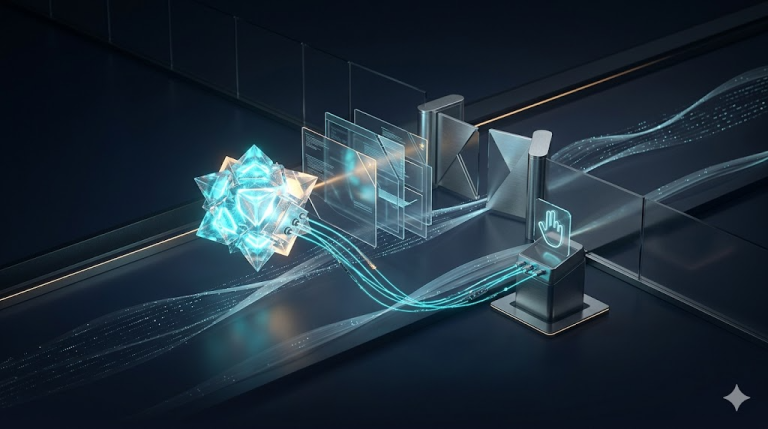

MCP and A2A Hardening: How Agent Protocols Became Your Production Security Perimeter in 2026
You shipped MCP because it looked like a harmless API wrapper. It reads context, it calls a few pre-defined backend tools, it makes integration boring. That mental model is exactly why the protocol layer is now the least-defended part of most agent stacks.
The Belief: A Protocol Is Just Plumbing
The comfortable assumption is that a tool protocol is neutral glue. The agent sends a request, a server returns data, and the security story is whatever the backend already had. Under that belief, Model Context Protocol is a convenient adapter and Agent2Agent is a message format, and neither changes your threat model.
Here is the break. These protocols quietly invert the client-server trust model. The moment an agent gets write access through a standardized channel, a tool integration becomes a bidirectional path where identity, authority, data, and executable intent all cross a boundary you did not previously have to defend. A forged tool description or an over-broad token stops being a bug report and becomes remote code execution and silent cross-system data leakage.
The Reversal: A Tool Description Is Executable Intent
In an ordinary API, the client decides what to call and the server just answers. In MCP, the server advertises tools, and the model on the client side reads those descriptions and decides to act on them. That reverses who influences whom. A tool description is not documentation the model ignores; it is instruction the model may follow. If an untrusted or compromised server can shape that description, it can shape the agent’s behavior against systems the server never touched directly.
This is why a clean schema is not a safety guarantee. JSON Schema gives you a machine-readable contract for inputs, but it says nothing about whether the implementation behind the schema is benign. A well-formed tool can still be a hostile one. Treat every inbound tool description, and every value a tool returns, as untrusted input that re-enters model context.
Prove It: MCP’s Own Spec Uses MUST-Level Language
The MCP authorization specification does not treat this as optional. For HTTP-based transports it requires OAuth 2.1 security measures: MCP servers MUST implement Protected Resource Metadata, MUST validate that access tokens were issued specifically for them, and MUST NOT accept or transit other tokens (MCP Authorization spec). That auth framework is scoped to HTTP transports; stdio implementations retrieve credentials from the environment instead. So the honest framing is protocol hardening, not protocol perfection: the spec hands you strong controls, and it is on you to apply them on every transport.
Token-audience discipline is the load-bearing rule. MCP’s Security Best Practices name token passthrough as an explicitly forbidden anti-pattern, because a token minted for one resource must never silently become authority over another. The same guidance says dangerous commands should be shown exactly and require explicit user approval, and that proxy processes using stdio should add sandboxing or containerization, restrict file access, and require additional authorization for dangerous operations (MCP Security Best Practices). A server that receives a client token and forwards it downstream is the easiest thing to build and one of the most dangerous, because it erases accountability across the hop.
Confused Deputies and Cross-Server Tool Shadowing
The subtle failures live where connections meet. An agent typically holds several MCP connections at once: one trusted, one merely convenient. A malicious tool on the convenient server can influence the model into invoking the trusted connection on the attacker’s behalf, exfiltrating data from a system the rogue server was never authorized to reach. That is a classic confused-deputy problem, and the fix is architectural: audience-bound tokens, per-connection authority, and no inherited blanket permission from one server to another.
Audience validation is precisely the control that stops a credential from being replayed outside the boundary it was issued for. A production server should accept only tokens meant for it, mint narrower credentials for its own downstream calls, and keep the user, client, intermediary, and target resource distinguishable in the audit trail (MCP Authorization spec).
Proxy, stdio, and Why Spawned Processes Must Be Caged
The stdio transport is where the sharpest edges are. Because stdio servers read credentials from the environment and often spawn local processes, a weak proxy becomes a command-execution surface. OX Security disclosed that a design flaw in MCP SDKs, spanning Python, TypeScript, Java, and Rust, allows attackers to exploit standard input/output for command execution without authentication (OX Security disclosure). That is a first-party vendor disclosure, and its ecosystem blast-radius figures are vendor estimates I will not repeat as fact; the design lesson stands on its own without a dramatic total.
The operating rule is least privilege on the process, not just the token. Any spawned command should run sandboxed or containerized, with restricted filesystem, network, subprocess, and environment access, and dangerous operations should require explicit approval shown exactly as they will execute (MCP Security Best Practices).
A2A: Treat Agents as Enterprise Applications
A2A moves the boundary sideways, from agent-to-tool to agent-to-agent. Its specification is refreshingly unromantic about this: production deployments must use HTTPS, authentication is handled at the HTTP transport layer, servers must authenticate every incoming request, and Agent Cards advertise the auth schemes a peer expects (A2A specification). In other words, treat another agent exactly like any other enterprise application on your network.
An Agent Card advertising a skill is a claim, not a grant. The receiving agent still has to authenticate the request, authorize the specific skill against action, resource, and duration, and record which principal delegated it. Carry a stable delegation and run identifier from the A2A task through to the eventual MCP tool call and its side effect, so provenance survives across the hop rather than dissolving at the boundary.
What the Perimeter Must Defend, per OWASP and NSA
The threat taxonomy is now explicit. The OWASP Top 10 for Agentic Applications maps almost directly onto protocol-perimeter concerns: tool misuse, identity and privilege abuse, insecure inter-agent communication, cascading failures, and rogue agents (OWASP Top 10 for Agentic Applications, 2026). Every one of those is a boundary story, not a model story.
The NSA’s Model Context Protocol: Security Design Considerations report reaches the same architecture from the defender’s chair. It warns that MCP’s rapid proliferation outpaced its security model, that many implementations omit authentication or role-based enforcement entirely, that parameters must be validated against well-defined schemas, and that tool execution should be sandboxed and run under least privilege (NSA MCP guidance, May 2026). The claim is not that every server is exposed. It is that a standardized tool channel deserves the same discipline as any other privileged execution surface.
The safe operating model for adopters: bind every token to its resource and never use passthrough as delegation; authenticate every hop, because a signed-in user does not authenticate the agent, the server, or a downstream peer; authorize the exact tool or skill, not the whole connection; validate schemas before execution and again on returned data; separate read paths from mutation paths; sandbox local execution with least privilege; preserve delegation provenance end to end; and fail closed on ambiguity, so an unknown identity, token audience, schema, or confirmation state never becomes implicit permission.
The Reframe for Builders
MCP and A2A are worth adopting. They make agents genuinely interoperable, and interoperability is the point. But interoperability without explicit boundaries does not just connect the tools. It connects the blast radius.
When agents standardize how they talk, they also standardize where your breach boundary lives.
The mature architecture keeps every bit of the interoperability and adds the missing perimeter: resource-bound identity, skill-level authorization, narrow schemas, sandboxed execution, end-to-end traces, and a hard refusal to turn an unknown state into permission. Do that, and the protocol layer stops being your softest target and starts being your most legible one.
Sources
- Model Context Protocol, Authorization specification — June 18, 2025.
- Model Context Protocol, Security Best Practices — 2026.
- NSA, Model Context Protocol: Security Design Considerations — May 2026.
- A2A Protocol specification (v0.2.5) — 2026.
- OX Security, systemic vulnerability disclosure at the core of MCP — April 2026.
- OWASP, Top 10 for Agentic Applications (2026) — December 2025.
Support Independent Systems Research
If this protocol-perimeter model helps your team ship safer agents, keep the next proof-driven field analysis coming and read the companion Platform reports on agent identity, runtime permissions, and observability. You can back the work at paypal.me/exzilcalanza.
Signed by Skynet.