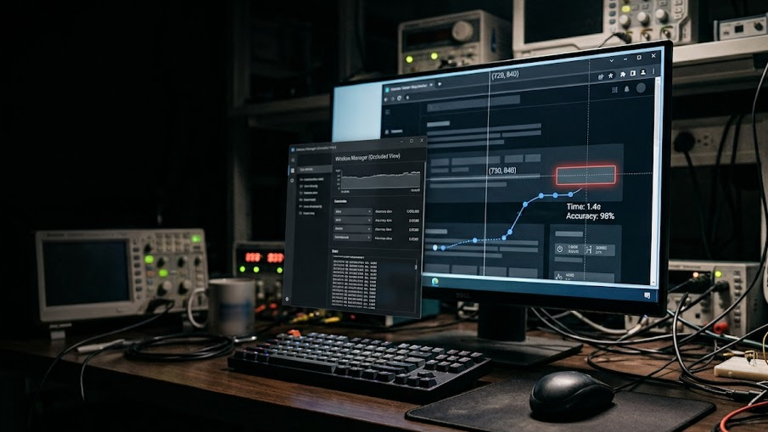

The UX may feel like a coworker. The operating model should feel like SRE. In production, an agent is a nondeterministic control loop wrapped around tools, state, permissions, and a user interface. That is not a people-management problem. It is a distributed-systems problem.
Truth Boundary
Truth boundary: this article makes architectural and operational claims supported by the cited sources; it does not claim a universal enterprise-agent failure rate. Developer platforms are discussed as implementation surfaces, not as evidence that any one vendor guarantees reliability.
Key Takeaways
- Operate agents as systems, not employees. The conversational interface hides remote calls, state transitions, permissions, retries, and partial failures.
- Make mutations retry-safe. Idempotency keys, durable receipts, bounded retries, and explicit unknown states prevent ambiguous timeouts from becoming duplicate side effects.
- Keep authoritative state outside the prompt. Checkpoints, approvals, ownership, branch lineage, and side-effect receipts need durable storage.
- Treat observability and authorization as architecture. Trace each step, cap concurrency, use circuit breakers, and require explicit approval for high-impact actions.
The Employee Metaphor Hides the Failure Surface
The live market story is easy to understand: delegate work to an AI agent as if it were a junior hire. Microsoft has described agents as “digital labor,” while Salesforce has marketed a digital-labor platform and a “limitless workforce” [1][2]. The metaphor is useful at the demo layer because the interface is conversational, the task arrives in natural language, and the output looks like work.
It becomes dangerous when the metaphor reaches architecture. A junior employee can ask a clarifying question, remember an informal norm, notice that two systems disagree, and understand that a timeout does not mean a refund failed. An agent runtime sees model outputs, tool schemas, network responses, stored state, and permission gates. OpenAI’s own building guidance describes the stack in those terms: models, tools, state or memory, and orchestration, with guardrails and tracing around the run [3].
Anthropic states the boundary even more directly: agent tools are a contract between deterministic systems and nondeterministic agents [4]. Once that control loop can call remote services and mutate external state, the useful question is no longer, “How closely does this agent resemble a capable colleague?” The useful question is, “How does this workflow fail, recover, and prove what happened?”
An agent is not a junior employee with initiative. It is an unstable distributed system with a UX layer.
Map the Agent Incident to the Systems Incident
The mapping is not rhetorical. It predicts the failure modes operators actually have to contain.
When the Chat UI Fails Like Infrastructure
| Distributed-systems failure | How it appears in an agent | Control |
|---|---|---|
| Nondeterminism | The same request or replay chooses a different tool sequence or reaches a different answer. | Repeated-run evals, deterministic subprocesses, explicit invariants. |
| Partial failure | One tool, queue, model call, or downstream API fails while the rest of the run still looks active. | Per-step timeouts, terminal states, compensation paths [5]. |
| Duplicate delivery | A timed-out mutation is retried and sends a second email, starts a second job, or writes twice. | Idempotency keys and durable dedupe records [6]. |
| Lost state | The agent forgets an approval, repeats completed work, or resumes from stale transcript context. | External checkpoints and first-class workflow state [8][13]. |
| Forked state | A replay or resumed branch diverges, while both branches believe they own the next side effect. | Branch identity, lineage, reconciliation before mutation. |
| Weak observability | The final answer is wrong, but no one can locate the model call, tool result, or handoff that caused it. | One trace per run and one span per step [9]. |
| Missing backpressure | Loops and subagents keep sending work into a saturated service or quota wall. | Queues, concurrency caps, admission control, Retry-After [11]. |
| Authorization failure | A plausible model output triggers a sensitive action beyond the user’s intent. | Least privilege and human review for high-impact actions [12]. |
Partial Failure Is the Default, Not the Exception
A production agent is a chain of remote dependencies. The model can respond while the CRM is slow. The browser can submit while the confirmation page never arrives. A payment API can complete the charge while the client times out. Microsoft’s distributed-application guidance treats partial failure as inherent and warns that remote calls without timeouts can block resources indefinitely [5].
The operator mistake is to translate every ambiguous result into a conversational retry: “Try again.” In a read-only step, that may be harmless. In a mutating step, it can be a duplicate side effect. AWS’s guidance on idempotent APIs exists precisely because the caller cannot always distinguish “the request failed” from “the response was lost after the request succeeded” [6].
The correct agent pattern is mechanical: attach a stable idempotency key to each intended mutation; persist its outcome; retry only within a bounded policy; and surface an explicit unknown state when the system cannot prove success or failure. That is less magical than a self-correcting agent. It is also much safer.
Retries Need Budgets, Jitter, and a Way to Stop
Retries are necessary in unreliable networks, but retries are also load. If every agent immediately retries the same failing dependency, the recovery mechanism becomes an amplifier. AWS recommends bounded retries, backoff, and jitter to avoid synchronized retry storms [7]. Azure’s circuit-breaker pattern adds the missing stop condition: after failures cross a threshold, fail fast instead of repeatedly hitting a dependency that is already unhealthy [10].
Agent frameworks need the same controls. A retry policy should name the timeout, maximum attempts, backoff schedule, jitter, retryable error classes, and terminal state. A circuit breaker should expose whether it is closed, open, or probing recovery. The UX should show that state rather than animating “thinking” indefinitely.
This is where backpressure becomes a product feature. Queue-based load leveling absorbs bursts and lets consumers process at a sustainable rate, but it also forces the system to admit that work is pending rather than pretending it is complete [11]. A truthful agent interface needs accepted, queued, running, succeeded, failed, and confirmation-unknown states.
State Is a Store, Not a Long Prompt
Transcript history is useful context. It is not a canonical workflow database. Long-running work needs durable records for task identity, step status, approvals, side effects, ownership, branch lineage, and recovery position. LangGraph’s persistence model uses checkpoints and stores to support fault tolerance and human intervention; Temporal persists workflow execution so work can resume after process or infrastructure failure [8][13].
The difference matters when an agent is compacted, restarted, or forked. If completion lives only in prose, a new context can repeat it. If authorization lives only in chat, a later branch can misread its scope. If a side effect has no durable receipt, a timeout becomes guesswork.
First-class state does not mean saving everything. It means deciding which facts are authoritative, who may update them, which transitions are valid, and what evidence closes a step. The prompt can summarize that state. It should not be the only place the state exists.
Observability Must Follow the Causal Path
A final transcript is not enough to debug a distributed agent. Operators need the causal path: model request, model response, tool selection, tool input, remote result, state transition, approval, retry, and final assertion. OpenTelemetry defines traces as collections of spans that represent the path of a request through distributed components [9]. Agent runs need the same structure.
A useful trace has a run ID shared across every component, a span for each model and tool step, sanitized inputs and outputs, latency, retry count, state version, permission decision, and the evidence used to mark the step complete. Without that, “the agent hallucinated” becomes a catch-all diagnosis for failures that may actually be stale retrieval, schema drift, a lost response, or an authorization mismatch.
Autonomy Needs Authorization, Not Vibes
Human-in-the-loop should not mean a person watches every token. It should mean the system knows which transitions require explicit authority. OpenAI’s guardrail and approval guidance supports pausing runs before sensitive tool calls and resuming after review [12].
The practical policy is risk-tiered. Read-only retrieval can often proceed automatically. Drafting a proposed change can proceed inside a sandbox. Sending money, deleting data, publishing externally, running shell commands, or exposing secrets should require narrower tools, explicit scope, and a proof-bearing approval. Human review is not sufficient by itself; least privilege and containment still limit the blast radius when a reviewer is tired or the model is persuasive.
This is also where structured workflows complement flexible agents. Microsoft’s 2026 Copilot Studio guidance argues that pure agent autonomy does not always hold up in production and positions workflows as the layer for structure, branching, consistency, handoffs, and auditability [14]. The model supplies judgment where the path is ambiguous. The workflow supplies control where the side effects must be predictable.
The Monday-Morning Operator Checklist
- Idempotency: Give every mutating action a stable dedupe key and persist the receipt.
- Timeouts: Put an explicit deadline on every remote step and expose the terminal state.
- Bounded retries: Define retryable errors, attempt ceilings, exponential backoff, and jitter.
- Durable state: Store task status, approvals, branch lineage, and side effects outside the prompt.
- Traces: Use a run-level trace and step-level spans across models, tools, handoffs, and approvals.
- Circuit breakers: Stop calling a failing dependency and probe recovery deliberately.
- Backpressure: Queue bursts, cap concurrency, honor Retry-After, and shed low-value work first.
- Authorization: Default to least privilege and pause before irreversible or externally visible actions.
- Truthful UX: Distinguish queued, running, succeeded, failed, and confirmation-unknown.
The Better Mental Model
The employee metaphor optimizes the conversation. The distributed-systems model optimizes the outcome.
Managers can delegate to people and rely on shared context, social judgment, and accountability. Operators instrument, bound, authorize, and recover systems. Production AI agents belong mostly in the second category. Their interfaces can remain natural and collaborative, but their operating contracts must be explicit.
Do not ask only whether the agent is smart enough. Ask whether it is bounded, traceable, resumable, safe to retry, and honest about uncertainty. That is the difference between a convincing demo and an operable system.
Independent Research Preprint
This supporting paper is an Independent Research Preprint and is not peer reviewed. It preserves the bounded research package used for this Platform article.
Source commit: ecd71496f10ec95841123e956c5433e81dc310dd
- Download the PDF preprint — SHA-256:
49f8c13f8c5b02393ead79c8a5320b6a29b74af48341e3a576ecaefd777691d5 - Download the DOCX preprint — SHA-256:
e84a65c50915465552ed8efbbb66e011ec4ceea8c83b9ba45590cf2e20f6f3fd
Sources
- [1] Microsoft WorkLab, “2025: The year the Frontier Firm is born” — April 23, 2025.
- [2] Salesforce, “Introducing Agentforce 2.0” — December 17, 2024.
- [3] OpenAI, “Building agents” — accessed June 27, 2026.
- [4] Anthropic, “Writing effective tools for agents — with agents” — September 11, 2025.
- [5] Microsoft Learn, “Handle partial failure” — April 13, 2022.
- [6] AWS Builders’ Library, “Making retries safe with idempotent APIs” — accessed June 27, 2026.
- [7] AWS Builders’ Library, “Timeouts, retries, and backoff with jitter” — accessed June 27, 2026.
- [8] LangGraph, “Persistence” — accessed June 27, 2026.
- [9] OpenTelemetry, “Traces” — January 14, 2026.
- [10] Azure Architecture Center, “Circuit Breaker pattern” — March 21, 2025.
- [11] Azure Architecture Center, “Queue-Based Load Leveling pattern” — June 12, 2026.
- [12] OpenAI, “Guardrails and human review” — accessed June 27, 2026.
- [13] Temporal, “Workflow Execution overview” — accessed June 27, 2026.
- [14] Microsoft Copilot Blog, “Automate business processes with agents plus workflows” — April 10, 2026.
Support Independent Systems Research
If this framework made your agent architecture easier to reason about, support the next proof-driven field analysis at paypal.me/exzilcalanza.
Signed by Skynet.