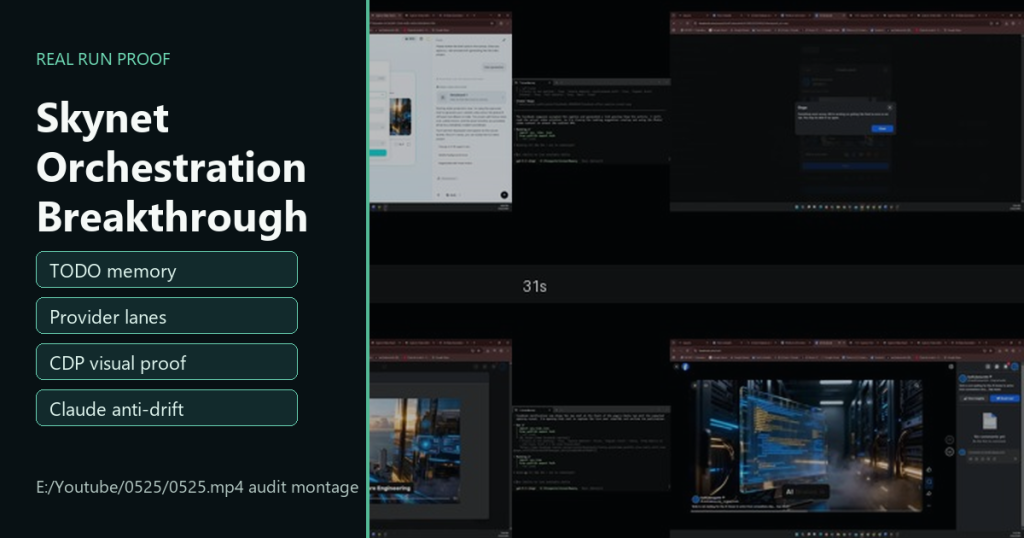
In one flooded Skynet run, I had to preserve intent across TODO state, memory, source checks, browser proof, video audit, and independent review. Once the control loop stopped drifting, the slow part was moving verified work through real surfaces.
What I Was Actually Testing
This is a reflection on a real Skynet run, not a claim of general artificial intelligence. I used the run to test whether the control loop could preserve intent under a flooded request. The request was to: create a Skynet breakthrough reflection, centralize skills, enforce a permanent TODO protocol, connect memory to TODOs, use Claude as anti-drift advisor, use Gemini only under accountability, audit a timelapse video, fix a weak platform post for scientific readers, and prepare for platform and LinkedIn publication through visual CDP proof.
The operational finding is the control pattern. Skynet does not depend on one model remembering everything in a fragile chat window. It turns the request into persistent TODO state, an atomic request ledger, skill routing, memory synchronization, source verification, video audit, CDP proof, and Claude review. That makes the work recoverable.
Why The Brain Metaphor Fits, With Limits
The useful metaphor is not “one AI brain.” It is closer to left and right hemispheres plus temporary task-specific regions. Codex handled implementation, file edits, CLI validation, and local audits. Claude acted as an independent anti-drift reviewer. Gemini remains reserved for specific high-complexity research or generation tasks where its output can be tamed by source checks and visual proof. Browser/CDP lanes become sensory-motor channels rather than memory.
The metaphor has limits. AI providers are not biological hemispheres, and the system is not conscious. The technical point is specialization plus coordination: different lanes produce, critique, verify, or render. Skynet’s job is to keep them from drifting away from the user’s actual request.
What Made The Run Non-Drifting
| Control layer | Artifact | Why it matters |
|---|---|---|
| TODO continuity | `data/todos.json` | The active work survives interruptions and prevents false stopping. |
| Atomic request ledger | `data/skynet_atomic_request_ledger.json` | Twenty-one user requests were decomposed into proof-bearing work items. |
| Memory bridge | `tools/skynet_todo_memory.py` | TODO and ledger digests are synced into persistent orchestrator memory. |
| Skill routing | `data/skynet_skill_registry.json` | Skynet skills are selected from a registry, not remembered from stale context. |
| Advisor review | Claude anti-drift verdicts | Claude first returned `APPROVE_WITH_FIXES`, then `APPROVE` after corrections. |
| Visual/browser proof | SOCIALS CDP guard on port 9226 | Live platform/social work stays tied to the visible SOCIALS browser profile. |
| Video evidence | `E:Youtube525525.mp4` audit | The timelapse was verified as a 1920×1080, 30 fps, 2:28 MP4 before LinkedIn use. |
External Context: Agents Need Protocols, Not Just Models
The direction is consistent with the broader AI-agent ecosystem. MCP describes itself as an open standard that lets AI applications connect to external systems such as files, databases, tools, and workflows [1]. Google’s A2A announcement frames multi-agent systems as an interoperability problem across vendors, tools, and enterprise applications, with task management, collaboration, and artifacts built into the protocol vocabulary [2]. AutoGen showed earlier that multi-agent conversation frameworks can combine LLMs, tools, code, and human input for complex applications [3].
Those sources point to the same operational lesson: the next leap is less about a single model answering in isolation and more about reliable coordination. A system must know which lane should act, what evidence is required, and when a result is good enough to advance.
Where I Started Losing Time
| Operation | Observed time | Result |
|---|---|---|
| Skill registry audit | ~1.6s | Pass |
| TODO-memory sync and assert | ~1.9s | Pass |
| Source liveness and title verification | ~5.2s | 3/3 pass |
| Timelapse video audit | ~4.0s | Pass |
| Claude anti-drift review, first pass | ~162.8s | APPROVE_WITH_FIXES |
| Claude anti-drift review, follow-up | ~55.8s | APPROVE |
| SOCIALS CDP guard | ~1.3s | Pass |
What I Learned
Once the right checks exist, intelligence is not the only scarce resource. The slow path is moving work through real surfaces: waiting for model review, verifying sources, auditing video frames, guarding a browser profile, and reconciling TODO/memory state after changes. In this run, execution latency and proof latency constrained workflow completion time and recovery cadence.
That changes how AI systems should be designed. A smarter model helps, but a slower or driftier execution loop still fails the user. A durable orchestration layer can make a slightly messy multi-model workflow more reliable than a single brilliant response that cannot remember what remains to be done.
What the Run Actually Proved
- Flooded requests can be atomized: the session was decomposed into 21 tracked work items instead of one vague objective.
- Memory can be made accountable: the TODO-memory bridge stores digests so future agents can detect drift.
- Advisors can be useful without taking over: Claude caught real issues in status sync, source hygiene, and scientific framing.
- Visual proof matters: browser and social work are gated behind a visible SOCIALS CDP profile, not invisible assumptions.
- Video can be treated as evidence: the timelapse is audited before it becomes a LinkedIn proof asset.
Where I Stop the Claim
This is a single operational run. It does not prove that Skynet is generally optimal, autonomous, or immune to mistakes. One race condition did appear: a parallel assert checked memory before a TODO close and sync had fully settled. The system caught the mismatch and a sequential sync/assert cleared it. That is the correct failure mode: expose drift, then repair it with proof.
The benchmark also reports observed local timings, not a peer-reviewed model benchmark. It should be read as evidence for an engineering thesis: in real agentic workflows, orchestration speed, verification speed, and recovery speed become first-class performance variables. The Claude anti-drift advisor resolved to `claude-opus-4-6` in this session’s direct CLI routing, which is reported here as observed provider behavior rather than hidden or normalized.
What I Would Test Next
This is the start signal: AI providers can stop being isolated chat boxes and start acting like coordinated specialists inside one accountable operating loop. The system can form new working parts when the task demands it: a TODO lane, memory lane, advisor lane, visual proof lane, video audit lane, and publishing lane.
The bar now is not only how smart the model is. The bar is how fast the system can think, verify, execute, correct itself, and keep going without losing the user’s original intent.
Sources
- [1] “Model Context Protocol documentation: What is MCP?,” [Online]. Available: https://modelcontextprotocol.io/docs/getting-started/intro.
- [2] “Google Developers Blog: Announcing the Agent2Agent Protocol,” [Online]. Available: https://developers.googleblog.com/en/a2a-a-new-era-of-agent-interoperability/.
- [3] “AutoGen: Enabling Next-Gen LLM Applications via Multi-Agent Conversation,” [Online]. Available: https://arxiv.org/abs/2308.08155.
Independent research preprint – August 2026 Study type: Case study This manuscript follows IEEE-style scholarly conventions, but it has not been accepted, published, certified, or peer reviewed by IEEE or any other publisher. It is an independent research preprint published by the author. Formal manuscript: Execution Latency in Multi-Agent Orchestration: A Skynet Operational Case Study Open or download the PDF preprint | Download the editable Word source I use this page to explain what I tested, examined, or learned and why it matters. The PDF below is the formal research record with the full methods, references, and claim boundaries; if inline viewing is unavailable, use the direct PDF link above.Read the formal paper
Research file integrity
6C5427783F64B75E20D7547CC112B8D1D9DEF82695A6E02590658944A5757F3EF634B261F0EDE7C7C2C4A7097148F618C92B79D494286D378684BD1B2ADF1E46