
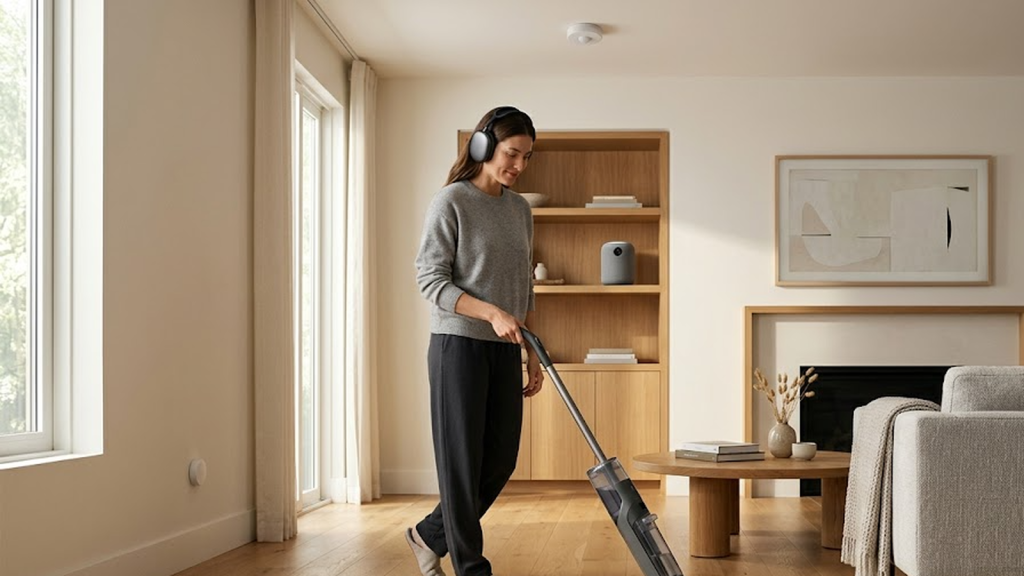
AI-Powered Smart Home 2026: Sony WH-1000XM6, Dyson PencilWash, Chrome Split View, and OpenAI’s Camera Speaker
The domestic technology landscape in 2026 is being reshaped by localized machine intelligence across every product category. Sony’s WH-1000XM6 deploys a 12-microphone QN3 processor for algorithmic noise shaping, Dyson’s PencilWash replaces vacuum suction with hydrated mechanical agitation at 380 grams in-hand, Chrome evolves into a self-contained workspace, and OpenAI plans a $200–$300 camera-equipped AI speaker designed by Jony Ive for late 2026 or early 2027.
Smart Home & Audio 2026 at a Glance
↑ +4 over XM5 generation [1]
↑ Over previous generation [2]
↑ Ultra-slim 38mm handle [3]
→ Camera + biometric auth [7]
→ Foldable design returns [1]
↑ 8 hydration points [5]
Sony WH-1000XM6: Acoustic Dominance Through Algorithmic Noise Shaping
In the highly competitive premium acoustic market, Sony’s 1000X series continues to define the industry benchmark for active noise cancellation and high-fidelity wireless audio. The newly released over-ear WH-1000XM6, retailing at $449 (£399 / ₱25,000), reintroduces the highly requested foldable chassis that was conspicuously omitted in the XM5 generation, vastly improving portability while maintaining an exceptionally lightweight 254-gram profile. [1]
The acoustic architecture relies on precision-engineered 30mm dynamic drivers paired with the new proprietary QN3 processor. This processor acts as an intelligent “noise shaper,” harnessing an expansive 12-microphone array—four more microphones than the XM5—to execute real-time digital-to-analog conversion and surgically isolate the user from erratic environmental noise signatures. A notable quality-of-life addition is the capacity for in-use charging, allowing continuous audio operation while the device is tethered to a power source, addressing a long-standing consumer grievance. [1]
Sony WF-1000XM6: True Wireless Precision
The true wireless WF-1000XM6 earbuds, retailing at $329.99 (₱18,999), introduce a refined, pill-shaped design with a matte texture engineered to enhance physical stability in the ear canal and improve passive noise isolation. [2]
Internally, they are equipped with the third-generation QN3e HD Noise Cancelling Processor, which Sony claims delivers a quantifiable 25 percent improvement in noise reduction efficacy over the previous generation. Each individual earbud houses four discrete microphones and relies on complex AI beamforming algorithms alongside physical bone conduction sensors to precisely isolate vocal frequencies during voice calls in high-decibel environments, effectively muting background chaos. [2]
Sony WH-1000XM6 vs WF-1000XM6 Specifications
| Specification | WH-1000XM6 (Over-Ear) | WF-1000XM6 (True Wireless) |
|---|---|---|
| Retail Price | $449 (£399 / ₱25,000) | $329.99 (₱18,999) |
| ANC Processor | QN3 | QN3e HD |
| Microphone Array | 12 microphones | 4 per earbud (8 total) |
| Driver Size | 30mm dynamic | Compact dynamic |
| Bone Conduction Sensor | No | Yes (voice isolation) |
| Foldable Design | Yes (returned from XM4) | N/A |
| In-Use Charging | Yes | Case charging only |
| Weight | 254g | ~5.9g per earbud |
Dyson PencilWash: Domestic Micro-Mobility Engineering
In the realm of physical home maintenance, Dyson has introduced a radically novel form factor with the PencilWash wet floor cleaner. Recognizing the inherent bulkiness and maneuverability constraints of traditional wet vacuums, the PencilWash is engineered for extreme agility and rapid deployment in modern, space-constrained environments. [3]
The device features an ultra-slim, 38mm-diameter handle—barely wider than a traditional wooden broom—weighing a remarkable 380 grams “in hand,” as the bulk of the 2.2 kg total unit weight is perfectly balanced and rests entirely on the floorhead. The articulated neck allows the device to lean back a full 170 degrees, dropping to a height of just 15cm to clean deep under low-clearance furniture with a simple twist of the wrist. [3][4]
Crucially, the cleaning mechanism discards traditional vacuum suction entirely. Instead, it utilizes a densely packed 64,000-filament microfiber roller that relies on eight distinct hydration points to evenly dispense fresh water. The system uses continuous hydration and mechanical agitation to buff away wet spills and simultaneously collect dry debris into a separated solid waste chamber at the base. [5]
This transition from blunt vacuum force to precise, hydrated mechanical agitation represents a more energy-efficient, hygienic, and specialized approach to hard-floor maintenance, ensuring only clean water ever touches the surface. [5]
Chrome Split View: The Browser as Workspace
The digitization of the domestic and professional environment is also seeing software upgrades designed to streamline productivity. Google Chrome has introduced a highly anticipated native Split View function, allowing users to consolidate two distinct, fully operational web pages side-by-side within a single browser tab. [6]
This architectural change eliminates the cognitive and spatial friction of manually managing multiple overlapping windows, particularly on single-monitor setups or compact laptops. Users can navigate between two active sites, close one side independently, or separate them into distinct windows seamlessly. [6]
Paired with new integrated PDF annotation tools that eliminate the need for third-party software and an automatic Google Drive backup integration for downloaded documents, the Chrome browser is evolving from a rendering engine into a comprehensive, self-contained workspace environment. [6]
OpenAI’s Hardware Ambition: The Camera-Equipped AI Speaker
The most disruptive data point regarding the future of the smart home stems from detailed reports exposing OpenAI’s hardware development roadmap. Faced with massive operational cash burn and the strategic vulnerability of relying entirely on Apple and Google’s mobile ecosystems to distribute ChatGPT, OpenAI is actively developing proprietary consumer hardware. [7]
Industry reports confirm that OpenAI, in close collaboration with former Apple design chief Jony Ive, is targeting a late 2026 or early 2027 launch for its inaugural physical device: an advanced, AI-powered smart speaker. Projected to carry a retail price between $200 and $300, this hardware is fundamentally different from conventional smart speakers. [7]
The OpenAI speaker is reportedly equipped with an array of complex environmental sensors, most notably a built-in, always-on camera system. The onboard camera is designed to grant the localized AI profound multimodal awareness—it allows the system to visually scan its surroundings in real-time, autonomously identify objects, and contextualize the physical environment alongside ambient conversations. [8]
Furthermore, the system reportedly utilizes advanced biometric facial recognition—functionally similar to Apple’s Face ID architecture—to passively authenticate users. This biometric handshake would authorize frictionless purchases via visual confirmation, allowing a user to buy a product simply by looking at the device and issuing a command. [7]
To realize this vision and bypass development bottlenecks, OpenAI has reportedly established back-channel supply chain deals and is aggressively recruiting top-tier hardware, design, and manufacturing experts directly from Apple. [9]
OpenAI Speaker vs Established Ecosystem Speakers
| Feature | OpenAI Speaker (Projected) | Amazon Echo Show | Apple HomePod |
|---|---|---|---|
| Price Range | $200–$300 | $249 (Show 15) | $299 |
| AI Engine | ChatGPT / AGI-lite | Alexa | Siri + Apple Intelligence |
| Camera System | Always-on environmental camera | Front-facing camera | No camera |
| Biometric Authentication | Facial recognition (Face ID–style) | Voice recognition | Voice recognition |
| Multimodal Awareness | Visual + audio + contextual | Audio + screen | Audio only |
| Purchase Authentication | Visual confirmation | Voice PIN | Device confirmation |
| Design Lead | Jony Ive | Amazon Design | Apple Industrial Design |
| Launch Timeline | Late 2026 / Early 2027 | Available | Available |
Privacy Friction and Market Implications
The socio-technical implications of OpenAI’s hardware device are staggering. By deploying a visually aware, intelligent agent into the intimate space of the living room, OpenAI transitions its product from text-based, screen-bound abstraction to physical, real-world grounding. The hardware effectively transforms the domestic space into a continuous, live data feed for the AI, allowing it to transition from providing “chat responses” to actively anticipating needs and managing household logistics. [8]
However, the introduction of a constantly monitoring camera from a data-driven AI firm introduces immense privacy friction. While consumers have slowly accepted always-listening microphones from established hardware veterans like Apple or Amazon, a dedicated optical sensor feeding data back to the creators of ChatGPT represents a novel intrusion. Whether the promise of a truly frictionless, AGI-lite domestic assistant is enough to override consumer privacy concerns will be the defining technological narrative of 2027. [7]
“OpenAI is not building another smart speaker. It is building a physical vessel for its march toward Artificial General Intelligence—one that can see, hear, and understand the domestic environment in ways no existing consumer device can.”
— 9to5Google analysis of OpenAI hardware development, February 2026 [8]
Converging Synthesis: Intelligence Enters Every Surface
The products and roadmaps examined here—from Sony’s 12-microphone algorithmic noise shaping to Dyson’s hydration-based micro-mobility engineering, from Chrome’s evolution into a split-view workspace to OpenAI’s visually aware living-room agent—delineate a consumer landscape that is aggressively transitioning away from isolated, single-purpose hardware toward densely integrated, contextually aware ecosystems.
The ultimate battleground over the next multi-year development cycle will not be fought over mere noise-cancellation decibels or cleaning wattage, but over which ecosystem can most securely, seamlessly, and intuitively integrate ambient artificial intelligence into the daily domestic reality. The privacy calibration of that integration—how much awareness consumers will tolerate in exchange for frictionless utility—remains the central unresolved question of the AI hardware era.
Key Takeaways
- Sony WH-1000XM6 raises the ANC ceiling: A 12-microphone array (up from 8) paired with the QN3 processor enables algorithmic noise shaping rather than brute-force cancellation. The return of the foldable chassis and in-use charging addresses the XM5’s primary user complaints.
- WF-1000XM6 earbuds add bone conduction sensing: The QN3e HD processor delivers 25% better noise reduction, while bone conduction sensors + AI beamforming isolate vocals from background noise during calls.
- Dyson PencilWash redefines wet cleaning form factor: At 380g in-hand with a 38mm handle and 170-degree articulation, the PencilWash replaces vacuum suction with a 64,000-filament hydrated microfiber roller—only clean water touches surfaces.
- Chrome evolves into a workspace: Native split-view tabs, built-in PDF annotation, and automatic Google Drive backup transform the browser from a rendering engine into a productivity platform.
- OpenAI enters physical hardware with a $200–$300 AI speaker: Designed by Jony Ive, the camera-equipped speaker represents OpenAI’s move from software abstraction to real-world physical grounding.
- Privacy friction is the adoption bottleneck: An always-on camera from an AI company introduces novel intrusion concerns that exceed consumer tolerance established by audio-only assistants. This is 2027’s defining narrative.
- The domestic AI ecosystem is consolidating: Every product category—audio, cleaning, browsing, assistants—is transitioning from standalone function to contextually aware, network-connected intelligence.
References
- [1] “Sony WH-1000XM6 review: excellent headphones,” [1] “Sony WH-1000XM6 review: excellent headphones,” TechRadar, 2026. Accessed February 22, 2026.. [Online]. Available: https://www.techradar.com/audio/wireless-headphones/sony-wh-1000xm6-review. [Accessed: 2026-03-02].
- [2] “Sony WF-1000XM6 is out now: Price,” [2] “Sony WF-1000XM6 is out now: Price, availability,” GadgetMatch, 2026. Accessed February 22, 2026.. [Online]. Available: https://www.gadgetmatch.com/sony-wf-1000xm6-launch-specs-price-availability/. [Accessed: 2026-03-02].
- [3] “Dyson just made the smallest wet cleaner I’ve ever seen,” [3] “Dyson just made the smallest wet cleaner I’ve ever seen,” TechRadar, 2026. Accessed February 22, 2026.. [Online]. Available: https://www.techradar.com/home/vacuums/dyson-just-made-the-smallest-wet-cleaner-ive-ever-seen-and-the-vacuum-master-claims-it-glides-effortlessly-and-reaches-where-others-cant. [Accessed: 2026-03-02].
- [4] “Which of Dyson’s wet-floor cleaners should you buy?,” [4] “Which of Dyson’s wet-floor cleaners should you buy?” TechRadar, 2026. Accessed February 22, 2026.. [Online]. Available: https://www.techradar.com/home/vacuums/dyson-pencilwash-vs-washg1-vs-clean-wash-hygiene. [Accessed: 2026-03-02].
- [5] “What exactly is the Dyson PencilWash,” [5] “What exactly is the Dyson PencilWash, and should I buy one?” TechRadar, 2026. Accessed February 22, 2026.. [Online]. Available: https://www.techradar.com/home/vacuums/what-exactly-is-the-dyson-pencilwash-and-should-i-buy-one. [Accessed: 2026-03-02].
- [6] “Google Chrome just got a new ‘Split view’ feature — 3 upgrades you need to know,” [6] “Google Chrome just got a new ‘Split view’ feature — 3 upgrades you need to know,” Tom’s Guide, 2026. Accessed February 22, 2026.. [Online]. Available: https://www.tomsguide.com/computing/browsers/google-chrome-just-got-a-new-split-view-feature-3-upgrades-you-need-to-know. [Accessed: 2026-03-02].
- [7] “OpenAI may sell $300 smart speaker with camera — in 2027,” [7] “OpenAI may sell $300 smart speaker with camera — in 2027,” Mashable SEA, February 2026. Accessed February 22, 2026.. [Online]. Available: https://sea.mashable.com/tech/42240/openai-may-sell-300-smart-speaker-with-camera-in-2027. [Accessed: 2026-03-02].
- [8] “OpenAI smart speaker with camera coming in 2027,” [8] “OpenAI smart speaker with camera coming in 2027, report,” 9to5Google, February 20, 2026. Accessed February 22, 2026.. [Online]. Available: https://9to5google.com/2026/02/20/openai-smart-speaker-camera-report/. [Accessed: 2026-03-02].
- [9] “OpenAI is recruiting from Apple’s hardware,” [9] “OpenAI is recruiting from Apple’s hardware, design, manufacturing, and supply chain teams,” Techmeme / The Information, September 2025. Accessed February 22, 2026.. [Online]. Available: https://www.techmeme.com/250919/p7. [Accessed: 2026-03-02].
- [10] “OpenAI reportedly developing AI-powered hardware lineup,” [10] “OpenAI reportedly developing AI-powered hardware lineup,” MacDailyNews, February 20, 2026. Accessed February 22, 2026.. [Online]. Available: https://macdailynews.com/2026/02/20/openai-reportedly-developing-ai-powered-hardware-lineup-starting-with-200-300-smart-speaker-featuring-built-in-camera/. [Accessed: 2026-03-02].
- [11] “Sony WH-1000XM6 Review: Better Noise Cancellation Than Bose,” [11] “Sony WH-1000XM6 Review: Better Noise Cancellation Than Bose,” PCMag, 2026. Accessed February 22, 2026.. [Online]. Available: https://www.pcmag.com/reviews/sony-wh-1000xm6. [Accessed: 2026-03-02].
- [12] “Introducing the Dyson PencilWash wet floor cleaner,” [12] “Introducing the Dyson PencilWash wet floor cleaner,” Dyson Official, 2026. Accessed February 22, 2026.. [Online]. Available: https://www.dyson.com/floor-cleaners/wet/pencilwash. [Accessed: 2026-03-02].
- [13] “Your Chrome browser just got three huge upgrades,” [13] “Your Chrome browser just got three huge upgrades,” ZDNet, 2026. Accessed February 22, 2026.. [Online]. Available: https://www.zdnet.com/article/chrome-browser-new-upgrades-tab-split-view-mode/. [Accessed: 2026-03-02].