
We Rebuilt Our Front Page to Show How Skynet Actually Works
Most AI landing pages ask you to take their word for it. We rebuilt ours to do the opposite: the home page of exzilcalanza.info is now a working demo of the system that publishes it. This is the story of that rebuild — what changed, why, and how the design itself was reviewed by frontier models before it shipped.
From a blank promise to a visible pipeline
The old hero said the right words — “autonomous AI infrastructure with proof built in” — but it didn’t show anything. The new front page opens with an animated neural constellation: a network of nodes with a bright signal that travels a fixed path — prompt, to a risk floor, to an advisor pair, to the agent fleet, to a proof gate. That path is not decoration. It is the actual control ladder every request runs through.
Right below the hero, we spell it out as five plain steps under the heading “How a simple prompt becomes analyzed logic.” A plain-language prompt comes in. A zero-cost risk classifier decides whether the request even needs review — is it publishing something, is it public-facing, is it a claim, does it touch an account? If it does, a pair of frontier advisors reviews it. Then the agent fleet executes in parallel over a shared message bus. Finally, a fail-closed proof gate refuses to call anything “done” without an independent signal and a real artifact.
That is the whole point of the design: a prompt is not magic, it is a routed, gated decision.
Proof, not promises: what the system has actually built
The middle of the page is a grid of six things Skynet has genuinely shipped — every card carries a measured outcome, not an adjective:
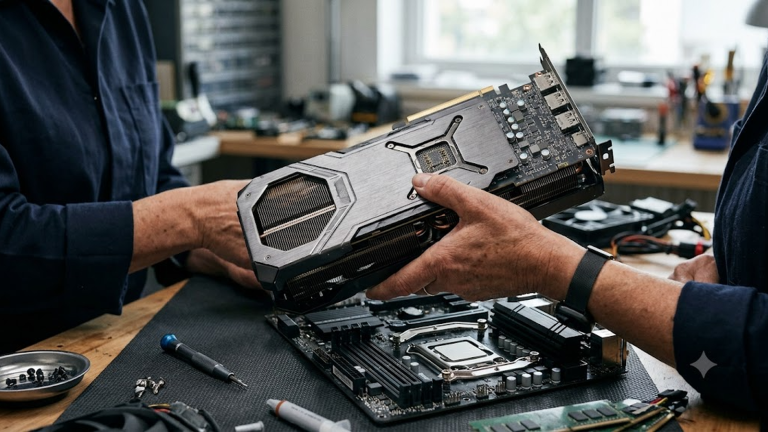
- AMD GPU machine learning without NVIDIA. Real PyTorch, TensorFlow and ONNX training on a consumer Radeon RX 6600 through DirectML, plus a ROCm 6.2.4 HIP unlock for a card AMD never officially supported. A model runs fully on the GPU at 2.92 GB, roughly 14× faster than CPU.
- Demand forecasting. A direct multi-horizon model using log-returns and a Huber loss, GPU-trained, that lands at 3.5% MAPE and beats a naive baseline on all eight forecast origins.
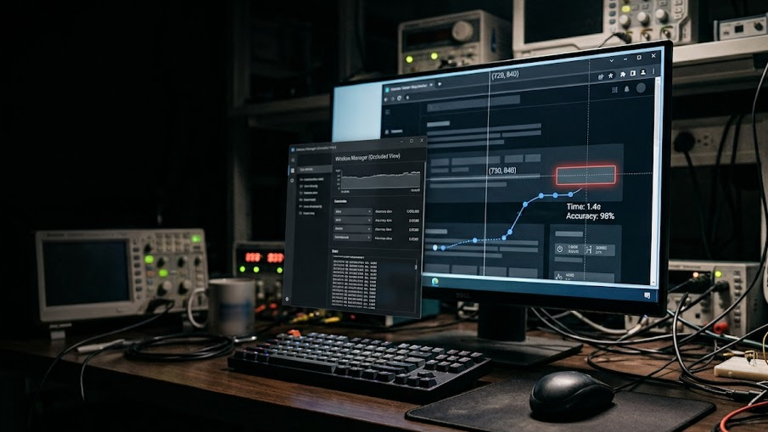
- Computer control. ScreenMemory captures any screen through GPU DXGI, reads it with a three-tier OCR engine, and navigates with eight layers of semantic understanding across Win32, UI Automation and Chrome DevTools.
- The AI WordPress manager — which is this very website. A custom plugin and theme research, write, illustrate and publish with lane guards and an auto-rollback deploy.
- Social automation that posts and independently verifies across six platforms, guarded by a fail-closed “silent drop” check so a drafted post can never quietly disappear.
- A memory system that layers file-based facts, a shared-state store, and a vector layer that computes its embeddings on the local AMD GPU.
Built in-house — not LangChain, not LangGraph
We get asked which agent framework runs underneath. The honest answer is: none of the popular ones. There is no LangChain and no LangGraph in the core. The orchestrator, the message bus, the typed workers, the advisor ladder and the proof gates are all first-party — a Go backend with Python workers. That is a deliberate choice. When every step has to be provably gated, it is easier to own the plumbing than to wrap someone else’s.
How the design itself was reviewed
Here is the part that makes the rebuild a demo of its own thesis: we did not just eyeball the redesign. We built three distinct visual directions, screenshotted each one, and ran them through the same advisor ladder the platform uses for any public-facing decision — a review by a frontier model over a signed-in browser lane. The reviewer ranked the “Neural Constellation” direction first, calling it the most credible for a technical audience and the least likely to look like a generic crypto project.
After the winning design went live, we asked the same reviewer to grade the real page. It scored it 7.2 out of 10 and approved it, while pointing out exactly where to go next: make the demo cards link straight to their evidence, tighten the pipeline into one continuous gated rail, and let the strongest numbers lead. Those notes are already shaping the next pass. Being told, in writing, where your work is weak — and acting on it — is the whole discipline.
How Skynet got here
The system did not start this way. It began as a coding assistant living inside an editor. It grew a fleet of agents coordinating over a shared bus and audit trails. It added the advisor ladder and proof gates so nothing ships on a model’s say-so. It unlocked real machine learning on a consumer AMD card. And it became an operator that can research, write, illustrate, publish and distribute — with a gate at every handoff.
The front page is now the honest surface of all of that. Open it, watch the signal travel from prompt to proof, and every claim on the page is something you can go and inspect.
Want to support independent research like this? paypal.me/exzilcalanza — sponsorship, not equity or investment.