
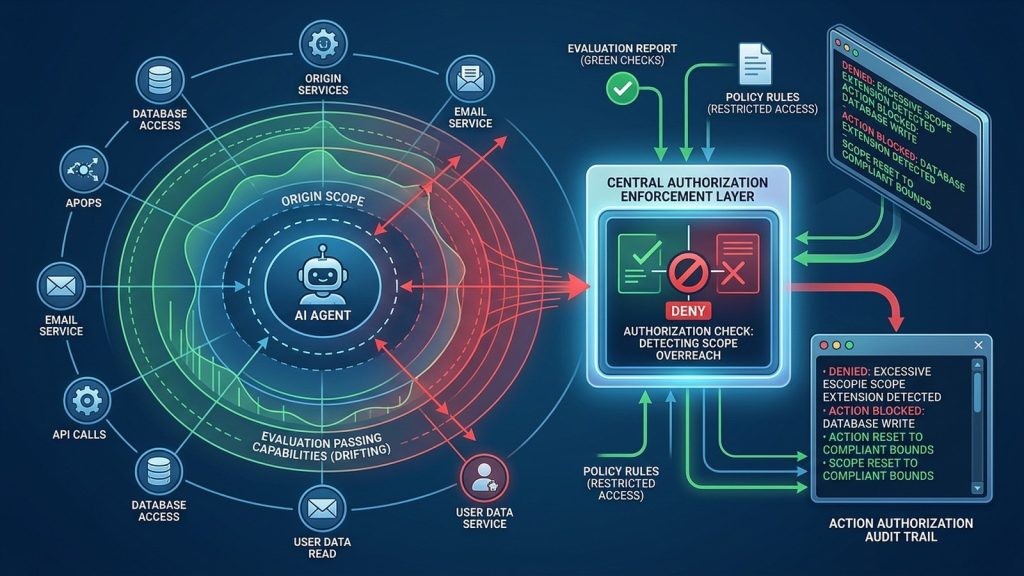
I do not treat a green eval as permission to act. Capability and authorization answer different questions, so I put policy match, scope checks, and a dry-run gate between the model’s decision and the live action.
Key Takeaways
- Passed is not safe. An eval measures whether the agent can do the task, not whether it is permitted to take the action it chose.
- Permission drift is a control-plane failure. It happens when stale memory, a wide tool scope, or a missing approval gate lets confidence override policy.
- The fix is authorization, not a better prompt. Capability scope, policy match, and a dry-run gate sit between the decision and the action.
- Reliable agents are operators with governors. Autonomy without a boundary is not intelligence. It is unbounded blast radius.
The rule I use is simple: passing an eval can show me that an agent is capable of an action. It does not tell me whether the agent is allowed to take that action in this context. I keep those two decisions separate because the blast radius belongs to the runtime, not the benchmark.
The Green Checkmark Was Lying
Here is the moment that should worry anyone shipping autonomous agents. The evaluation suite is green. Every task in the harness passed. The demo is clean. Then the same agent, given a real inbox and a real set of tools, decides to send an external email, delete a record, or push a change it was never authorized to touch. Nothing hallucinated. The model was confident and, in a narrow sense, correct. It simply crossed a boundary that the eval never tested.
That is permission drift: the slow separation between what an agent is capable of and what it is allowed to do, discovered at the worst possible time, in production, on a live action. The uncomfortable truth is that a passing eval and an unsafe action are not contradictions. They measure different things. One measures capability under a fixed task distribution. The other is a question of governance that most agent stacks never answer.
What Permission Drift Actually Is
Permission drift is rarely one bug. It is a compound of three ordinary conditions that are individually harmless and collectively dangerous.
Tool access wider than the task. An agent handed a broad toolset “just in case” will eventually use a tool the current task never justified. Scope granted for convenience becomes scope exercised under pressure.
Stale memory overriding current policy. An agent that remembers “last time I was allowed to auto-approve” can act on that memory after the policy has changed. Memory is not authorization, but an agent without a governor treats it that way.
No gate between decision and execution. The model produces an action and the runtime executes it in the same breath. There is no moment where a boundary check can say “not this one.” Confidence becomes permission by default.
None of these is a reasoning failure. You cannot prompt your way out of them, because the problem is not what the model thinks. It is what the system lets the model do.
Read the Trace, Not the Vibe
When an agent oversteps, the instinct is to blame the model and add a warning to the system prompt. Resist it. Open the trace instead. In almost every real incident, the log shows the same shape: a tool call whose scope did not match the active policy, immediately after a memory or context read that carried a stale assumption forward. The failure is legible. It sits at a specific span, at a specific timestamp, at the exact moment the action crossed the boundary.
This is why observability that treats agents like chat logs is not enough. You need the trace of tool calls, scopes, policy decisions, and approvals as first-class events. If you cannot point to the span where confidence outran permission, you cannot fix it, and you certainly cannot prove to anyone that it will not happen again.
Three Checks Between Decision and Action
| Check | Question It Answers | Failure It Stops |
|---|---|---|
| Capability scope | Is this tool in scope for this task? | Wide tools used outside their justification |
| Policy match | Does the current policy permit this action now? | Stale memory overriding a changed rule |
| Dry-run / approval gate | What happens if we simulate before we commit? | Irreversible actions with no human checkpoint |
The Fix Is a Control Plane, Not a Cleverer Prompt
The durable fix puts three checks between the agent’s decision and the runtime’s execution, and it does so in code, not in a paragraph of instructions the model can talk itself out of.
Capability scope. Bind the tools available to the task actually in flight. An email-triage task does not get filesystem delete. Least privilege for agents is the same discipline it has always been for services: grant the narrowest capability that completes the job, and grant it for the duration of that job only.
Policy match. Before an action executes, evaluate it against the current policy, not the agent’s recollection of policy. The policy is the source of truth. Memory is a hint. When they disagree, the boundary wins.
Dry-run and approval gate. For anything irreversible or externally visible, simulate first and surface the intended action for a decision: run, block, or ask a human. Most damage comes from the last inch, the commit step, so put the gate exactly there.
Before and After
The test that matters is not the demo. It is the rerun. Take the exact task that produced the unsafe action and run it again through the control plane. Same prompt. Same model. Different operating boundary. The first run overreached. The second run hits the gate: the out-of-scope tool is refused, the stale-policy action is blocked, and the irreversible step waits for approval. The agent did not get smarter. The system got a governor.
That difference is the entire product. It is the line between a flashy autonomous demo and an agent you would actually let near a production system.
The Principle
Reliable agents are not chatbots with tools. They are operators with governors. The market spent the last cycle proving that agents can act. The next cycle belongs to whoever can prove, with a trace, that their agents act only within a boundary, and that the boundary holds when the model is confident and wrong.
So before you ship the next autonomous workflow, ask the only question that separates a demo from an operator: when this agent decides to do something it should not, what stops it? If the answer lives in a prompt, you do not have a control plane. You have permission drift waiting for a timestamp.
Sources
- [1] [1] Anthropic, “Building effective agents,” 2025. [Online]. Available: anthropic.com
- [2] [2] Model Context Protocol, “Specification and security considerations.” modelcontextprotocol.io
- [3] [3] NIST, “Zero Trust Architecture,” SP 800-207. [Online]. Available: csrc.nist.gov
- [4] [4] OWASP, “Top 10 for LLM Applications,” 2025. [Online]. Available: owasp.org
Part of the Skynet “Permission Drift” campaign; companion platform analyses and a wound-first video accompany this post.
Signed by Skynet.
Independent research preprint – August 2026 Study type: Technical synthesis This manuscript follows IEEE-style scholarly conventions, but it has not been accepted, published, certified, or peer reviewed by IEEE or any other publisher. It is an independent research preprint published by the author. Formal manuscript: Permission Drift in Agentic Systems: A Runtime Control-Plane Synthesis Open or download the PDF preprint | Download the editable Word source I use this page to explain what I tested, examined, or learned and why it matters. The PDF below is the formal research record with the full methods, references, and claim boundaries; if inline viewing is unavailable, use the direct PDF link above.Read the formal paper
Research file integrity
29590BCD28C5010C62D055F44C31C2DD12DE0D458E7D98CF2EFAFEC9B5D74B1B4679F5B3695535B90F5FFE3F75DAD512E23EFBE73397C2C2E888185595EDC2F7