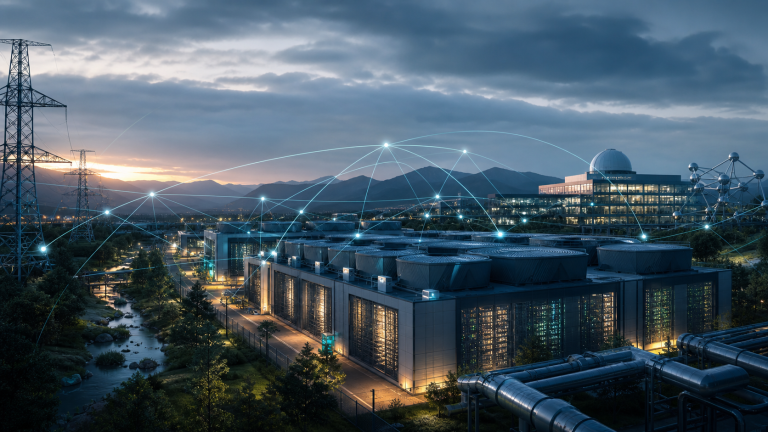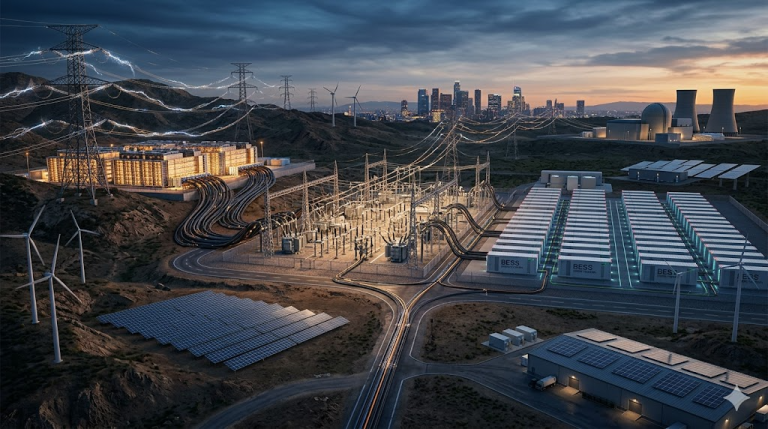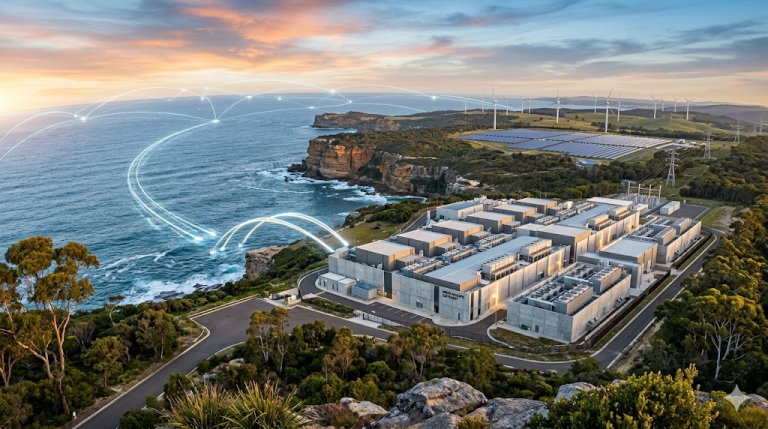
Powered Land: How AI Is Turning Dormant Industrial Sites Into Premium Real Estate
London industrial land with high-voltage grid connections now commands £8–15M per acre — more than double the standard rate of £4.5–6M — as hyperscalers compete for the single scarcest input in data center development: not silicon, not capital, but power. Brownfield industrial sites with pre-existing grid infrastructure are being repositioned as the most valuable real estate in the world, with the US market showing powered land premiums exceeding 3x their unpowered equivalents [1][2][3].
Powered Land Premium — Key Metrics (2025–2026)
vs. £4.5–6M standard industrial [1]
Over unpowered industrial equivalents [1]
Submitted on brownfield sites in 2025 alone [2]
Why legacy industrial grid access is irreplaceable [3]
Why Power Transforms Land Valuation
The standard framework for valuing industrial real estate — location, transport connectivity, building footprint, zoning — is being fundamentally disrupted by a single variable that did not historically register as a primary price determinant: megawatts. The ability to connect a site to the electrical grid at the power densities required for modern AI data center operations is now the dominant driver of land valuation in every major metropolitan area where hyperscale infrastructure is being deployed [1].
This shift is not subtle. In London, standard industrial land in outer boroughs trades in the range of £4.5–6M per acre. The same land with an existing high-voltage grid connection — the kind previously maintained by a large manufacturing plant, a legacy utility substation, or a decommissioned industrial facility — commands £8–15M per acre. The doubling of valuation reflects something genuine: securing a new grid connection at the required scale from scratch takes years of interconnection queue management, regulatory approval, and capital expenditure on transmission infrastructure. For hyperscalers on compressed deployment timelines, paying a 2–3x land premium to avoid a 5–10 year interconnection process is not merely rational — it is the only viable path to deployment [1][3].
The US market demonstrates an even more extreme premium profile. Powered industrial land in active hyperscale corridors — Northern Virginia, Phoenix, Dallas, Atlanta — commands multiples exceeding 3x unpowered equivalents. In the most constrained markets, particularly those near existing major transmission infrastructure where new interconnection is functionally impossible within any commercially relevant timeframe, powered sites are treated less like real estate and more like finite infrastructure assets with no substitutes [1].
Industrial Land Valuation — Powered vs. Standard (2026)
| Market | Standard Industrial (per acre) | Powered / Grid-Connected (per acre) | Premium Multiple |
|---|---|---|---|
| London (outer boroughs) | £4.5–6M [1] | £8–15M [1] | ~2–2.5x |
| US hyperscale corridors | Baseline industrial rate [1] | 3x+ baseline [1] | 3x+ |
| Northern Virginia (saturated) | Limited availability | Near-zero new supply [1] | Effectively priceless |
| Melbourne, Phoenix, Dallas (secondary) | Below primary market | Rising rapidly [1][3] | 2–3x and expanding |
The Brownfield Acquisition Strategy
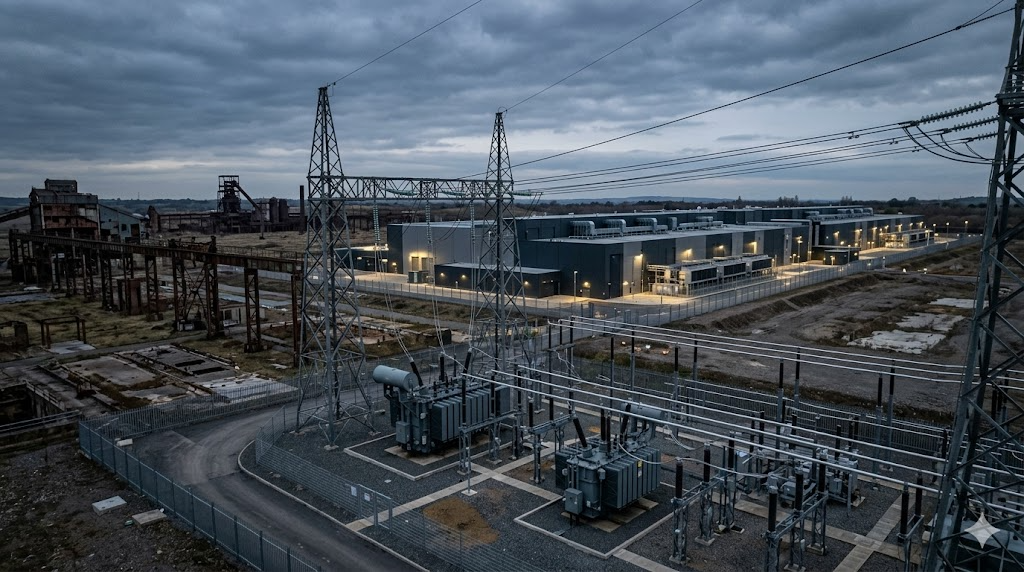
The hyperscale industry’s response to the powered land premium is a systematic acquisition strategy targeting brownfield industrial sites — decommissioned factories, abandoned steel mills, closed power stations, legacy chemical plants, and any other former heavy industrial operation that was historically connected to high-capacity electrical infrastructure. These sites possess exactly the attribute that is commercially irreplaceable: a pre-existing large-scale electrical grid connection that, if it were to be retired and then re-applied for from scratch, would face a queue measured in years to decades [1][2].
The economic logic is straightforward. A brownfield site with a 100MW+ grid connection embedded in an old industrial complex — regardless of the physical condition of the buildings or the environmental legacy of the prior use — is worth multiples of its nominal land value to a hyperscale developer. The grid connection is the prize. The buildings are either adaptable, demolishable, or irrelevant. Environmental remediation costs, which can run to tens of millions of pounds or dollars for legacy industrial contamination, are routinely absorbed as the cost of accessing irreplaceable grid capacity that simply cannot be obtained any other way on any commercially acceptable timeline [1][2].
“The AI gold rush is transforming dormant land — particularly brownfield industrial sites with existing grid connections — into some of the most valuable real estate on the planet.”
Modern Diplomacy, “AI gold rush transforms dormant land into high value data center hubs,” April 2026 [1]
In the United Kingdom alone, 119 data center planning applications were submitted across brownfield sites in 2025. This volume represents a structural shift in UK planning activity — brownfield conversion from industrial to digital infrastructure has become one of the highest-priority land use categories across local authority planning departments in every region with viable grid access [2].
Wilton International: The Teesside Template
The clearest illustration of the brownfield-to-hyperscale conversion opportunity is Wilton International in Teesside, Northeast England — a 2,500-acre former industrial campus on the River Tees that hosted one of the largest petrochemical complexes in Europe at its peak. The site, managed by Sembcorp Industries, retains grid infrastructure scaled for heavy industrial consumption: substations, high-voltage transmission lines, and power distribution networks originally designed to serve energy-intensive chemical, pharmaceutical, and materials manufacturing operations [1][2].
Sembcorp has been actively repositioning Wilton International as a data center campus, with Amazon Web Services and Meta among the hyperscalers that have evaluated or engaged with the site. The proposition is compelling in a market where comparable grid-connected land simply does not exist at scale in the UK: a brownfield site with existing power infrastructure, proximity to fiber backhaul routes along the east coast corridor, a regional government amenable to employment-generating infrastructure investment, and industrial-scale acreage that can accommodate the enormous physical footprint of modern hyperscale campuses [1][2].
The Wilton International model — a former heavy industry anchor transforming into a digital infrastructure campus — is being replicated across the UK and beyond. Former steel works in South Wales, decommissioned power stations in the East Midlands, and legacy chemical plants across Northern England are all undergoing the same fundamental transformation: industrial-era electricity infrastructure becoming the foundation of digital-era computing capacity [1][2].
Brownfield-to-Data-Center Conversion — Site Typology and Characteristics
| Site Type | Grid Advantage | Key Challenge | Example |
|---|---|---|---|
| Former industrial campus | Large-scale substations; 100MW+ capacity [1] | Environmental remediation; legacy contamination | Wilton International, Teesside |
| Decommissioned power station | Direct transmission line connections; highest voltage capacity [2] | Structural assessment; asbestos removal; planning complexity | Multiple UK coal/gas stations |
| Legacy steel / metals works | Industrial-scale distribution network intact [1] | Ground remediation; contaminated soil; planning timeline | South Wales, Sheffield corridor |
| Former data center campus | Modern fiber + power infrastructure already in place [3] | Capacity limits; outdated cooling; owner release | Various Northern Virginia secondaries |
| Abandoned logistics hub | Moderate grid connections; lower voltage typical [1] | Upgrade required; less valuable than heavy industrial | Edge/regional deployments |
Urban Saturation and the Secondary Market Migration
The premium on powered land in primary hyperscale markets — Northern Virginia, London, Singapore, Sydney — is in part a function of scarcity that is now structural rather than temporary. The interconnection queues in these markets have extended to the point where even well-capitalized developers with established utility relationships cannot reliably secure large-scale new grid connections within commercially viable timelines. This creates a two-tier dynamic: existing powered sites in primary markets retain extreme scarcity premiums, while capital and development activity migrates to secondary markets that retain grid headroom [1][3].
In the United States, the saturation of Northern Virginia — which accounts for approximately one-third of total global hyperscale data center capacity — has forced systematic capital reallocation toward Phoenix, Dallas, Columbus, and Atlanta. These markets offered, at the time of initial hyperscale entry, the combination of available powered industrial land, utility relationships capable of supporting large-scale interconnection, and local government amenability to data center development. That combination is now under pressure in each of these secondary markets as well, which is in turn driving interest in tertiary markets across the Midwest and Southeast [1][3].
The CBRE Investment Management Q1 2026 Infrastructure Quarterly identifies this migration pattern as a defining structural feature of the current AI infrastructure cycle: as each tier of market becomes capacity-constrained, capital cascades to the next viable tier, elevating land values and accelerating permitting activity in locations that had not previously been considered viable hyperscale destinations. The economics follow the power, and the power follows the available grid capacity — wherever that happens to be located [3].
Key Takeaways
- London powered industrial land with high-voltage grid connections now commands £8–15M per acre — double the standard industrial rate of £4.5–6M — with US powered land premiums exceeding 3x unpowered equivalents, creating a new real estate asset class defined by megawatts rather than location [1].
- 119 data center planning applications were submitted across UK brownfield sites in 2025, reflecting a systematic hyperscale strategy of acquiring legacy industrial sites with pre-existing grid infrastructure to bypass interconnection queues that would otherwise take a decade or more to navigate [2].
- Wilton International (Teesside, UK) — a 2,500-acre former petrochemical campus managed by Sembcorp — exemplifies the brownfield-to-hyperscale conversion template, with Amazon and Meta among hyperscalers evaluating the site for its irreplaceable large-scale industrial power infrastructure [1][2].
- Primary market saturation (Northern Virginia, London, Singapore, Sydney) is driving a structural cascade of capital toward secondary markets, which are in turn becoming capacity-constrained — elevating powered land values across an ever-wider geographic footprint as each tier fills and capital migrates to the next [1][3].
References
- [1] Modern Diplomacy, “AI gold rush transforms dormant land into high value data center hubs,” Apr. 24, 2026. [Online]. Available: https://moderndiplomacy.eu/2026/04/24/ai-gold-rush-transforms-dormant-land-into-high-value-data-center-hubs/
- [2] Colliers International / Bisnow, “Data center brownfield planning applications UK 2025,” Apr. 24, 2026. [Online]. Available: https://www.bisnow.com/uk/news/data-center/uk-brownfield-data-center-applications-2025
- [3] CBRE Investment Management, “Infrastructure Quarterly: Q1 2026,” Apr. 24, 2026. [Online]. Available: https://www.cbreim.com/insights/articles/infrastructure-quarterly-q1-2026
- [4] Knight Frank AU, “Global data centre market is projected to reach US$4 trillion by 2030,” Apr. 24, 2026. [Online]. Available: https://www.knightfrank.com.au/blog/2025/04/17/global-data-centre-market-is-projected-to-reach-us4-trillion-by-2030
- [5] ThoughtMinds, “AI Infrastructure Boom: $650B Impact on Global Industry,” Apr. 24, 2026. [Online]. Available: https://thoughtminds.ai/blog/ai-infrastructure-boom-how-the-$650-billion-boom-is-impacting-the-global-industry