Blackstone’s $150B AI Infrastructure Bet: How Private Equity Is Financing the Physical Internet
Blackstone reported record assets under management of $1.3 trillion in Q1 2026, with $1.8 billion in distributable earnings — a 25% year-over-year increase. The core driver: a $150 billion data center portfolio, a $160 billion development pipeline, and a strategic position in natural gas pipelines that management projects will supply 50% of all AI data center power within five years [1][3][4][5].
Key Financial and Infrastructure Metrics
+12% year-over-year; record Q1 [7]
+25% year-over-year growth [3]
Operational + under construction [1]
Identified development opportunities [1]
The World’s Largest AI Infrastructure Investor
During its Q1 2026 earnings call, Blackstone leadership explicitly positioned the firm as “the largest investor in AI-related infrastructure in the world” — a self-designation that reflects not merely a strategic interest but a fundamental reorientation of the firm’s flagship investment strategies. The language was intentional and precise: not the largest investor in AI companies, not the largest investor in technology, but specifically in the physical infrastructure that makes AI workable at scale. This distinction matters enormously for understanding where institutional capital has concluded value is accumulating in the AI era [5].
The Q1 2026 results demonstrate that this positioning has been financially validated. Despite broader market volatility driven by geopolitical turbulence and shifting interest rate dynamics through the quarter, Blackstone’s infrastructure segment posted +7.8% appreciation — a performance that insulated the firm from sector-level turbulence while generating distributable earnings 25% above the prior year. The $69 billion in total Q1 inflows reflects continued institutional conviction in infrastructure as a long-duration, yield-generating anchor position in mixed portfolios [3][5][6].
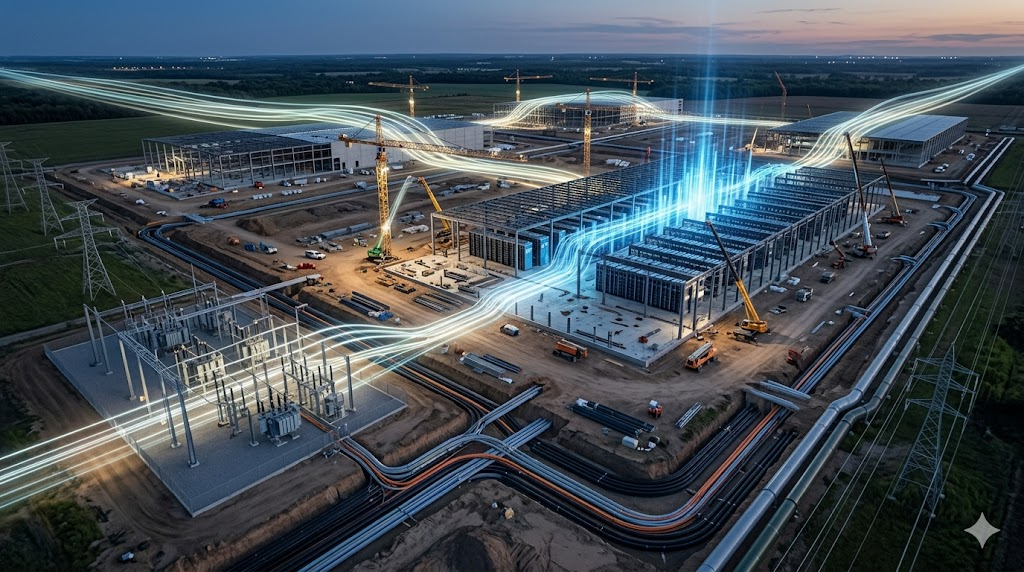
The investment thesis behind this performance is straightforward in its logic: AI models require massive, continuous physical support systems that extend far beyond the server rack. Data centers are the front-end of a value chain that includes high-voltage power transmission, generation capacity, cooling infrastructure, and fiber optic connectivity. Blackstone has invested across that entire chain — it is not merely a landlord for technology companies but an integrated energy and infrastructure provider to the digital economy [1][5].
Blackstone AI Infrastructure Investment Breakdown
| Asset Class | Scale / Commitment | Strategic Rationale |
|---|---|---|
| Data center portfolio (operational + construction) | >$150 billion [1] | Direct exposure to hyperscale compute demand growth |
| Prospective development pipeline | $160 billion identified [1] | Forward capital deployment as grid capacity unlocks |
| Natural gas pipeline network (US) | Longest cross-country network in US [1] | Baseload power for data centers — projected 50% of AI power by 2031 |
| US grid modernization | Active investor in transmission upgrades [1] | Bottleneck removal — unlocks stranded data center capital |
| New data center public company | Filed April 2026 [1] | Public market access to stabilized, newly constructed facilities |
Natural Gas as the AI Power Backbone
Blackstone’s ownership of the longest cross-country natural gas pipeline network in the United States is not an incidental legacy position — it is a deliberate, forward-looking integration play. Management has projected that natural gas assets of this type will account for approximately 50% of all data center power generation within the next five years. The reasoning is grounded in the operational constraints of modern AI infrastructure: large language model inference and training require uninterrupted, reliable baseload power available on demand at any time of day or night [1].
Intermittent renewable energy sources — wind and solar — cannot independently satisfy this requirement without prohibitively large and expensive battery energy storage systems that do not yet exist at the required scale. Natural gas reciprocating engines and gas-fired combined-cycle plants provide the consistent, dispatchable baseload generation that hyperscale data campus operators require. As operators race to bring new gigawatt-scale facilities online faster than utility grid connection timelines allow, on-site gas generation has emerged as the dominant “behind-the-meter” power strategy for campus-scale deployments [1].
“Blackstone has positioned itself as the largest investor in AI-related infrastructure in the world.”
Blackstone Q1 2026 Earnings Call, April 23, 2026 [5]
The strategic coherence of this vertical integration is significant. Blackstone collects value at every layer of the AI compute stack’s physical energy supply chain: it holds the pipeline delivering natural gas, the generation assets converting it to electricity, the transmission infrastructure delivering power to facilities, and the real estate assets housing the compute. Each layer individually generates yield; combined, they create a near-monopolistic position in the physical energy supply chain underpinning American AI infrastructure [1][5].
AI Infrastructure Supercycle — Scale and Growth Projections
| Metric | Current / Projected | Source |
|---|---|---|
| Global data center CAGR (2026–2030) | 14% annually [2] | Infrastructure Quarterly Q1 2026 |
| New capacity online 2026–2030 | ~100 gigawatts [2] | Doubles current installed base |
| Total capital required through 2030 | ~$3 trillion [1] | AI Infrastructure and Energy Supercycle report |
| Blackstone Q1 inflows | $69 billion [6] | Firm-wide, Q1 2026 |
| Infrastructure segment appreciation | +7.8% [3] | Blackstone Q1 2026 results |
The New Public Company and Capital Markets Access
Blackstone’s April 2026 filing to launch a new publicly traded company dedicated exclusively to acquiring stabilized, newly constructed data centers represents a structural expansion of the AI infrastructure investment ecosystem. By creating a listed vehicle, Blackstone opens this asset class to a substantially larger pool of capital — pension funds, retail investors, and institutional allocators who cannot access private equity vehicles but can hold publicly traded infrastructure REITs and operating companies. This move simultaneously monetizes the firm’s operational expertise and creates a persistent acquisition channel for new facility supply [1].
The economic model is well-suited to the current market structure: data center developers face intense pressure to recycle capital quickly as construction and interconnection timelines stretch. A well-capitalized acquirer of stabilized assets at defined yields provides a reliable exit path for developers, lubricating supply through the development pipeline. As the global data center sector expands at a projected 14% CAGR through 2030 and adds approximately 100 gigawatts of new capacity over that period, the total addressable acquisition opportunity for a vehicle of this type scales proportionally with new construction completions [1][2].
Key Takeaways
- Blackstone reported record Q1 2026 AUM of $1.3T, $1.8B in distributable earnings (+25% YoY), and a $150B data center portfolio with $160B in prospective pipeline — driven by its self-described position as the world’s largest AI infrastructure investor [3][5][7].
- Natural gas pipeline ownership is core to the thesis: management projects natural gas will supply ~50% of all data center power within five years, making legacy energy infrastructure a critical AI enabler rather than a fossil-fuel legacy asset [1].
- The firm’s vertical integration spans pipeline, generation, transmission, and real estate — creating compounding yield at every layer of the physical AI power supply chain [1][5].
- A new public data center acquisition vehicle filed in April 2026 opens the AI infrastructure asset class to public market capital for the first time, potentially unlocking trillions in additional institutional allocation toward the $3T estimated requirement through 2030 [1][2].
References
- [1] Investing.com, “Earnings call transcript: Blackstone Q1 2026 beats expectations amid market volatility,” Apr. 24, 2026. [Online]. Available: https://www.investing.com/news/transcripts/earnings-call-transcript-blackstone-q1-2026-beats-expectations-amid-market-volatility-93CH-4633236
- [2] CBRE Investment Management, “Infrastructure Quarterly: Q1 2026,” Apr. 24, 2026. [Online]. Available: https://www.cbreim.com/insights/articles/infrastructure-quarterly-q1-2026
- [3] The Motley Fool, “Blackstone (BX) Q1 2026 Earnings Transcript,” Apr. 23, 2026. [Online]. Available: https://www.fool.com/earnings/call-transcripts/2026/04/23/blackstone-bx-q1-2026-earnings-transcript/
- [4] Blackstone, “Blackstone Reports First Quarter 2026 Results,” Apr. 2026. [Online]. Available: https://www.blackstone.com/wp-content/uploads/sites/2/2026/04/Blackstone1Q26EarningsPressRelease.pdf
- [5] MarketBeat, “Blackstone Q1 Earnings Call Highlights,” Apr. 24, 2026. [Online]. Available: https://www.marketbeat.com/instant-alerts/blackstone-q1-earnings-call-highlights-2026-04-23/
- [6] In.Investing.com, “Blackstone Q1 2026 slides: AUM hits $1.3T despite market volatility,” Apr. 24, 2026. [Online]. Available: https://in.investing.com/news/company-news/blackstone-q1-2026-slides-aum-hits-13t-despite-market-volatility-93CH-5355261
- [7] Commercial Observer, “Blackstone Reports Record $1.3T AUM, Earnings Increases of 25% in Q1,” Apr. 24, 2026. [Online]. Available: https://commercialobserver.com/2026/04/blackstone-first-quarter-2026-earnings/