
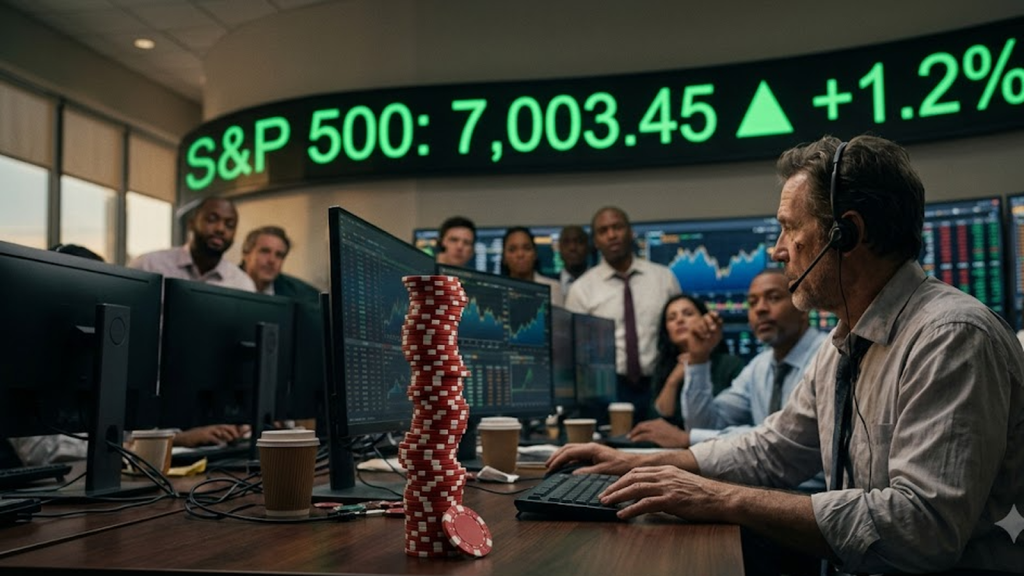
S&P 500 Hits 7,000: Historic Speed Masks Market Fragility
The S&P 500 breached the 7,000 threshold for the first time, touching an intraday peak of 7,002.28. But the velocity of ascent — from 6,000 to 7,000 in just 302 trading days — masks a market structurally dependent on a narrow cohort of mega-cap tech equities for its historic multiples.
Key Metrics at the 7,000 Threshold
↑ Historic first breach of 7,000 [25]
↓ Compressed from 4,168 days (1K→2K) [1]
↑ Highest concentration in history [1]
↑ Tech at 27%, rest trails [2]
The 7,000 Milestone and the Velocity of Ascent
On January 28, 2026, the S&P 500 touched 7,002.28 on an intraday basis — the first time in the index’s seventy-year history that it crossed the 7,000 threshold. [3] The breach came as investors digested a confluence of catalysts: strong mega-cap earnings previews, persistent AI capital expenditure narratives, and a broader risk-on sentiment that had been building since the post-election rally of late 2024. Yet the number itself, while psychologically significant, conceals a far more important structural story — the velocity at which consecutive thousand-point milestones are being achieved, and the narrowing base of equities responsible for propelling them.
Former President Donald Trump was quick to claim credit, posting on Truth Social within minutes of the milestone. [1] The political optics of a record index level are irresistible, but the attribution is misleading. The S&P 500’s trajectory from 6,000 to 7,000 unfolded over roughly 302 trading days — approximately fourteen months. [2] That pace is historically extraordinary, but it is best understood in context: the compounding acceleration of milestone velocity is not a feature of any single administration’s policy. It is a mathematical consequence of exponential compounding on an ever-larger base, amplified by unprecedented capital concentration in a handful of technology companies.
To appreciate the compression, consider the full trajectory of thousand-point milestones. The S&P 500 required 4,168 trading days to travel from 1,000 to 2,000 — a journey that spanned more than sixteen years, from February 1998 to August 2014. [2] The index then needed roughly 1,227 trading days to move from 2,000 to 3,000, another 512 days from 3,000 to 4,000, and 719 days from 4,000 to 5,000. The 5,000-to-6,000 leg was completed in just 190 trading days — approximately nine months — before the most recent leg consumed 302 days. [2]
The slight deceleration from the 5,000–6,000 sprint does not diminish the broader pattern. That preceding leg was anomalously fast, propelled by the post-election euphoria of November 2024 and the initial AI monetization narrative. The 6,000–7,000 leg, while slower in relative terms, still represents one of the fastest thousand-point advances in the index’s history. The overall arc is one of relentless compounding: each successive thousand-point milestone requires a smaller percentage gain to achieve, and the absolute dollar flows into index-tracking vehicles continue to expand as passive investing’s share of total equity assets surpasses fifty percent.
Velocity of Thousand-Point Advances
| Milestone Range | Approximate Trading Days | Calendar Duration |
|---|---|---|
| 1,000 → 2,000 | 4,168 | ~16 years |
| 4,000 → 5,000 | 719 | ~3 years |
| 5,000 → 6,000 | 190 | ~9 months |
| 6,000 → 7,000 | 302 | ~14 months |
The compounding effect is the critical insight. A move from 6,000 to 7,000 represents a 16.7% gain — a strong annual return by any historical standard, but far less dramatic than the 100% gain required to move from 1,000 to 2,000. The mathematics of percentage gains on larger bases means that headline milestones will continue to arrive at compressed intervals, assuming even modest positive returns. This is not cause for celebration or alarm in isolation. The question that matters is not how quickly the index is climbing, but how broadly the gains are distributed — and on that measure, the picture is far less reassuring.
The bull market that carried the index through 7,000 began in October 2022, when the S&P 500 bottomed near 3,577. [4] Since that trough, the index has nearly doubled. The gains have been driven overwhelmingly by a small cohort of mega-cap technology companies — the so-called “Magnificent Seven” and their adjacent beneficiaries in the AI supply chain. This concentration dynamic is not new, but it has reached levels that have no precedent in modern market history, raising fundamental questions about the durability of the advance and the fragility of the index beneath its headline number.
The AI Capex Engine and Concentration Risk
The technology sector now commands approximately fifty percent of the S&P 500’s total market capitalization — the highest concentration of any single sector in the index’s history. [1] This is not merely a statistical curiosity. It represents a structural transformation of the most widely followed equity benchmark in the world. When half of an index’s weight is concentrated in a single sector, the index ceases to function as a broad measure of the American economy and instead becomes a leveraged bet on the fortunes of that sector’s largest constituents.
The earnings picture reinforces the asymmetry. Consensus estimates for 2026 project overall S&P 500 earnings growth at 15.5% — a robust figure by historical standards. [2] But disaggregate that number and the tech sector accounts for earnings growth of approximately 27%, while the remaining sectors collectively trail at single-digit rates. The gap between tech and non-tech earnings growth is not narrowing; it is widening. This divergence creates a mathematical dependency: the index’s headline earnings growth rate is achievable only if tech delivers on its elevated expectations. Any shortfall — whether from revenue misses, margin compression, or a reassessment of AI monetization timelines — would disproportionately impact the aggregate number.
The engine driving these expectations is the unprecedented capital expenditure cycle in artificial intelligence infrastructure. The four dominant hyperscalers — Microsoft, Meta, Alphabet, and Amazon — have collectively committed hundreds of billions of dollars to AI data center construction, custom silicon procurement, and model training infrastructure over the 2025–2027 planning horizon. [1] This spending is flowing directly into the revenue lines of semiconductor companies, equipment manufacturers, and power infrastructure providers, creating a reinforcing loop of capital deployment and earnings growth that has propelled the sector’s market capitalization to historic levels.
Nvidia remains the emblematic beneficiary of this cycle. The company’s data center revenue has grown at triple-digit year-over-year rates for multiple consecutive quarters, driven by insatiable demand for its GPU architectures from hyperscaler customers. Its market capitalization has at various points during 2025 and early 2026 rivaled or surpassed that of Apple and Microsoft, making it one of the three most valuable companies on the planet. [1] ASML, the Dutch lithography monopolist whose extreme ultraviolet (EUV) machines are the bottleneck in advanced chip manufacturing, has seen similar valuation validation. Both companies derive their premium from the structural necessity of AI infrastructure — a capex cycle that shows no signs of abating so long as the hyperscalers continue to compete for AI model superiority.
Goldman Sachs has set a year-end 2026 price target for the S&P 500 at 7,600 — implying roughly eight percent upside from the 7,000 level. [5] The target is predicated on continued earnings growth, stable multiples, and a soft landing for the U.S. economy. It is a consensus-hugging forecast that assumes the AI capex cycle remains intact and that geopolitical risks — tariffs, trade wars, Taiwan tensions — do not materialize in a way that disrupts supply chains or corporate confidence. The prediction market Kalshi assigns a 66% probability that the S&P 500 will finish 2026 at or above 7,200, and a 48% probability that it will reach 7,400. [5] These probabilities embed the same base-case assumption: that tech earnings deliver, that multiples hold, and that the Federal Reserve does not surprise with a hawkish pivot.
But the concentration risk embedded in these forecasts is rarely acknowledged explicitly. When analysts project index-level targets, they are implicitly forecasting the weighted average performance of 503 stocks — but with tech at fifty percent of the weight, they are effectively forecasting six or seven companies. If Nvidia misses earnings expectations by ten percent, the impact on the S&P 500 is equivalent to dozens of smaller companies missing by similar margins. If Microsoft, Meta, Alphabet, and Amazon simultaneously signal a slowdown in AI capex — perhaps because first-generation AI applications fail to demonstrate sufficient return on investment — the index-level impact would be immediate and severe, even if every other sector in the index performed perfectly.
The concentration is further amplified by the passive investment ecosystem. Index-tracking ETFs and mutual funds — which now command the majority of U.S. equity fund assets — mechanically allocate capital in proportion to market capitalization. This means that every dollar flowing into an S&P 500 index fund disproportionately flows into the largest tech stocks, reinforcing their weight and making the index even more concentrated. The feedback loop is self-reinforcing: tech outperformance drives higher weights, which attract more passive flows, which drive further outperformance. The virtuous cycle operates in reverse with equal force: any sustained underperformance triggers mechanical selling, weight reduction, and accelerated outflows.
The Equal-Weight Divergence: Fragility Beneath the Surface
The most revealing diagnostic of the market’s structural fragility is not the headline index level but the divergence between the cap-weighted S&P 500 and its equal-weight counterpart. The S&P 500 Equal Weight Index assigns identical weight to each constituent, stripping away the distorting effect of mega-cap concentration. When both indices move in tandem, market breadth is healthy — gains are broadly distributed across sectors and market capitalizations. When they diverge, it signals that the headline index is being propelled by a narrow cohort while the majority of constituents are stagnating or declining.
In mid-March 2026, the S&P 500 pulled below 6,900 and recorded a four-day losing streak — the longest of the year. [6] The index had retreated approximately five percent from its all-time intraday high of 7,002.28. [6] But the pullback was not uniform. Mega-cap tech names bore the brunt of the selling, as investors reassessed earnings multiples in the face of rising Treasury yields and renewed tariff rhetoric from the administration. The rotation was conspicuous: capital flowed out of technology and into defensive sectors — energy, materials, consumer staples, and utilities — that had been relative laggards during the AI-driven rally.
The year-to-date performance divergence tells the story in stark numerical terms. Through mid-March 2026, the cap-weighted S&P 500 was down 3.12% on a year-to-date basis. [6] The equal-weight S&P 500, by contrast, was up 0.71% over the same period. [6] This is a nearly four-percentage-point gap — a spread that reveals how dependent the headline index has become on its largest constituents. The equal-weight index is effectively telling a different story: the average S&P 500 stock is holding up reasonably well, posting modest gains amid an uncertain macro environment. It is the mega-cap tech cohort, specifically, that is dragging the cap-weighted index lower.
This divergence is not a benign technical curiosity. It reveals the structural dependency that makes the current market framework fragile. When an index’s performance is overwhelmingly determined by the fortunes of five to seven companies, it introduces single-point-of-failure risk to the most widely held investment vehicle in the world. Retirement portfolios, pension funds, sovereign wealth allocations, and institutional mandates are all benchmarked to or invested in the cap-weighted S&P 500. A severe and sustained underperformance by the mega-cap tech cohort would cascade through the global financial system in ways that a typical sector rotation would not.
The sector rotation underway in Q1 2026 offers a potential counterfactual. Capital moving into energy, materials, and consumer staples suggests that investors are beginning to price in the possibility that the AI earnings narrative may be peaking — or at least decelerating from its parabolic trajectory. Energy stocks have benefited from sustained crude oil prices above $85 per barrel and the structural underinvestment in fossil fuel production capacity. Materials companies have seen tailwinds from infrastructure spending and the electrification buildout. Consumer staples, the perennial defensive allocation, have attracted capital from risk-averse investors seeking yield and earnings stability in an uncertain rate environment.
If this rotation broadens and sustains, it could actually improve the health of the market from a structural perspective. A flatter distribution of sector weights, with tech’s share declining from fifty percent toward its historical average of twenty to twenty-five percent, would reduce the index’s vulnerability to single-sector shocks. But that rebalancing would necessarily involve a sustained period of tech underperformance relative to other sectors — a process that would likely produce a headline index that moves sideways or lower even as the average stock appreciates. The paradox is that a healthier market, from a breadth and fragility perspective, would generate worse headline numbers in the near term.
The forward-looking risk matrix is bifurcated. In the bull case, AI monetization accelerates faster than consensus expects: enterprise software companies demonstrate measurable productivity gains from AI integration, autonomous systems begin generating revenue at scale, and the hyperscalers’ capex spending proves justified by explosive cloud demand. In this scenario, tech earnings growth sustains at 25–30%, the concentration risk is retrospectively validated, and the S&P 500 moves toward Goldman’s 7,600 target or beyond. [5]
In the bear case, AI monetization disappoints — first-generation applications prove difficult to sell at scale, enterprise adoption stalls amid budget constraints and integration challenges, and hyperscaler capex begins to generate diminishing returns. Simultaneously, macro headwinds intensify: tariffs reduce corporate margins, Treasury yields climb above 5% and tighten financial conditions, and geopolitical disruptions interrupt semiconductor supply chains. In this scenario, the mega-cap tech cohort de-rates sharply — not because the companies are fundamentally impaired, but because their valuations have priced in a best-case AI adoption curve that fails to materialize. The cap-weighted S&P 500, with its fifty-percent tech exposure, would bear the full force of this reassessment.
The gap between these scenarios is wider than at any point since the dot-com era. The magnitude of the AI capex cycle, the degree of index concentration, the scale of passive flows, and the velocity of milestone advances have collectively created a market that is simultaneously achieving historic highs and exhibiting historic fragility. The 7,000 milestone is real, but what it represents — a market that has never been more dependent on fewer companies for its aggregate performance — is a structural risk that no headline number can obscure.
“The market is experiencing a paradoxical condition: headline indices suggest historic prosperity, yet the breadth beneath reveals a market structurally dependent on a narrow cohort of mega-cap equities to sustain its multiples.”
— Market Structure Analysis, Q1 2026 [4]
S&P 500 Thousand-Point Advance Velocity
Prediction Markets and Institutional Positioning
Prediction markets have emerged as a complementary signal to traditional Wall Street price targets, and their implied probabilities for the S&P 500’s year-end 2026 level offer a useful lens for evaluating consensus expectations. On Kalshi, the leading U.S.-regulated prediction exchange, contracts pricing the S&P 500 to finish at or above 7,200 were trading at approximately 66% implied probability as of late March 2026. [5] Contracts for 7,400 or higher implied a 48% probability. These are not wildly bullish numbers — they suggest a market that the crowd expects to grind modestly higher, but with significant uncertainty about the magnitude of gains.
Goldman Sachs’ year-end target of 7,600 sits at the upper end of the prediction market distribution, implying roughly 8.5% upside from the 7,000 level. [5] The target embeds assumptions about earnings growth continuity, multiple stability, and a benign interest rate environment — all of which are contestable. The bank’s equity strategists have historically anchored their targets to a “fair value” framework that combines trailing earnings, forward earnings estimates, and an equity risk premium model calibrated to the 10-year Treasury yield. Under this framework, the current multiple expansion is justified so long as earnings growth sustains at or above trend and real rates remain contained.
Institutional positioning data adds another layer of complexity. Long-only funds have been systematically overweight technology relative to their benchmarks, a positioning that has been rewarded over the trailing two-year period. Hedge fund net exposure, as measured by prime brokerage data, remains elevated but has begun to moderate from its November 2025 peak. The most notable shift is in systematic strategies — commodity trading advisors (CTAs) and volatility-targeting funds — which have reduced equity exposure in response to the March pullback and rising realized volatility. These mechanical strategies tend to amplify drawdowns by selling into falling markets, adding a pro-cyclical risk to any sustained tech-led correction.
The options market is also pricing elevated uncertainty. The VIX, which had compressed to near-historic lows in late January as the index breached 7,000, has since expanded to the mid-twenties range. [6] More significantly, the skew — the premium for downside protection relative to upside calls — has steepened meaningfully. This tells us that institutional investors are willing to pay up for tail-risk hedges, even as they maintain long positions. The combination of elevated skew and moderate VIX levels is characteristic of a market that expects continued positive drift but is increasingly hedging against a left-tail event.
The Compounding Illusion and What 8,000 Would Require
If the S&P 500 follows the trajectory implied by Goldman’s year-end target and the median prediction market probability, the index would approach 7,600 by December 2026 and could plausibly breach 8,000 in the first half of 2027. [5] At that pace, the 7,000-to-8,000 leg would be completed in approximately twelve to fourteen months — roughly in line with the 6,000-to-7,000 velocity. The mathematics of compounding would make this appear as a continuation of an established trend.
But reaching 8,000 would require a 14.3% gain from the 7,000 level — a return that demands either sustained earnings growth at current rates, further multiple expansion, or both. The current forward price-to-earnings ratio for the S&P 500 sits near 22x, well above its twenty-five-year average of approximately 16.5x. [4] For the index to reach 8,000 without further multiple expansion, aggregate earnings would need to grow by approximately 14% — achievable if tech delivers on its 27% growth estimates, but vulnerable to any disappointment in that narrow cohort.
Multiple expansion from current levels would require either a meaningful decline in risk-free rates — unlikely given the Federal Reserve’s signaled intention to hold the federal funds rate steady through mid-2026 — or a reacceleration of earnings growth expectations that convinces investors to pay even more for each dollar of future earnings. The latter scenario is possible if AI monetization surprises to the upside, but it would push valuations into territory not seen since the late-1990s tech bubble — a comparison that even the most ardent bulls acknowledge carries historical weight.
The compounding illusion is precisely that: the appearance of effortless, accelerating progress created by applying positive returns to an ever-larger base. Each successive thousand-point milestone feels more routine because it represents a smaller percentage gain. But the absolute dollar value created — or destroyed — at these levels is enormous. A five-percent drawdown from 7,000 erases 350 index points, an absolute decline that would have represented a 35% crash from the 1,000 level. The amplification of absolute moves at higher index levels means that the emotional and financial impact of routine percentage swings is amplified in ways that can trigger behavioral cascades — forced selling, margin calls, risk-off rotations — that extend beyond what the percentage move alone would warrant.
Structural Implications for Portfolio Construction
The concentration dynamics at the 7,000 level have direct implications for portfolio construction and risk management. Investors who hold the cap-weighted S&P 500 as their core equity allocation — whether through index funds, ETFs, or institutional mandates — are carrying roughly fifty percent exposure to the technology sector. [1] This is not a deliberate sector bet; it is the emergent outcome of market-cap weighting in a market where tech has dramatically outperformed. But the effect is the same: these portfolios are structurally vulnerable to any event that reprices the tech sector.
The equal-weight S&P 500 offers one form of diversification, but it introduces its own distortions — overweighting smaller constituents that may lack the earnings quality and balance sheet strength of the mega-caps. A more nuanced approach involves blending cap-weighted and equal-weight exposures, or supplementing the core S&P 500 allocation with explicit sector diversifiers: energy, industrials, healthcare, and international equities that have lower correlation to the AI capex cycle. [3]
For institutional allocators, the fragility diagnosis suggests a reexamination of benchmark construction itself. A benchmark that derives half its return from a single sector may no longer serve its intended purpose as a broad representation of U.S. equity market returns. Some large pension funds and endowments have already begun migrating toward custom benchmarks that cap sector weights or incorporate factor diversification. This trend is likely to accelerate if the concentration risk materializes in a way that produces benchmark-relative losses for diversified managers who are underweight tech.
The paradox of the current moment is that the market has never been higher and never been more fragile. The 7,000 milestone is a genuine achievement — a reflection of American corporate earnings power, technological innovation, and the relentless compounding of equity returns over time. But the structural composition of that achievement — fifty percent tech weight, a four-percentage-point divergence between cap-weighted and equal-weight returns, and a dependency on six or seven companies for aggregate earnings growth — introduces vulnerabilities that previous milestone moments did not carry. The headline number is historic. The architecture beneath it is precarious. [4][6]
Key Takeaways
- Historic velocity: The S&P 500 travelled from 6,000 to 7,000 in just 302 trading days, compared to 4,168 days for the 1,000-to-2,000 leg — a compression driven by compounding on an ever-larger base and unprecedented passive flows. [1][2]
- Dangerous concentration: The technology sector now commands approximately 50% of the S&P 500’s total market capitalization — the highest single-sector concentration in the index’s history — making the benchmark a leveraged bet on mega-cap tech. [1]
- Earnings asymmetry: Projected 2026 S&P 500 earnings growth of 15.5% masks a deep divide — tech at 27% growth, while the rest of the index trails at single-digit rates, creating single-point-of-failure risk. [2]
- Equal-weight divergence: Cap-weighted S&P 500 down 3.12% YTD versus equal-weight up 0.71% — a nearly four-percentage-point gap that reveals the average stock is performing adequately while mega-caps drag the headline index. [6]
- AI capex dependency: Hyperscaler capital expenditure from Microsoft, Meta, Alphabet, and Amazon is the primary engine sustaining tech earnings growth and index-level momentum — any deceleration would cascade through the cap-weighted structure. [1][3]
- Prediction market caution: Kalshi assigns only a 48% probability that the S&P 500 reaches 7,400 by year-end, while Goldman Sachs targets 7,600 — suggesting even bullish forecasters see meaningful downside risk. [5]
References
- [1] “S&P 500 breaches 7000 as tech giants prep earnings,” Investing.com, Jan. 2026, accessed Mar. 24, 2026. [Online]. Available: https://www.investing.com/news/stock-market-news/sp-500-breaches-7000-as-tech-giants-microsoft-and-meta-prep-earnings-4470579
- [2] “S&P 500 Surpasses 7000-Point Milestone for First Time,” IndexBox, Jan. 2026, accessed Mar. 24, 2026. [Online]. Available: https://www.indexbox.io/blog/sp-500-surpasses-7000-point-milestone-for-first-time/
- [3] “S&P 500 touches 7,000 for the first time, led by a surprising group of stocks,” Morningstar, Jan. 2026, accessed Mar. 24, 2026. [Online]. Available: https://www.morningstar.com/news/marketwatch/20260128480/sp-500-touches-7000-for-the-first-time-led-by-a-surprising-group-of-stocks
- [4] “Is The S&P 500’s March To 7,000 Sustainable Or A Bull Trap?,” The Luxury Playbook, Feb. 2026, accessed Mar. 24, 2026. [Online]. Available: https://theluxuryplaybook.com/is-the-sp-500s-march-to-7000-sustainable-or-a-bull-trap/
- [5] “How high can the S&P 500 climb in 2026?,” Seeking Alpha, Mar. 2026, accessed Mar. 24, 2026. [Online]. Available: https://seekingalpha.com/news/4552488-how-high-can-the-s-and-p-500-climb-in-2026-here-s-what-prediction-markets-are-signaling
- [6] “S&P 500 Snapshot: Longest Losing Streak of 2026,” Advisor Perspectives, Mar. 2026, accessed Mar. 24, 2026. [Online]. Available: https://www.advisorperspectives.com/dshort/updates/2026/03/13/s-p-500-snapshot-lowest-close-of-2026