Apple M5 Pro and M5 Max: How Fusion Architecture and Per-Core Neural Accelerators Transform Local AI Inference
Apple’s March 2026 silicon release shatters the paradigm of cloud-dependent AI — 40 per-core neural accelerators and 614 GB/s memory bandwidth bring multi-billion parameter models to the laptop.
Hardware Performance at a Glance
↑ Per-core Neural Accelerators [1]
↑ 12.5% vs M4 Max [2]
→ Each with Neural Accelerator [2]
→ M5 Max [4]
The Fusion Architecture: A Fundamental Manufacturing Innovation
On March 3, 2026, Apple disrupted the established paradigm of cloud-dependent AI inference with the announcement of the M5 Pro and M5 Max silicon architectures [1]. These processors are engineered specifically to execute massive parameter inference locally on edge devices, severing reliance on continuous internet connectivity and recurring API token costs that define contemporary AI deployment economics.
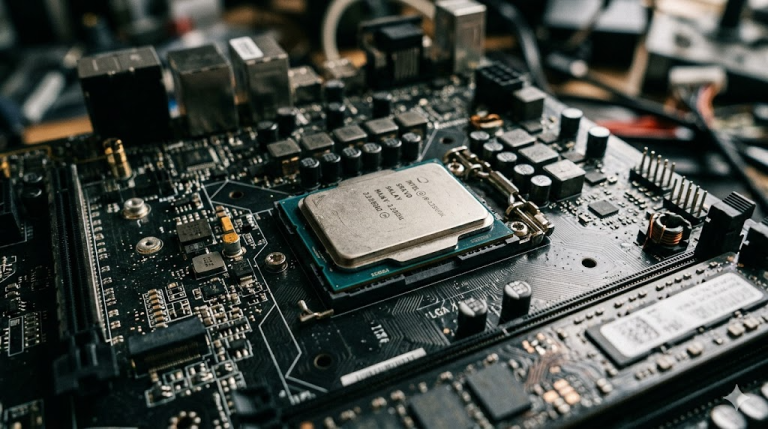
The foundation of this leap is Apple’s proprietary Fusion Architecture [1]. Departing from the traditional monolithic die methodology utilized in previous laptop-class processors, Apple employed advanced packaging techniques to bond two independent, third-generation 3-nanometer dies into a single System on a Chip (SoC) [2]. This dual-die approach utilizes a high-bandwidth, low-latency interconnect that enables unprecedented component density without the thermal throttling and manufacturing yield issues that typically constrain large-scale silicon production [3].
The architectural significance of Fusion cannot be overstated. Traditional chip scaling faces fundamental physical limits — as individual dies grow larger, manufacturing defect probability increases exponentially, driving yields down and costs up. By distributing computation across two optimized, smaller dies connected via a high-speed bridge, Apple circumvents these physical constraints while achieving the aggregate transistor count and computational throughput of a hypothetical single massive die [3].
Per-Core Neural Accelerators: The Architectural Breakthrough
Both the M5 Pro and M5 Max share an identical 18-core CPU layout, featuring six high-performance “super cores” and twelve efficiency-focused performance cores [2]. The defining differentiation between the Pro and Max tiers lies in the GPU structure and a revolutionary change to how machine learning computation is physically organized on the chip.
Apple has abandoned the strategy of relying solely on a sequestered, system-level Neural Engine for machine learning operations. Instead, the M5 series embeds a dedicated Neural Accelerator directly into every individual GPU core [2]. The M5 Pro scales up to 20 GPU cores, while the M5 Max doubles this capacity to 40 individual cores — yielding a configuration where 40 discrete Neural Accelerators operate in parallel [2].
This structural redesign delivers up to a four-fold increase in peak AI computational capability compared to the M4 generation, and an eight-fold increase relative to the M1 series that initiated Apple’s silicon transition [1]. The distributed architecture eliminates the centralized bottleneck of the legacy Neural Engine, where AI workloads competed for cycles on a shared, fixed-capacity resource. With per-core accelerators, AI computation scales linearly with GPU core count.
Apple Silicon Generational Evolution
| Specification | M5 Max | M5 Pro | M4 Max (Legacy) |
|---|---|---|---|
| CPU Cores | 18 (6S + 12E) | Up to 18 | Up to 16 |
| GPU Cores | 40 (w/ Neural Acc.) | Up to 20 | 40 (no per-core acc.) |
| Neural Accelerators | 40 (per-core) | 20 (per-core) | Centralized only |
| Max Unified Memory | 128 GB | 64 GB | 128 GB |
| Memory Bandwidth | 614 GB/s | 307 GB/s | 546 GB/s |
| SSD Read/Write | 14.5 GB/s | 14.5 GB/s | ~7.4 GB/s |
| Process Node | 3nm (Fusion dual-die) | 3nm (Fusion) | 3nm (monolithic) |
Breaking the Memory Wall: Bandwidth as the True Bottleneck
Local model execution is historically constrained not by raw processing power, but by the “memory wall” — the speed at which massive weight matrices can be shuttled between storage and the processor. A model with 70 billion parameters stored at 4-bit quantization requires approximately 35 GB of memory, but the inference speed is determined entirely by how quickly those weights can reach the compute units during each token generation step.
Apple addressed this bottleneck with expanded unified memory bandwidth: 307 GB/s on the M5 Pro and an astonishing 614 GB/s on the M5 Max [2]. For context, the previous-generation M4 Max delivered 546 GB/s — the M5 Max represents a 12.5 percent improvement in raw bandwidth, achieved through the Fusion Architecture’s dual-die interconnect optimizations.
Furthermore, the underlying solid-state drive architecture was upgraded to deliver read/write speeds of up to 14.5 GB/s — roughly double the throughput of previous generations [2]. This SSD enhancement matters for model loading: a 70 GB quantized model loads from storage to unified memory in under five seconds, compared to nearly ten seconds on the M4 generation.
Apple Silicon Max-Tier: Memory Bandwidth Progression
Local Inference: The Economic Disruption
The combination of massive memory pools, extreme bandwidth, and distributed Neural Accelerators transforms the laptop from a consumption device into a localized inference server. Software engineers and data scientists can now host deeply quantized, multi-billion parameter models locally, executing complex agent-driven operations with absolute data privacy, zero API latency, and zero ongoing token costs [5].
Consider the economic arithmetic. An enterprise running Claude Opus 4.6 at standard pricing processes approximately 150 million tokens per month for a team of 20 engineers. At $5.00/$25.00 per million tokens (input/output), assuming a 1:3 input-to-output ratio, the monthly API expenditure approaches $12,000. Equipping those same engineers with M5 Max MacBook Pros running quantized open-weight models eliminates the recurring token cost entirely after the initial hardware investment.
This shift directly challenges the economic models of cloud AI providers by severing the reliance on continuous internet connectivity for advanced inference [1]. The 128 GB unified memory of the M5 Max can host models up to approximately 100 billion parameters at 8-bit quantization — comfortably accommodating highly capable open-weight models like Llama 3.1 405B at aggressive 4-bit quantization or Qwen 2.5 72B at full 16-bit precision.
“The M5 Max’s 614 GB/s memory bandwidth and 40 per-core neural accelerators effectively transform every MacBook Pro into a private, zero-latency inference server — no cloud required.”
— Apple Newsroom, M5 Architecture Announcement, Mar. 3, 2026 [1]
Data Sovereignty and Privacy Implications
Beyond pure economics, local inference addresses a critical enterprise concern: data sovereignty. Organizations in healthcare, defense, financial services, and legal practice frequently cannot transmit proprietary data to external API endpoints due to regulatory constraints (HIPAA, ITAR, GDPR) or internal data governance policies.
The M5 Max enables these organizations to run frontier-class intelligence entirely within their physical security perimeter. A hospital system can process patient records through a locally hosted medical language model without any data leaving the facility. A defense contractor can analyze classified technical documents using on-device inference without exposing content to third-party servers. This architectural capability transforms AI from a cloud service requiring data transmission to an internal computational resource operating within existing security frameworks.
The Developer Ecosystem Impact
The M5 silicon family accelerates a parallel trend in AI development: the rise of sophisticated local development environments. Software engineers building AI-powered applications can now iterate on model selection, prompt engineering, and pipeline architecture entirely locally — testing against quantized models at interactive speeds without incurring API costs during the development cycle [5].
The elevated SSD speeds (14.5 GB/s) further enhance developer workflow by enabling rapid model swapping. An engineer evaluating whether a 7B, 13B, or 70B parameter model best suits their application can load each variant from storage in seconds rather than minutes, dramatically accelerating the experimentation cycle that precedes production deployment decisions.
Key Takeaways
- 4x AI Performance Leap: Per-core Neural Accelerators embedded in every GPU core deliver a four-fold AI throughput increase over M4, scaling linearly with core count [1].
- 614 GB/s Memory Bandwidth: The M5 Max’s memory wall breakthrough enables real-time inference on multi-billion parameter models at interactive token generation speeds [2].
- Fusion Architecture Innovation: Dual 3nm dies bonded via high-speed interconnect circumvent manufacturing yield constraints while achieving massive aggregate transistor counts [2][3].
- Cloud Dependency Disrupted: 128 GB unified memory supports quantized models up to ~100B parameters locally — eliminating recurring API costs and enabling complete data sovereignty [5].
- 2x SSD Throughput: 14.5 GB/s read/write enables sub-5-second loading of 70 GB quantized models, accelerating developer experimentation cycles [2].
References
- [1] “Apple debuts M5 Pro and M5 Max to supercharge the most demanding pro workflows,” Apple Newsroom, Mar. 3, 2026, accessed Mar. 6, 2026. [Online]. Available: https://www.apple.com/newsroom/2026/03/apple-debuts-m5-pro-and-m5-max-to-supercharge-the-most-demanding-pro-workflows/
- [2] “Apple Unveils MacBook Pro Featuring M5 Pro and M5 Max Chips With New Fusion Architecture,” MacRumors, Mar. 3, 2026, accessed Mar. 6, 2026. [Online]. Available: https://www.macrumors.com/2026/03/03/apple-unveils-macbook-pro-with-m5-pro-and-m5-max-chips-with-neural-accelerators/
- [3] “10 things to know about Apple’s new M5 Pro and M5 Max MacBook Pros,” Popular Science, Mar. 3, 2026, accessed Mar. 6, 2026. [Online]. Available: https://www.popsci.com/gear/apple-m5-pro-max-chips-macbook-pros-details/
- [4] “MacBook Pro — Tech Specs,” Apple, Mar. 2026, accessed Mar. 6, 2026. [Online]. Available: https://www.apple.com/macbook-pro/specs/
- [5] “Apple M5 Pro & M5 Max just announced. Here’s what it means for local AI,” Reddit r/LocalLLaMA, Mar. 3, 2026, accessed Mar. 6, 2026. [Online]. Available: https://www.reddit.com/r/LocalLLaMA/comments/1rk7n3u/apple_m5_pro_m5_max_just_announced_heres_what_it/
- [6] “How M5 Pro and M5 Max push MacBook Pro into high-bandwidth AI era,” AppleInsider, Mar. 3, 2026, accessed Mar. 6, 2026. [Online]. Available: https://appleinsider.com/articles/26/03/03/how-m5-pro-and-m5-max-push-macbook-pro-into-high-bandwidth-ai-era
- [7] “7 Wild Things About the New MacBook Pro That Sound Made Up,” The Gadgeteer, Mar. 3, 2026, accessed Mar. 6, 2026. [Online]. Available: https://the-gadgeteer.com/2026/03/03/7-wild-things-about-the-new-macbook-pro-that-sound-made-up/