
Philippine Fuel Crisis 2026: How a Persian Gulf War Transmits Inflation to Manila
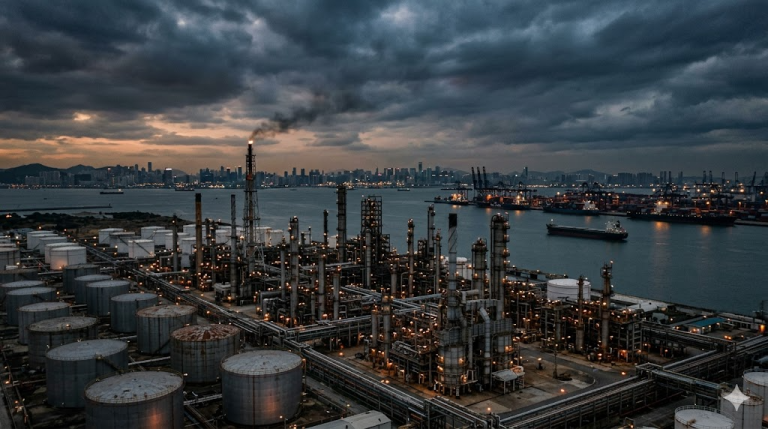
The Philippines sourced 96.8% of its crude oil imports from the Middle East in 2024. When the Strait of Hormuz was effectively blockaded following the February 2026 Iran strikes, the $4–$10 geopolitical risk premium on Brent crude transmitted instantly into Philippine pump prices — triggering the 9th consecutive weekly fuel hike, threatening the 5.7% GDP growth forecast, and forcing PHP 3 billion in emergency subsidies. This is how a missile strike in Tehran becomes inflation in Manila.
The Mathematics of Energy Dependence
The Philippines is a net importer of petroleum products, structurally defenseless against external supply shocks. Philippine Department of Energy (DOE) data reveals that the country sourced an overwhelming 96.8 percent of crude oil imports directly from the Middle East in 2024. [1]
While the Philippines does not directly import Iranian crude due to pre-existing international sanctions, the deeply interconnected nature of the global petroleum system guarantees that the $4–$10 geopolitical risk premium on Brent crude bleeds instantly into domestic pricing via the Mean of Platts Singapore (MOPS) benchmark — the reference price for all petroleum imports into the Philippines. [1]
Senator Win Gatchalian, chair of the Senate Energy Committee, publicly called for immediate government intervention to “safeguard Philippine energy security amid Iran unrest,” underscoring the acute vulnerability of the nation’s energy supply chain. [1]
Nine Consecutive Weeks of Price Hikes
The DOE’s Oil Industry Management Bureau, monitoring the MOPS benchmark, announced heavy upward adjustments at the domestic pump for early March 2026: [2][3]
- Gasoline: +PHP 1.10 to PHP 1.60 per liter
- Diesel: +PHP 0.50 to PHP 1.00 per liter
- Kerosene: +PHP 0.90 per liter
This represented the ninth consecutive weekly price hike for diesel and kerosene since the start of 2026, compounding the financial strain on both the civilian populace and industrial sectors that rely on diesel-powered transportation and machinery. [2]
Domestic Pump Price Increases and Economic Impact
| Metric | Value | Impact |
|---|---|---|
| Middle East Import Reliance | 96.8% | Near-total dependency on Gulf crude |
| Gasoline Price Hike | +PHP 1.10–1.60/L | Direct consumer impact |
| Diesel Price Hike | +PHP 0.50–1.00/L | Transport + agriculture cost escalation |
| Kerosene Price Hike | +PHP 0.90/L | Off-grid community impact |
| Consecutive Weekly Hikes (Diesel) | 9 weeks | Persistent, compounding inflation |
| Pre-Crisis GDP Forecast | 5.7% (ADB) | At risk of downward revision |
| Pre-Crisis Inflation Forecast | 2.8%–3.0% (BSP) | May breach 4% target ceiling |
Threat to the 5.7% GDP Growth Trajectory
Before the Iran strikes, the Philippine macroeconomic outlook was positive. The Asian Development Bank (ADB) and the Bangko Sentral ng Pilipinas (BSP) forecast robust GDP growth of 5.7 percent for 2026 — one of the highest in Southeast Asia. Baseline inflation was expected at a manageable 2.8–3.0 percent, within the government’s 2.0–4.0% target band. [4]
The oil price shock threatens to derail both projections simultaneously. Energy costs function as a universal input across the entire economy. A sustained crude oil spike elevates electricity generation costs — particularly acute for the Philippines’ off-grid areas that rely on expensive, diesel-fed power plants operated by the National Power Corporation–Small Power Utilities Group (NPC-SPUG). [1]
The ADB explicitly warned that “external headwinds, shifting global economic policies, and highly volatile commodity prices” represent the primary downside risks to the nation’s growth narrative. If Brent crude approaches $100 per barrel under the sustained disruption scenario, the BSP may be forced to abandon its accommodative monetary stance and raise interest rates to combat imported inflation — choking off domestic demand and inducing stagflation. [4]
“A precision airstrike on a compound in Tehran forces rapid sovereign debt utilization and emergency fiscal deployment in Manila simply to prevent systemic economic failure at the municipal level. This is the asymmetry of modern geopolitical crises.”
— Emerging market analysis, March 2026 [1][4]
Emergency Fiscal Interventions: PHP 3 Billion in Subsidies
The Philippine government, through the Development Budget Coordination Committee (DBCC), authorized immediate fiscal interventions to prevent economic cascade failure: [5]
Transport Fuel Subsidy — PHP 2.5 Billion: Administered by the Department of Transportation (DOTr), this program provides targeted fuel vouchers to over 377,000 qualified Public Utility Vehicle (PUV) drivers, including operators of public jeepneys, taxis, and ride-hailing services. The intervention aims to prevent nationwide transport strikes that would paralyze the urban economy. [5]
Agricultural Fuel Subsidy — PHP 500 Million: The Department of Agriculture (DA) allocated specialized fuel discounts targeting vulnerable farmers and fisherfolk, subsidizing the soaring operational costs of agricultural machinery and marine vessels in an attempt to sever the link between rising global oil prices and domestic food inflation. [5]
Lawmakers proposed additional emergency measures, including tapping into a PHP 4.5 billion contingency fund and a PHP 3.0 billion presidential socio-civic fund, while exploring conditional state of calamity declarations in highly vulnerable, fuel-dependent fishing communities. [6]
Philippine Government Fuel Crisis Interventions
| Program | Amount | Target Beneficiaries |
|---|---|---|
| Transport Fuel Subsidy (DOTr) | PHP 2.5 Billion | 377,000+ PUV drivers (jeepneys, taxis, ride-hail) |
| Agriculture Fuel Subsidy (DA) | PHP 500 Million | Farmers, fisherfolk, agricultural machinery operators |
| Contingency Fund (Proposed) | PHP 4.5 Billion | Broader emergency relief |
| Presidential Socio-Civic Fund (Proposed) | PHP 3.0 Billion | Vulnerable fishing communities |
The Transmission Chain: Tehran to Tondo
The Philippine fuel crisis perfectly illustrates the asymmetric transmission of geopolitical shocks from advanced military theaters to vulnerable developing economies. The causal chain is direct and unbreakable:
- Military strike in Tehran → IRGC declares Strait of Hormuz blockade
- Blockade threat → $4–$10/bbl geopolitical risk premium on Brent crude
- Brent premium → MOPS benchmark rises → Philippine pump prices increase
- Fuel cost increase → Transport costs rise → Food prices rise
- Food inflation → BSP considers rate hikes → GDP growth at risk
- Government response → Emergency subsidies → Sovereign debt increases
Each link in this chain is mathematically deterministic. The only variable is magnitude, which depends on the duration and severity of the Hormuz disruption. For a nation that imports 96.8% of its crude from the theater of active conflict, there is no diversification strategy that can mitigate this structural vulnerability in the short term.
The broader lesson extends beyond the Philippines to every import-dependent emerging economy in Southeast Asia and the Pacific. The February 2026 crisis has demonstrated that energy sovereignty is not a policy preference — it is a national security imperative.
Sources
- [1] “Safeguard PH energy security amid Iran unrest — Gatchalian,” https://www.pna.gov.ph/articles/1268154. [Online]. Available: https://www.pna.gov.ph/articles/1268154. [Accessed: 2026-03-02].
- [2] “Another oil price hike looms in March,” https://news.abs-cbn.com/news/business/2026/2/27/another-oil-price-hike-come-march-0802. [Online]. Available: https://news.abs-cbn.com/news/business/2026/2/27/another-oil-price-hike-come-march-0802. [Accessed: 2026-03-02].
- [3] “Oil firms extend price hike in March,” https://qa.philstar.com/headlines/2026/02/28/2510990/oil-firms-extend-price-hike-march. [Online]. Available: https://qa.philstar.com/headlines/2026/02/28/2510990/oil-firms-extend-price-hike-march. [Accessed: 2026-03-02].
- [4] “Philippine GDP Seen on a Steady Growth Path in 2025,” https://www.adb.org/news/philippine-gdp-seen-steady-growth-path-2025-2026. [Online]. Available: https://www.adb.org/news/philippine-gdp-seen-steady-growth-path-2025-2026. [Accessed: 2026-03-02].
- [5] “DBCC Statement on the Government’s Response to Rising Fuel Prices,” https://www.dbm.gov.ph/index.php/management-2/455-dbcc-statement-on-thegovernments-response-to-rising-fuel-prices. [Online]. Available: https://www.dbm.gov.ph/index.php/management-2/455-dbcc-statement-on-thegovernments-response-to-rising-fuel-prices. [Accessed: 2026-03-02].
- [6] “Lawmakers propose oil price hike mitigations,” https://newsinfo.inquirer.net/1560071/lawmakers-propose-oil-price-hike-mitigations. [Online]. Available: https://newsinfo.inquirer.net/1560071/lawmakers-propose-oil-price-hike-mitigations. [Accessed: 2026-03-02].