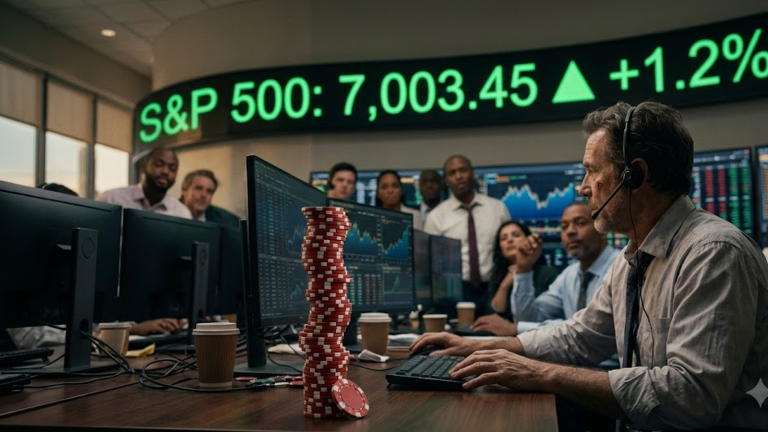

S&P 500 Rotation: Stagflation Risks and the Institutional Flight to Value
Hot PPI data, AI-driven labor displacement, and surging commodity prices have shattered the soft-landing narrative—forcing institutional capital into a violent reallocation from mega-cap technology into energy, materials, and consumer defensives.
Q1 2026 Market Snapshot
↑ vs 2.6% consensus [1]
↑ vs 0.3% forecast [1]
↑ Rolling 3-month [2]
↓ Multiple compression [2]
The Inflation Resurgence and the Collapse of the Soft Landing
The macroeconomic narrative governing the S&P 500 was decisively rewritten in February 2026 following the release of Producer Price Index (PPI) data that dramatically exceeded consensus estimates. The year-over-year PPI accelerated to 2.9%, significantly overshooting the 2.6% median forecast compiled by Bloomberg economists [1]. More critically, core PPI—which strips out volatile food and energy components to expose underlying supply-chain inflation—surged 0.8% on a month-over-month basis, nearly tripling the 0.3% forecast [3].
This inflationary resurgence extends across the entire commodities complex. Precious metals including gold, silver, and platinum have tested multi-year or all-time highs, while agricultural staples like live cattle have surged on tight supply dynamics [1]. Crude oil prices spiked 15% in January 2026 alone, injecting severe headwinds into global logistics and manufacturing cost structures [1]. The prevailing “soft landing” hypothesis—which presumed the Federal Reserve could normalize interest rates without triggering a recession—has been severely undermined by this data.
The 10-year U.S. Treasury yield exhibited anomalous behavior by dipping below the 4% threshold despite these excessively hot inflation prints [1]. This divergence—where hot inflation meets falling long-end yields—indicates that bond markets are pricing in a rapid deterioration of macroeconomic health, creating the conditions for a stagflationary environment where the Federal Reserve is constrained from cutting rates without risking an acceleration of inflation.
Structural Unemployment and the AI Efficiency Paradox
The stagflationary pressure is compounded by a structural shift in the U.S. labor market driven by aggressive corporate adoption of artificial intelligence. A bellwether event occurred when fintech firm Block announced the termination of approximately half its workforce to pivot toward AI-driven operational efficiency [1]. While equity markets initially rewarded the cost-cutting—Block’s stock surged 20% on the announcement—the long-term macroeconomic feedback loop is highly destructive [1].
Consumer spending drives approximately 70% to 80% of the U.S. economy [4]. As major corporations systematically substitute human capital with AI infrastructure, aggregate purchasing power inevitably diminishes. This dynamic creates a severe macroeconomic paradox: the efficiency gains realized by individual technology conglomerates are beginning to disconnect from—and actively harm—the long-term health of the broader economy [1].
The emergence of structural unemployment tied directly to AI integration differentiates the current labor environment from cyclical downturns. Unlike temporary layoffs during a recession, positions eliminated through AI replacement may not return when economic conditions improve, creating a permanent reduction in the labor force participation rate among mid-skill knowledge workers.
S&P 500 Q1 2026 Sector Rotation (Rolling 3-Month)
The Bifurcation of Equities: Distribution Patterns and Exit Liquidity
Capital is aggressively fleeing the technology sector as the S&P 500 displays classic institutional distribution patterns, characterized by a “rounded top” formation and heavy technical resistance near the 7,000-point threshold [1]. Institutional trading desks are systematically offloading major technology positions to retail investors attempting to “buy the dip” on legacy momentum stocks.
Nvidia, the primary hardware engine of the AI boom, serves as the ultimate proxy for this market exhaustion. Despite reporting a massive earnings and revenue beat with raised forward guidance, Nvidia’s stock plunged 5.5% in post-earnings trading [1]. The broader technology sector slumped 1.8% in a single session due to Nvidia’s drag, resulting in a $259 billion erasure of market capitalization—the stock’s biggest single-day decline since April 2025 [5].
Full-year 2026 earnings per share estimates for the S&P North American Technology Index have been cut by over 10% in just four weeks, marking the largest rate of change since the Federal Reserve-induced sell-off in December 2018 [6]. This demonstrates severe bear market behavior where positive fundamental news is fully priced in and utilized as exit liquidity by large institutional funds.
The Rotation Into “Real Economy” Value
Capital has rotated into sectors that produce tangible goods and essential services, driving a massive divergence in performance [2]. The Energy and Consumer Staples sectors—the worst relative performers from 2019 to 2025—have become the absolute leaders of early 2026. The prevailing market psychology dictates that physical assets, industrial machinery, and petrochemical refinement processes cannot be automated out of existence by large language models.
Companies such as Caterpillar and GE Vernova provide a tangible economic moat that high-multiple software companies currently lack [2]. However, this rotation has pushed many value sectors into the 99th percentile of relative performance extremes, leading analysts at NewEdge Wealth to warn of potential buyer exhaustion in real estate and utilities as these traditionally defensive sectors begin trading with growth-like volatility [4].
Morgan Stanley strategists note that the “Magnificent Seven” technology giants are all individually underperforming the broader S&P 500 year-to-date for the first time since 2022 [7]. This simultaneous underperformance across all seven names signals a structural regime change rather than idiosyncratic weakness in any single company.
Value vs Growth: Q1 2026 Investment Thesis
| Factor | Value / Cyclicals | Growth / Tech |
|---|---|---|
| Q1 2026 Performance | +20% to +26% | -2% to flat |
| Inflation Sensitivity | Positive (pricing power) | Negative (multiple compression) |
| AI Disruption Risk | Low (physical assets) | High (seat-based models) |
| Earnings Revisions | Upward | -10% in 4 weeks |
| Institutional Flow | Net accumulation | Net distribution |
| Valuation Risk | Approaching 99th percentile | Entering undervalued |
Federal Reserve Policy Constraints
The convergence of hot inflation, slowing growth indicators, and structural labor displacement creates an historically rare policy trap for the Federal Reserve. The central bank faces a classic stagflationary constraint: cutting rates to support employment and growth would risk re-accelerating inflation that is already running above target, while maintaining restrictive monetary policy would deepen the economic slowdown being amplified by AI-driven workforce reductions.
Bond market pricing reflects this dilemma. The anomalous decline in the 10-year Treasury yield below 4%—simultaneous with above-consensus inflation data—suggests fixed income markets are positioning for a growth shock that will ultimately force the Fed’s hand regardless of inflation readings [1]. Investors are pricing in an eventual capitulation where economic deterioration compels rate cuts despite persistent price pressures.
For equity investors, this translates to a historically unusual environment where traditional asset allocation models based on the inverse correlation between stocks and bonds may prove unreliable. Both asset classes could face simultaneous pressure if the stagflationary scenario fully materializes during the second half of 2026.
“Physical assets, industrial machinery, and petrochemical refinement cannot be coded out of existence by large language models. The market is returning to fundamental durability over speculative growth.”
— Morningstar Equity Research, February 2026 [2]
Macro Signals Dashboard
↑ Supply constraints [1]
↓ Growth fear signal [1]
↓ Single session [5]
↓ 4-week rate of change [6]
Key Takeaways
- Inflation is entrenched: Core PPI at 0.8% MoM (nearly 3x the forecast) signals supply-chain price pressures that cannot be dismissed as transitory.
- Stagflation risk is real: The divergence between hot inflation and declining long-end Treasury yields indicates bond markets are pricing in simultaneous economic deterioration and persistent price pressure.
- AI-driven unemployment accelerates the paradox: Corporate efficiency gains from AI workforce replacement threaten to erode the consumer spending base that sustains 70-80% of U.S. GDP.
- Value rotation may be overextended: While fundamental logic supports real-economy assets, many value sectors have reached 99th-percentile relative performance extremes, warranting caution on late entries.
- Tech is not dead, but repricing: Information Technology is entering undervalued territory for the first time since 2022, potentially creating asymmetric opportunities for patient capital once the macro regime stabilizes.
References
- [1] “My Trading Game Plan Revealed – 02/27/2026: Hot PPI, AI Layoffs and S&P Distribution Signal Market Risk,” Verified Investing, Feb. 27, 2026. [Online]. Available: https://verifiedinvesting.com/blogs/live-show-recap/my-trading-game-plan-revealed-02-27-2026-hot-ppi-ai-layoffs-and-s-p-distribution-signal-market-risk
- [2] “6 Stocks Driving the 2026 US Stock Market Rotation,” Morningstar Europe, accessed Feb. 28, 2026. [Online]. Available: https://global.morningstar.com/en-eu/stocks/6-stocks-driving-2026-us-stock-market-rotation
- [3] “US Open: Rising oil and PPI pressure Wall Street,” XTB Market Analysis, accessed Feb. 28, 2026. [Online]. Available: https://www.xtb.com/int/market-analysis/news-and-research/us-open-rising-oil-and-ppi-pressure-wall-street-technology-and-financial-stocks-drop
- [4] “Fake Plastic Trees,” NewEdge Wealth Market Commentary, accessed Feb. 28, 2026. [Online]. Available: https://www.newedgewealth.com/fake-plastic-trees/
- [5] “Why the S&P 500 was doomed to fall when Nvidia plunged after its earnings,” Morningstar / MarketWatch, Feb. 26, 2026. [Online]. Available: https://www.morningstar.com/news/marketwatch/20260226466/why-the-sp-500-was-doomed-to-fall-when-nvidia-plunged-after-its-earnings
- [6] “AI Market Narrative: From Bubble Fears to Disruption Risk,” LPL Financial Weekly Market Commentary, accessed Feb. 28, 2026. [Online]. Available: https://www.lpl.com/research/weekly-market-commentary/ai-market-narrative-from-bubble-fears-to-disruption-risk.html
- [7] “Every Magnificent Seven Stock Is Underperforming the S&P 500 in 2026,” The Motley Fool, Feb. 26, 2026. [Online]. Available: https://www.fool.com/investing/2026/02/26/buy-magnificent-seven-stock-2026/
- [8] “Why Good News Isn’t Moving Stocks,” Morgan Stanley Insights, accessed Feb. 28, 2026. [Online]. Available: https://www.morganstanley.com/insights/articles/magnificent-seven-rotation-portfolio-strategies-2026
- [9] “Sector Rotation Intensifies: Value Outperforms Growth in 2026 Market Split,” Investing.com, accessed Feb. 28, 2026. [Online]. Available: https://www.investing.com/analysis/sector-rotation-intensifies-value-outperforms-growth-in-2026-market-split-200675093