Triplet Superconductors: How the NbRe Alloy Discovery Unlocks Energy-Efficient Quantum Computing
Physicists at Norway’s NTNU and the QuSpin research center have experimentally identified the Niobium-Rhenium (NbRe) alloy as a triplet superconductor — a material that transports both electricity and electron spin with zero resistance at 7 Kelvin. The discovery enables Majorana fermion-based topological quantum computing, offering unprecedented fault tolerance and slashing the energy demands of quantum hardware.
NbRe Triplet Superconductor: Key Parameters
↑ Significantly above alternative candidates [1]
→ Zero-loss charge + spin transport [1]
→ Superconductor logic benchmark [5]
→ Physical Review Letters [1]
The Energy Bottleneck of Classical Computing
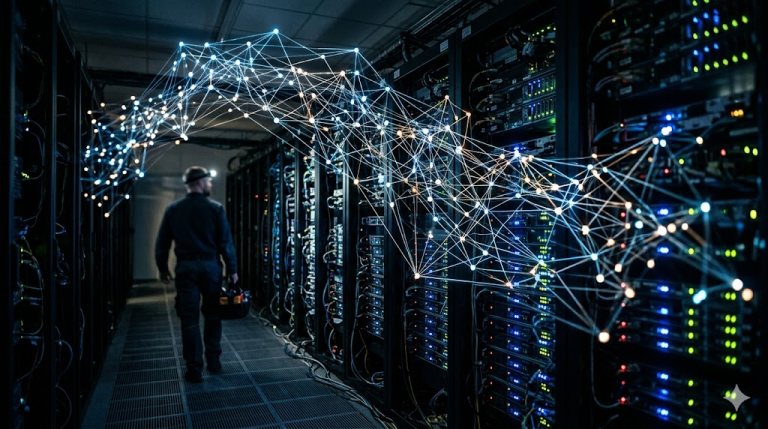
The fundamental limitation constraining the evolution of modern computational architecture is energy dissipation. Every transfer of electronic data through the conductive materials that form the backbone of classical silicon processors is intrinsically coupled to electrical resistance. This resistance generates immense waste heat — a thermodynamic tax that demands ever-larger cooling infrastructure and consumes escalating quantities of electrical power as transistor density increases. [5]
As the computational demands of artificial intelligence models, large-scale climate simulations, and cryptographic systems scale exponentially, the energy requirements of classical data centers are rapidly approaching the absolute limits of global power grid infrastructure and thermal management capabilities. The International Energy Agency has flagged data center electricity consumption as one of the fastest-growing components of global energy demand, with AI workloads projected to be a primary driver of growth through the end of the decade. [5]
Classical superconductors — formally known as singlet superconductors — partially address the resistance problem. In a singlet superconducting state, electrons pair up with opposite spins and flow through the material with zero electrical resistance, eliminating energy loss from charge transport. However, this solution introduces a critical limitation for advanced computational applications: because the paired electrons in singlet superconductors have opposing spins that cancel each other out, these materials can transport electrical charge but are incapable of transporting spin currents — a constraint that makes them fundamentally inadequate for the spin-based information encoding required by quantum bits (qubits). [1]
The Triplet Superconductor Breakthrough
The distinction between singlet and triplet superconductivity is atomic and profound. In a conventional singlet superconductor, the Cooper pairs — the bound electron pairs responsible for the superconducting state — consist of electrons with antiparallel spins: one spin-up and one spin-down. The opposite spins cancel, producing a net spin of zero. This is why singlet superconductors can carry charge currents without resistance but cannot carry spin currents. [1]
In a triplet superconducting state, the fundamental physics changes. The Cooper pairs consist of electrons with parallel, aligned spins — both spin-up or both spin-down — producing a net non-zero spin. [1] The profound consequence of this unique atomic architecture is that the material can simultaneously transport both electrical currents and continuous spin currents with absolutely zero resistance. This dual zero-loss transport capability has been the “holy grail” of quantum materials science for decades, because it enables a new paradigm of information processing where data is encoded not in electrical charge but in the spin state of electrons — the field known as spintronics. [2]
The experimental findings, published in Physical Review Letters by physicists at the Norwegian University of Science and Technology (NTNU) and the QuSpin Center for Quantum Spintronics, report the successful identification of the alloy Niobium-Rhenium (NbRe) as a material exhibiting properties entirely consistent with triplet superconductivity. [1] The research team, through meticulous low-temperature experiments and spectroscopic analysis, demonstrated that the electron pairing in NbRe displays the characteristic signatures of the triplet state — a finding that the global scientific community has widely characterized as a breakthrough. [2]
Singlet vs. Triplet Superconductors: Fundamental Properties
| Property | Singlet Superconductors | Triplet Superconductors (NbRe) |
|---|---|---|
| Electron Spin Alignment | Antiparallel (opposing spins) | Parallel (aligned spins) |
| Net Spin of Cooper Pair | Zero | Non-zero |
| Charge Current Transport | Zero resistance | Zero resistance |
| Spin Current Transport | Not supported | Zero resistance |
| Majorana Fermion Support | No | Yes — enables topological qubits |
| Spintronics Application | Limited | Direct — zero-loss spin logic |
The Temperature Advantage: 7 Kelvin Accessibility
A critical practical advantage of the NbRe alloy discovery is its operational temperature profile. The material achieves and maintains the triplet superconducting state at a temperature of 7 Kelvin (−266.15°C). [1] While 7 Kelvin is still extremely cold by everyday standards, it represents a significant engineering advantage over alternative theoretical candidates for triplet superconductivity, many of which require cooling to temperatures at or below 1 Kelvin — a threshold that demands substantially more sophisticated and expensive cryogenic infrastructure.
The difference between maintaining a system at 7 Kelvin versus 1 Kelvin is not merely a factor of seven in temperature; it represents an order of magnitude reduction in the complexity and cost of the cooling apparatus. Standard dilution refrigerators capable of reaching millikelvin temperatures cost millions of dollars and require continuous helium-3 supply chains. [1] By contrast, commercial cryocoolers can reliably maintain temperatures well below 7 Kelvin using more accessible cooling technologies, dramatically lowering the barrier to experimental verification and future commercial deployment.
This temperature accessibility transforms triplet superconductivity from a purely theoretical curiosity into a viable candidate for engineering applications. Research groups worldwide can now design and test spintronic circuit prototypes using NbRe without requiring the most extreme cryogenic facilities, accelerating the transition from materials science discovery to functional quantum hardware. [4]
Majorana Fermions and Topological Quantum Computing
Beyond the immediate applications in energy-efficient spintronics, the triplet superconductor discovery addresses the most formidable obstacle in practical quantum computing: qubit decoherence and systemic instability. [1]
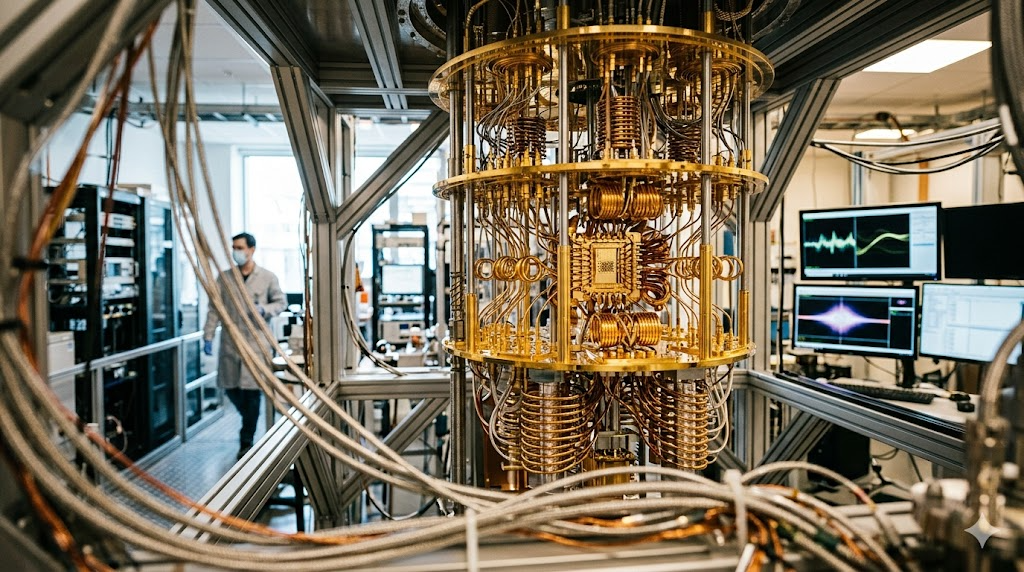
Modern quantum computers rely on qubits — quantum bits that exploit the principles of superposition and entanglement to perform massively parallel calculations. However, qubits are extraordinarily fragile. The slightest environmental perturbation — a stray electromagnetic field, a thermal fluctuation, a vibration from nearby mechanical equipment — can cause the delicate quantum state to collapse, a phenomenon known as decoherence. [5] Current quantum processors dedicate enormous overhead to error correction, with some architectures requiring thousands of physical qubits to maintain a single stable logical qubit.
Triplet superconductors offer a fundamentally different approach to stability. The unique spin properties of the triplet state facilitate the creation of an exotic physics phenomenon known as a Majorana fermion — a particle that acts as its own antiparticle. [1] Because a Majorana particle is its own antiparticle, it possesses a unique topological protection: the quantum information encoded in a pair of spatially separated Majorana fermions is stored non-locally, meaning it cannot be disrupted by any localized environmental noise. [2]
Integrating Majorana particles into quantum gates enables topological quantum computing — a paradigm where quantum operations are performed by braiding Majorana fermions around each other. The computational result depends on the topological path of the braiding, not on the precise physical state of any individual particle. [1] This topological encoding makes the computation inherently immune to most forms of decoherence, fundamentally mitigating the error-correction bottleneck that has limited the scalability of all existing quantum computing architectures.
“The triplet superconducting state is the missing link for quantum computers. It enables the creation of Majorana particles that provide fault-tolerant computation — the holy grail of practical quantum hardware.”
— Based on NTNU/QuSpin research characterization [1][2]
Implications for Superconductor Circuit Architecture
The NbRe discovery also addresses critical limitations in classical superconductor digital circuits. Current superconductor-based computing, positioned as an alternative to CMOS silicon for specialized high-performance applications, suffers from low integration density — the number of logic elements that can be packed onto a single chip. [5]
Logic cells based on energy-efficient rapid single-flux quantum (ERSFQ) technology, particularly MAGIC (Memory And loGIC) circuits, have demonstrated clock rates exceeding 100 GHz — orders of magnitude faster than the most advanced CMOS processors. [5] However, these circuits are highly sensitive to environmental noise and suffer from the limited computational states available in singlet superconductor devices. The addition of spin-current capability through triplet superconductors opens entirely new logic element designs that combine the speed advantages of superconductor circuits with the state-rich information encoding of spintronics.
This convergence has immediate implications for artificial intelligence hardware. The massive matrix multiplication operations that form the computational backbone of neural network training and inference are ideal candidates for spintronic acceleration, where the parallel spin states of quasiparticles can represent and process multiple tensor dimensions simultaneously with zero energy dissipation. [4]
The Road from Laboratory to Application
Despite the significance of the NbRe discovery, the path from materials science breakthrough to commercial quantum hardware requires multiple intermediate stages. The NTNU team has demonstrated that NbRe exhibits properties consistent with triplet superconductivity, but fabricating functional spintronic circuits and Majorana-based qubits from the material demands extensive additional engineering — including the development of reliable fabrication processes for NbRe thin films, the integration of NbRe junctions with existing quantum device architectures, and the demonstration of reproducible Majorana fermion signatures in controlled experiments. [1]
Nevertheless, the discovery fundamentally alters the strategic landscape for quantum computing research programs worldwide. Major quantum hardware companies, including IBM, Google, and Microsoft (which has explicitly invested in topological quantum computing through its StationQ research division), now have a concrete candidate material for engineering topological qubits. [4] The relatively accessible 7 Kelvin operating temperature lowers the barrier to independent verification by university research groups, accelerating the global scientific effort to confirm and extend the NTNU findings.
The discovery also carries implications for the sustainability of the technology sector. If spintronic quantum processors built on triplet superconductor materials can achieve the computational performance required for AI inference workloads while consuming a fraction of the energy required by classical silicon accelerators, the trajectory of data center power consumption — currently projected to exceed 1,000 terawatt-hours annually by 2030 — could be materially altered. [5]
Key Takeaways
- Holy grail identified: NTNU physicists experimentally verified triplet superconductivity in the NbRe alloy, enabling simultaneous zero-resistance transport of both electricity and spin currents. [1]
- 7 Kelvin accessibility: The NbRe critical temperature is significantly above alternative candidates, reducing cryogenic infrastructure costs and accelerating experimental verification. [1]
- Majorana fermion pathway: Triplet superconductors enable the creation of topologically protected Majorana qubits, potentially eliminating the dominant error-correction bottleneck in quantum computing. [1][2]
- Spintronics revolution: Zero-resistance spin transport opens new logic element designs that combine 100+ GHz superconductor speeds with spin-based information encoding. [4][5]
- Energy sustainability: Spintronic quantum processors could dramatically reduce the energy demands of AI workloads compared to classical silicon accelerators. [5]
- Industry impact: Major quantum computing programs, including Microsoft’s topological qubit initiative, now have a concrete candidate material for engineering fault-tolerant quantum hardware. [4]
References
- [1] “Physicists may have found the missing link for quantum computers,” Norwegian SciTech News, Feb. 2026. [Online]. Available: https://norwegianscitechnews.com/2026/02/physicists-may-have-found-the-missing-link-for-quantum-computers/
- [2] “Scientists may have found the holy grail of quantum computing,” ScienceDaily, Feb. 2026. [Online]. Available: https://www.sciencedaily.com/releases/2026/02/260221000252.htm
- [3] “Physicists may have found the missing link for quantum computers,” EurekAlert!, Feb. 2026. [Online]. Available: https://www.eurekalert.org/news-releases/1117229
- [4] “Triplet Superconductors: A Leap Toward Energy-Efficient Quantum Computing,” ICI Innolabs, Feb. 2026. [Online]. Available: https://www.innolabs.ro/ai-lens/2026-02-21-triplet-superconductors-a-leap-toward-energy-efficient-quantum-computing
- [5] “Beyond Moore’s technologies: operation principles of a superconductor alternative,” PMC/National Library of Medicine, 2018. [Online]. Available: https://pmc.ncbi.nlm.nih.gov/articles/PMC5753050/
- [6] “Matter & Energy News,” ScienceDaily, Feb. 2026. [Online]. Available: https://www.sciencedaily.com/news/matter_energy/