
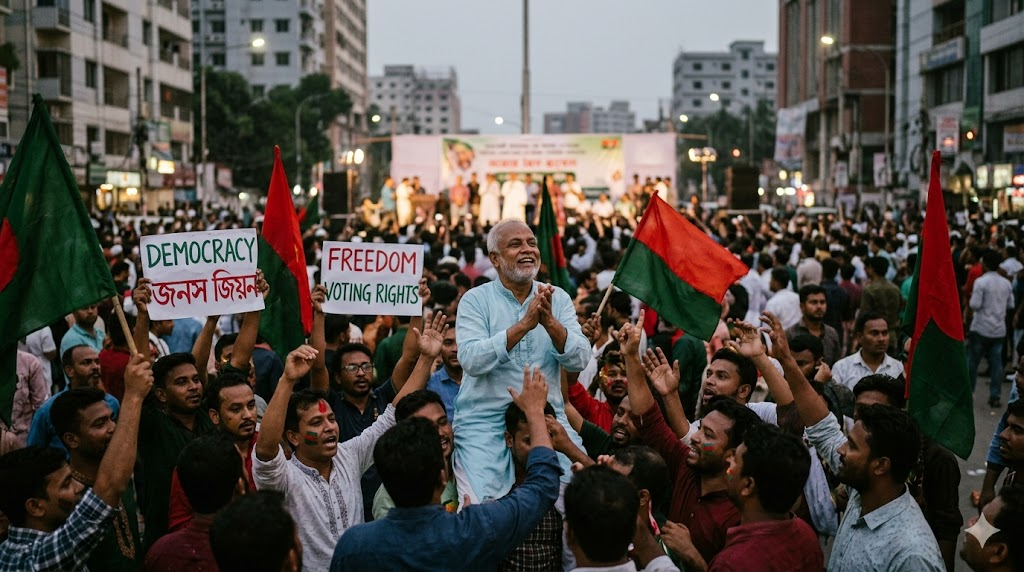
Bangladesh 2026 Elections: BNP Landslide, the July Charter, and South Asia’s Democratic Reset
The Bangladesh Nationalist Party secures 209 of 299 seats in the most consequential election in the nation’s history, while the July Charter referendum passes with 68.6% approval — enshrining prime ministerial term limits, a bicameral legislature, judicial independence, and the constitutional right to internet access.
Bangladesh Election Results: Key Metrics
↑ Two-thirds supermajority [1]
→ 64.8M men, 62.8M women, 1,200+ third-gender [1]
↑ +17.64 pp vs prior cycle [1]
↑ 48.2M “Yes” votes [1]
The Genesis: From Autocratic Collapse to Democratic Renewal
For fifteen years, Bangladesh was governed by Prime Minister Sheikh Hasina and the Awami League, an administration characterized by autocratic centralization, systemic suppression of political opposition, and democratic erosion. [1] This entrenched power structure violently collapsed in August 2024 following sustained, nationwide mass protests initially triggered by socio-economic grievances regarding government job quota systems, pervasive corruption, and chronic economic stagnation. [5]
The state’s response — a brutal security crackdown resulting in over 1,400 civilian deaths, internet blackouts, and mass arrests — ultimately forced Sheikh Hasina to resign and flee into exile in India, terminating the Awami League’s grip on power. [1]
Bangladesh then entered an eighteen-month transitional period overseen by Nobel laureate Muhammad Yunus. [8] This interim government, formed through consensus among student protest leaders, military officials, and civil society, was tasked with restoring public order et dismantling the former regime’s partisan apparatus. [8] The Awami League’s political registration was officially suspended under the Anti-Terrorism Act, effectively banning the party from the 2026 contest. [1]
Electoral Mechanics: The Largest Democratic Exercise of 2026
The February 12, 2026 elections encompassed over 127.7 million registered voters, including 64.8 million men, 62.8 million women, and over 1,200 officially recognized third-gender voters. [1] The interim government reinstated caretaker-style safeguards ensuring the neutrality of state administration throughout the polling period. [10]
The election was conducted across 42,766 permanent polling stations and 13 temporary facilities, using distinct ballots for parliamentary races and the concurrent constitutional referendum. [10] In a historic first, the electoral commission implemented mechanisms for diaspora participation alongside postal ballots for polling officials and detainees. [1]
Despite severe pre-election violence — at least sixteen political activists were assassinated during the campaign and multiple fatalities occurred on polling day from bombings and factional clashes — voter turnout reached 59.44%, a massive 17.64 percentage point increase from the boycotted, internationally condemned prior cycle. [1]
2026 Bangladesh Election: Seat Distribution
| Party / Alliance | Leader | Seats (of 299) | Popular Vote | Vote Share |
|---|---|---|---|---|
| Bangladesh Nationalist Party (BNP) | Tarique Rahman | 209 | 37,933,873 | 49.97% |
| Bangladesh Jamaat-e-Islami | Shafiqur Rahman | 68 | 24,109,762 | 31.76% |
| National Citizen Party (NCP) | Nahid Islam | 6 | 2,315,288 | 3.05% |
| Others / Independents | — | 16 | — | 15.22% |
Vote Distribution by Party
BNP’s Supermajority: The End of the “Two Begums” Era
The election results delivered a definitive political realignment, permanently closing the decades-long “Two Begums” era — the bitter dynastic rivalry between Sheikh Hasina and Khaleda Zia that defined Bangladeshi politics for decades. [2]
The BNP, led by Tarique Rahman who returned to Dhaka in December after over seventeen years in political exile in the United Kingdom, secured a commanding supermajority with 209 of 299 contested seats and nearly half of the popular vote (49.97%). [1] This two-thirds majority grants unprecedented legislative autonomy, structurally immunizing the government against coalition paralysis. [4]
The election also validated the dramatic resurgence of Bangladesh Jamaat-e-Islami, which secured 68 seats — its strongest parliamentary showing in the organization’s history, far surpassing previous peaks as a junior coalition partner. [1] The party’s gains were geographically diverse, spanning northern agrarian districts, southern coastal constituencies, and contested urban centers, indicating disciplined organizational mobilization rather than mere protest voting. [7]
The newly formed National Citizen Party (NCP) entered parliament with 6 seats under Nahid Islam, institutionalizing the 2024 youth uprising’s anti-establishment sentiment into formal legislative power. [1]
“Bangladesh’s election reveals a transformed political landscape. The BNP’s commanding majority, combined with Jamaat-e-Islami’s unprecedented showing and the entry of the youth-led NCP, creates a parliament fundamentally different from any in the nation’s history.”
— Chatham House, Bangladesh Election Analysis, February 2026 [9]
The July Charter: 47 Constitutional Amendments That Reshape Bangladesh
Running concurrently with the parliamentary vote, citizens voted on a historic “pink ballot” referendum regarding the July Charter, drafted by the interim government’s National Consensus Commission. [1] The Charter contains forty-seven constitutional amendments and passed with 68.59% approval (48.2 million “Yes” votes), creating a 180-working-day deadline for the new parliament to enact its provisions. [1]
Executive De-Centralization
The Charter strictly prohibits any individual from serving as Prime Minister for more than ten years. [1] The power to declare states of emergency is diluted, requiring explicit cabinet and opposition leader approval. Appointment powers for the Election Commission, Anti-Corruption Commission, Public Service Commission, and National Human Rights Commission are stripped from the Prime Minister and placed under independent, multi-partisan committees. [1]
Legislative Restructuring and Bicameralism
The unicameral Jatiya Sangsad will transition to a bicameral legislature through a 100-member upper house (Senate) providing proportional representation. [1] Article 70 — the “floor-crossing” law prohibiting MPs from voting against their party — is abolished, and reserved seats for women will be expanded to one hundred. [1]
Judicial Independence
The Charter guarantees full judicial freedom, entrusting lower court appointments to the Supreme Court and empowering the Chief Justice with sole authority over appellate and High Court bench composition. [1]
Internet Rights and Personal Data Protection
In a direct response to the internet blackouts weaponized against the 2024 student protesters, the Charter officially enshrines the right to uninterrupted internet service and personal data protection as inviolable fundamental human rights. [1] This represents one of the most progressive digital rights constitutional provisions in Asia.
July Charter: Key Constitutional Amendments
| Reform Domain | Previous System | July Charter (New) |
|---|---|---|
| PM Term Limits | None (unlimited tenure) | Maximum 10 years |
| Legislature | Unicameral (Jatiya Sangsad) | Bicameral (+ 100-seat Senate) |
| Floor Crossing (Art. 70) | MPs banned from dissent | Abolished — free votes |
| Emergency Powers | PM sole authority | Cabinet + opposition approval |
| Election Commission | PM-appointed | Independent committee |
| Caretaker System | Abolished by Hasina | Reinstated by consensus |
| Internet Access | Not constitutionally protected | Fundamental right |
| Women’s Seats | Limited reserved seats | Expanded to 100 seats |
| National Identity | “Bengali” nationalism | “Bangladeshi” nationality |
| Secularism | Rigid Mujibist doctrine | “Coexistence & dignity of all communities” |
Geopolitical Recalibration: India, China, and the Indo-Pacific
The power transition in Dhaka triggers immediate geopolitical recalibrations across South Asia. Under the Hasina administration, Bangladesh maintained a close, structurally dependent relationship with India. [3] Hasina’s ouster and subsequent flight to New Delhi temporarily strained bilateral relations. [1]
Prime Minister Tarique Rahman inherits a state buffeted by great-power rivalry, requiring equilibrium between New Delhi and Beijing to manage strategic debt risks, supply chain vulnerabilities, and critical infrastructure dependencies. [3] Indian Prime Minister Narendra Modi swiftly congratulated Rahman on his “remarkable victory,” an overture reciprocated by senior BNP leadership, indicating a shared commitment to avoiding bilateral rupture. [2]
Long-term success depends on security cooperation, border management, and resolution of persistent disputes over river water sharing (the Teesta conflict) and trade imbalances. [1] For international observers — particularly the United States and United Kingdom, which had previously criticized the democratic deficits of the 2024 election — the 2026 exercise has been officially lauded as a monumental success. [1]
Analysts at the Lowy Institute note that the election “gives India a chance to reset relations” with Bangladesh, though the outcome hinges on New Delhi’s willingness to address long-standing Bangladeshi grievances proactively rather than reactively. [3]
The Delivery Test: Economic Pressure on the New Government
The BNP’s supermajority provides a rare legislative window for genuine structural reform, but places immense pressure on the Rahman administration to deliver rapid economic relief. [3] Bangladesh faces the same global headwinds squeezing all developing economies: subdued global growth projected at 2.6%, contracting export demand from the US and China, high dollar-denominated debt servicing costs, and persistent inflationary pressures. [6]
The Soufan Center warns that the election represents a “democratic reset” but cautions that failure to deliver “stability through delivery, not declarations” will risk renewed domestic instability. [5] CSIS analysts similarly note that “stability will be earned through delivery” — the 180-day deadline for implementing the July Charter’s provisions creates an immediate institutional stress test. [11]
The Atlantic Council describes the election as one that “will echo far beyond its borders,” serving as a critical test case for institutional resilience, governance reform, and geopolitical non-alignment in the broader Indo-Pacific region. [13]
Bangladesh’s Democratic Transition: Key Events
-
Jul–Aug 2024
Gen-Z mass uprising; 1,400+ civilian deaths; Sheikh Hasina forced to resign and flee to India -
Aug 2024
Nobel laureate Muhammad Yunus appointed to lead interim government -
2024–2025
18-month transition: Awami League suspended; July Charter drafted -
Dec 2025
Tarique Rahman returns to Dhaka after 17 years in UK exile -
Feb 12, 2026
General election: BNP wins 209 seats; July Charter passes with 68.6% -
Feb–Aug 2026
180-day deadline: Parliament must enact July Charter provisions
Key Takeaways
- Historic Supermajority: BNP’s 209-seat win (49.97% popular vote) gives the Rahman government two-thirds legislative autonomy — the strongest mandate in Bangladesh’s post-independence history. [1]
- Jamaat’s Unprecedented Resurgence: 68 seats represent the Islamist party’s strongest showing ever, driven by disciplined, geographically diverse organizational mobilization. [1][7]
- Youth Uprising Institutionalized: The National Citizen Party’s 6 seats formally transition Gen-Z street activism into legislative representation. [1]
- Constitutional Revolution: The July Charter’s 47 amendments — including PM term limits, bicameralism, abolished floor-crossing, and internet rights — represent the most sweeping reforms since independence. [1]
- Geopolitical Tightrope: The BNP government must navigate India-China rivalry while managing strategic debt, infrastructure dependencies, and the Teesta water dispute. [3]
- Delivery Pressure: Global economic headwinds (2.6% growth, contracting demand) mean the 180-day reform deadline is both an opportunity and an existential test. [6][11]
References
- [1] “2026 Bangladeshi General Election,” https://en.wikipedia.org/wiki/2026_Bangladeshi_general_election. [Online]. Available: https://en.wikipedia.org/wiki/2026_Bangladeshi_general_election. [Accessed: 2026-03-02].
- [2] “Bangladesh’s 2026 Election: BNP Landslide Ends ‘Two Begums’ Era,” https://www.asiapacific.ca/publication/bangladeshs-2026-election-bnp-landslide-ends-two-begums-era. [Online]. Available: https://www.asiapacific.ca/publication/bangladeshs-2026-election-bnp-landslide-ends-two-begums-era. [Accessed: 2026-03-02].
- [3] “Bangladesh’s Election Gives India a Chance to Reset Relations,” https://www.lowyinstitute.org/the-interpreter/bangladesh-s-election-gives-india-chance-reset-relations. [Online]. Available: https://www.lowyinstitute.org/the-interpreter/bangladesh-s-election-gives-india-chance-reset-relations. [Accessed: 2026-03-02].
- [4] “India’s Cautious Optimism as Tarique Rahman Takes Charge,” https://www.orfonline.org/expert-speak/india-s-cautious-optimism-as-tarique-rahman-takes-charge. [Online]. Available: https://www.orfonline.org/expert-speak/india-s-cautious-optimism-as-tarique-rahman-takes-charge. [Accessed: 2026-03-02].
- [5] “Bangladesh’s Democratic Reset and Regional Realignment,” https://thesoufancenter.org/intelbrief-2026-february-13/. [Online]. Available: https://thesoufancenter.org/intelbrief-2026-february-13/. [Accessed: 2026-03-02].
- [6] “Global Trade Update (January 2026): Top Trends Redefining Global Trade in 2026,” https://unctad.org/publication/global-trade-update-january-2026-top-trends-redefining-global-trade-2026. [Online]. Available: https://unctad.org/publication/global-trade-update-january-2026-top-trends-redefining-global-trade-2026. [Accessed: 2026-03-02].
- [7] “Bangladesh’s Election as a New Chapter: Reform Is the Real Test,” https://www.dailysabah.com/opinion/op-ed/bangladeshs-election-as-a-new-chapter-reform-is-the-real-test. [Online]. Available: https://www.dailysabah.com/opinion/op-ed/bangladeshs-election-as-a-new-chapter-reform-is-the-real-test. [Accessed: 2026-03-02].
- [8] “Explainer: A Poll and Referendum to Define Bangladesh’s Next Chapter,” https://www.idea.int/blog/explainer-poll-and-referendum-define-bangladeshs-next-chapter. [Online]. Available: https://www.idea.int/blog/explainer-poll-and-referendum-define-bangladeshs-next-chapter. [Accessed: 2026-03-02].
- [9] “Bangladesh Election Reveals a Transformed Political Landscape,” https://www.chathamhouse.org/2026/02/bangladesh-election-reveals-transformed-political-landscape. [Online]. Available: https://www.chathamhouse.org/2026/02/bangladesh-election-reveals-transformed-political-landscape. [Accessed: 2026-03-02].
- [10] “Bangladesh Parliamentary Election and National Referendum,” https://www.ifes.org/sites/default/files/2026-02/Bangladesh%20Parliamentary%20Election%20and%20National%20Referendum_February%202026%20Updated%202.5.26.docx.pdf. [Online]. Available: https://www.ifes.org/sites/default/files/2026-02/Bangladesh%20Parliamentary%20Election%20and%20National%20Referendum_February%202026%20Updated%202.5.26.docx.pdf. [Accessed: 2026-03-02].
- [11] “After Bangladesh Votes: Stability Will Be Earned Through Delivery,” https://www.csis.org/analysis/after-bangladesh-votes-stability-will-be-earned-through-delivery-not-declarations. [Online]. Available: https://www.csis.org/analysis/after-bangladesh-votes-stability-will-be-earned-through-delivery-not-declarations. [Accessed: 2026-03-02].
- [12] “Shared Commitment to Peace,” https://timesofindia.indiatimes.com/india/shared-commitment-to-peace-stability-bangladeshs-bnp-thanks-pm-modi-for-wishes-after-victory-in-elections/articleshow/128339830.cms. [Online]. Available: https://timesofindia.indiatimes.com/india/shared-commitment-to-peace-stability-bangladeshs-bnp-thanks-pm-modi-for-wishes-after-victory-in-elections/articleshow/128339830.cms. [Accessed: 2026-03-02].
- [13] “Why Bangladesh’s Elections Will Echo Far Beyond Its Borders,” https://www.atlanticcouncil.org/dispatches/why-bangladeshs-elections-will-echo-far-beyond-its-borders/. [Online]. Available: https://www.atlanticcouncil.org/dispatches/why-bangladeshs-elections-will-echo-far-beyond-its-borders/. [Accessed: 2026-03-02].
- [14] “Bangladesh Elections: Democratic Transition or Ideological Shift?,” https://blogs.lse.ac.uk/southasia/2026/02/16/bangladesh-elections-democratic-transition-or-ideological-shift/. [Online]. Available: https://blogs.lse.ac.uk/southasia/2026/02/16/bangladesh-elections-democratic-transition-or-ideological-shift/. [Accessed: 2026-03-02].