
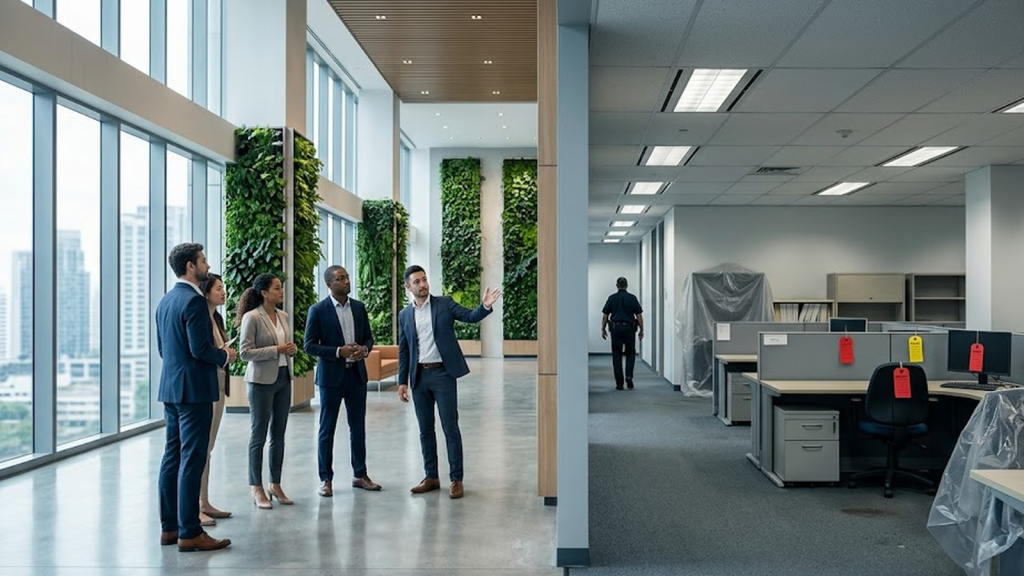
The 2026 Commercial Office Bifurcation: London and NYC Record Rents as Grade B Assets Face Terminal Obsolescence
Global new office construction has plummeted 75%, engineering an acute Grade A shortage that is pushing London West End rents to £185/sqft and NYC trophy leases past $305/sqft — while 130 million square meters of secondary office space risks permanent economic stranding.
Global Office Market Key Metrics
↓ 75% of remaining pipeline pre-leased [1]
↑ Record highs in Mayfair/St James’s [2]
↑ New Manhattan ceiling [3]
→ ESG + efficiency requirements [1]
The Death of the “Office Apocalypse” Narrative
The pervasive, simplistic narrative of an omnipresent “office apocalypse” has proven entirely inaccurate. Instead, 2026 is defined by an extreme flight to quality that has created an acute supply shortage of premium “Grade A” office space in major global financial hubs, existing concurrently with a vast, toxic oversupply of obsolete secondary and tertiary assets.[1]
The Collapse of the Development Pipeline
The genesis traces to the severe capital constraints and demand uncertainties of 2022–2024 that effectively halted speculative commercial development globally. In the United States, new office construction starts have plummeted to multi-decade lows, with completions projected to fall by an astonishing 75% in 2026 compared to peak delivery years. Approximately three-quarters of the remaining, diminished U.S. pipeline is already pre-leased.[1]
Europe mirrors this contraction: construction starts sit at their absolute lowest levels since 2010, with total deliveries projected to fall a further 5% in 2026 following equivalent consecutive declines in 2024 and 2025.[1] This severe constriction ensures that the few premium buildings coming to market operate in an environment devoid of competition, granting immense pricing power to institutional landlords holding trophy assets.[4]
London: The Pre-Letting Phenomenon and Record-Shattering Rents
The commercial supply squeeze is arguably most acute in Central London. Of the 5.9 million square feet of office development scheduled for delivery in 2026, an unprecedented 43% was already pre-let by Q1.[2] The competitive intensity among major corporate occupiers—particularly in finance, legal services, and the burgeoning AI sector—to secure environmentally sustainable, technologically advanced space has fundamentally altered leasing behavior.
Tenants are no longer able to wait until leases expire. They are being forced to commit years in advance via pre-let agreements on developments still under construction to outmaneuver rival firms.[5] By Q4 2025, London total demand reached 10.4 million square feet, 6% ahead of the 10-year average, driven heavily by large corporate deals exceeding 100,000 square feet.[2]
Central London Office Market by Submarket (Q4 2025)
| London Submarket | Annual Take-Up (vs 10-yr Avg) | Peak Prime Rents (per sqft) | Grade A / Core Vacancy |
|---|---|---|---|
| The City Core | 4.1M sqft (+10%) | £97.50–£106.00 | 4.4%–4.8% |
| West End (Mayfair/St James’s) | 1.9M sqft (−22%) | £160.00–£185.00 | 1.3% (Grade A only) |
| East London (Canary Wharf) | 1.1M sqft (+62%) | £47.00–£55.00 | 9.3% |
| Tech Belt | 1.0M sqft (−33%) | £95.00 | 10.1% (Overall) |
Occupiers are demonstrating clear willingness to pay massive premiums for best-in-class assets aligned with corporate ESG goals and talent retention strategies. In the London market, deals for spaces exceeding 50,000 sqft that achieved rents above £80/sqft accounted for over half of all transactions in that size bracket—a massive leap from the 23% share recorded between 2020 and 2022.[2]
Prime rents in Mayfair and St James’s have surged to £185.00 and £160.00 per sqft respectively, reflecting intense competition for a vanishingly small pool of ultra-premium stock where Grade A vacancy sits at a mere 1.3%.[2] In the City Core, vacancy rates have compressed for ten consecutive quarters to 4.8%, driving prime rents near £100/sqft.[2]
New York City: The Ultra-Premium Surge
A parallel extremity is observed in Manhattan. While the broader New York office vacancy rate remains elevated near 13.9–15%, this aggregate figure entirely obscures the explosive record-breaking demand for trophy assets.[6]
Transactions for space priced at or above $100/sqft surged in 2025, encompassing 313 leases across 125 buildings totaling approximately 9.96 million square feet—a staggering 48% increase from the previous year’s record, accounting for roughly one-third of all Manhattan leasing activity.[3]
The absolute peak has established new benchmarks rivaling global highs in London and Tokyo: 28 transactions started at $200/sqft or higher, with SL Green’s One Vanderbilt achieving $305/sqft—the new ceiling for Manhattan’s most coveted addresses.[3] Trophy space availability in Midtown’s prime corridors (Hudson Yards, Grand Central district) has compressed to roughly 7.5%, with premier buildings operating at occupancy levels exceeding 95%.[3]
NYC Ultra-Premium Office Leasing ($100+/sqft)
↑ 48% YoY increase [3]
↑ ~⅓ of all Manhattan activity [3]
↑ New historic ceiling [3]
Hybrid Work Equilibrium and the “Commute-Worthy” Premium
The fundamental driver behind the commercial recalibration is the permanent institutionalization of hybrid work architectures. By 2026, approximately 22% of the U.S. workforce (roughly 34.3 million individuals) remains entirely remote, while the majority of office-capable workers operate on an informal hybrid schedule averaging 1.5 to 2 days from home per week.[7]
Global utilization data spanning over 300 million square feet across 13 countries confirms a persistent mid-week clustering model: Tuesday peaks at 58.6% occupancy, Monday trails at 46.4%, and Friday is essentially abandoned at 34.5%.[8] Office utilization averages just 54% against organizational targets of 79%.[9]
Global Office Occupancy by Day of Week (2026)
Elastic Portfolios Replace Static Headquarters
Corporate real estate executives are abandoning static, long-term leasing models for monolithic headquarters. Strategy is pivoting toward “elastic portfolios”—a curated blend of a smaller, premium core space supplemented by flexible workspaces utilized on-demand.[9] Flexible operators and coworking management agreements are capturing significant letting activity as corporations seek rapid footprint expansion or contraction without decade-long lease liabilities.[10]
Because daily attendance is rarely mandatory, employees must be enticed to commute. “Experience” has become the paramount value driver in commercial asset pricing. The market is harshly penalizing buildings with “experience obsolescence.” Assets in vibrant “lifestyle districts”—neighborhoods integrating high-end retail, diverse culinary options, wellness facilities, and waterfront attractions—command a 32% rental premium over equivalent buildings in sterile central business districts.[1] Globally, 67% of the workforce (74% of those aged 25–34) explicitly prefers mixed-use environments facilitating social connectivity beyond the desk.[1]
Stranded Assets: The 130-Million-Square-Meter Problem
The inverse of the Grade A boom is the accelerating obsolescence of Grade B and C properties. Across the ten largest global office markets, an estimated 130 million square meters of office space is at high risk of becoming permanently “stranded”—economically unviable due to insurmountable capital expenditure requirements to meet modern energy efficiency standards and carbon regulations.[1]
In New York, occupied space in top-tier 5-star buildings grew by 11.5 million sqft while declining sharply across the rest of the market, widening the leasing performance gap.[11] Over 35 million sqft of U.S. office space was permanently removed in 2025 through conversions and demolitions, exceeding the long-term historical average by over 10 million sqft.[6]
The Office-to-Residential Conversion Boom
After years of logistical and financial friction, adaptive reuse has gained significant traction. In New York, developers initiated construction on 4.3 million sqft of residential conversions in 2025, and the 2026 pipeline is set to more than double to nearly 9.5 million sqft.[12] Similar conversions are breaking ground in Washington D.C. and other hubs.[13]
However, repositioning is architecturally complex: floorplate geometries, plumbing infrastructure, and natural light penetration render many deep-core office buildings unsuitable for residential conversion without prohibitive capital outlays.[14] Not every building can or should be saved.
Investors are increasingly turning to intensive retrofitting. In the UK’s “big nine” markets, refurbishments account for a record 53% of the 2026 office development pipeline.[15] Retrofitting offers lower embodied carbon, faster delivery, and energy-focused improvements that yield a 55% higher return on investment when implemented early in a building’s lifecycle.[1]
Fiscal Strain: The Municipal Tax Base Erosion
The devaluation of secondary office stock carries systemic fiscal implications. Commercial real estate constitutes a foundational pillar of the municipal tax base in cities like New York, Chicago, San Francisco, and Boston. The lag in property tax assessments means the steep market value drops of 2023–2024 are fully materializing in 2025–2026 tax levies.[16]
While “doomsday” scenarios were avoided—thanks to the upscaling of Manhattan’s office market and rising residential taxes offsetting commercial losses—the revenue contraction arrives as local governments face unprecedented pressures from expired pandemic-era federal funding, reduced Medicaid and food assistance subsidies, and rising pension liabilities.[17] The economic viability of the urban core now depends on the successful transition of defunct commercial corridors into mixed-use, residential-heavy districts generating reliable property tax revenues per acre.[18]
“The era of commoditized, one-size-fits-all office space has conclusively ended. Physical office space is no longer operational overhead—it is a strategic instrument for talent acquisition and brand projection.”
— JLL, Global Real Estate Outlook 2026 [1]
Key Takeaways
- Supply crisis is real: Global office completions have collapsed 75% from peak, with 43% of London’s 2026 pipeline already pre-let before delivery.
- London West End: 1.3% vacancy: The world’s tightest Grade A office submarket, with Prime rents reaching an unprecedented £185/sqft in Mayfair.
- NYC trophy surge: 313 leases above $100/sqft (48% YoY increase) with One Vanderbilt setting the $305/sqft ceiling for Manhattan.
- Hybrid work is permanent: 22% of the U.S. workforce is fully remote; Tuesday peaks at 58.6% office occupancy, Friday collapses to 34.5%.
- 130M sq. meters stranded: Older Grade B/C stock faces terminal obsolescence unless retrofitted to modern ESG and efficiency standards.
- Conversions accelerate: NYC’s office-to-residential pipeline doubles to 9.5M sqft in 2026; UK refurbishments hit a record 53% of pipeline.
- Lifestyle premium is real: Offices in vibrant mixed-use districts command 32% higher rents than sterile CBD equivalents.
References
- [1] “Global Real Estate Outlook,” JLL, 2026. [Online]. Available: https://www.jll.com/en-us/insights/market-outlook/global-real-estate
- [2] “43% of New London Office Space Pre-Let, as Occupiers Navigate Supply Squeeze,” Avison Young, February 2026. [Online]. Available: https://www.avisonyoung.co.uk/news-item/-/article/2026/02/05/43-per-cent-of-new-london-office-space-pre-let-as-occupiers-navigate-supply-squeeze
- [3] “New York Luxury Office Market Booms as Companies Seek High-End Amenities,” European Business Magazine, 2026. [Online]. Available: https://europeanbusinessmagazine.com/business/new-york-luxury-office-market-booms-as-companies-seek-high-end-amenities/
- [4] “Office Sector Outlook Remains Mixed for 2026,” CRE Daily, 2026. [Online]. Available: https://www.credaily.com/briefs/office-sector-outlook-remains-mixed-for-2026/
- [5] “London Offices: The Outlook for 2026,” Carter Jonas, 2026. [Online]. Available: https://www.carterjonas.co.uk/insights/outlook-2026-london-offices
- [6] “U.S. Office Vacancy Nears Peak as Outlook Improves Beyond 2026,” Wolf Commercial Real Estate, 2026. [Online]. Available: https://wolfcre.com/u-s-office-vacancy-nears-peak-as-outlook-improves-beyond-2026/
- [7] “80+ Remote Work Statistics for 2026: The Complete Data Guide,” Remotive, 2026. [Online]. Available: https://remotive.com/blog/remote-work-statistics-hiring-trends/
- [8] “Hybrid Working Is Stabilising Around the World, Office Occupancy Report Claims,” Workplace Insight, 2026. [Online]. Available: https://workplaceinsight.net/hybrid-working-is-stabilising-around-the-world-office-occupancy-report-claims/
- [9] “Five Corporate Real Estate Strategies Redefining Workplace in 2026,” JLL, 2026. [Online]. Available: https://www.jll.com/en-us/newsroom/five-corporate-real-estate-strategies-redefining-workplace-in-2026
- [10] “London’s Office Recovery Is Real, But Highly Selective — Raising The Bar For Flex Operators,” Allwork.Space, February 2026. [Online]. Available: https://allwork.space/2026/02/londons-office-recovery-is-real-but-highly-selective-raising-the-bar-for-flex-operators/
- [11] “What’s Ahead for Central London’s Office Market in 2026?” Langham Estate, 2026. [Online]. Available: https://langhamestate.com/industry-community/london-office-market/
- [12] “Office Conversions Drive NYC Housing Boom in 2026,” CRE Daily, 2026. [Online]. Available: https://www.credaily.com/briefs/office-conversions-drive-nyc-housing-boom-in-2026/
- [13] “Latest U.S. Real Estate News and Market Signals to Watch,” Investorlift Community, 2026. [Online]. Available: https://community.investorlift.com/the-lift-2/latest-u-s-real-estate-news-and-market-signals-to-watch-1063
- [14] “Office-to-Residential Conversions in NYC: Economics and Fiscal Estimates,” Office of the New York City Comptroller, 2026. [Online]. Available: https://comptroller.nyc.gov/reports/office-to-residential-conversions-in-nyc-economics-and-fiscal-estimates/
- [15] “Office Refurb Projects in the UK’s ‘Big Nine’ Markets Hits Record High,” BE News, 2026. [Online]. Available: https://benews.co.uk/office-refurb-projects-in-the-uks-big-nine-markets-hits-record-high/
- [16] “Spotlight: New York City’s Office Market,” NYC Comptroller, 2026. [Online]. Available: https://comptroller.nyc.gov/reports/spotlight-new-york-citys-office-market/
- [17] “Local Governments Are Increasingly Strapped: 2026 Will Bring New Challenges and New Opportunities,” ITEP, 2026. [Online]. Available: https://itep.org/local-governments-are-increasingly-strapped-2026-will-bring-new-challenges-and-new-opportunities/
- [18] “How Can Density and Varying Housing Types Influence Local Tax Bases?” National Association of Home Builders, January 2026. [Online]. Available: https://www.nahb.org/blog/2026/01/value-of-land-efficiency