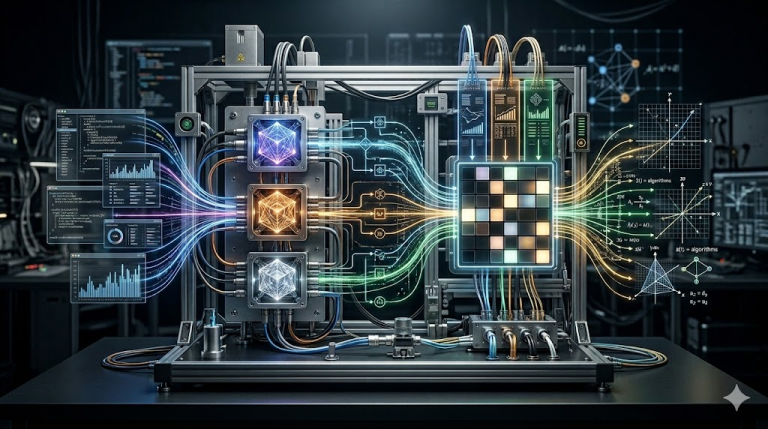

Agentic Coding 2026: Agent Teams, SWE-bench, and the Future of Autonomous Software Engineering
On SWE-bench Verified, Claude and Gemini are in a dead heat at 80.6-80.8%. Then GPT-5.3-Codex enters the arena, dominating Terminal-Bench 2.0 at 77.3% from isolated cloud sandboxes. The real differentiation is three-way: Claude’s dynamic Agent Teams vs Gemini’s sub-agent delegation vs Codex’s async cloud agent model. Enterprise software engineering is being fundamentally reshaped.
Agentic Coding Performance Metrics
→ Statistical tie [3]
↑ +3.1pp over Claude [3]
↑ +9.7pp over Claude [3]
↑ Competitive coding lead [3]
↑ Cloud sandbox leader [6]
↑ Harder SWE variant [6]
SWE-bench: The Dead Heat
SWE-bench Verified — the gold standard for evaluating AI code repair capability — tests models on real-world GitHub issues: bugs from actual open-source repositories that require understanding existing codebases, diagnosing problems, and generating correct patches. [3]
Claude Opus 4.6 scores 80.6%. Gemini 3.1 Pro scores 80.8%. The 0.2 percentage point difference is within noise margins — this is a statistical tie. Both models can correctly resolve approximately four out of every five real-world software bugs autonomously. [3]
This parity has profound implications. It means the choice between platforms for code generation and repair workloads cannot be made on raw capability alone. The differentiating factors are the agent architecture (how the model orchestrates multi-step coding tasks), the developer tool ecosystem (Claude Code vs Antigravity), and the cost profile (how much each correct resolution costs at scale). [3][2]
Beyond SWE-bench: Where Differentiation Emerges
While SWE-bench shows parity, other coding benchmarks reveal meaningful gaps:
Terminal-Bench 2.0 tests autonomous terminal operation — the ability to navigate file systems, execute commands, interpret output, and chain operations to accomplish system administration and development tasks. Gemini leads at 68.5% vs Claude’s 65.4%. [3]
MCP Atlas evaluates tool integration — how effectively models use external tools via the Model Context Protocol to accomplish tasks that require database queries, API calls, and file system operations. Gemini leads more decisively at 69.2% vs Claude’s 59.5% — a 9.7 percentage point gap. [3]
LiveCodeBench Pro measures competitive coding capability (algorithmic problem-solving under contest conditions). Gemini achieves 2,887 Elo, corresponding to roughly Candidate Master level in competitive programming. Claude’s score, while competitive, trails by a meaningful margin on pure algorithmic tasks. [3]
Agentic Coding Benchmark Results
| Benchmark | Claude Opus 4.6 | Gemini 3.1 Pro | GPT-5.3-Codex | Gap |
|---|---|---|---|---|
| SWE-bench Verified | 80.6% | 80.8% | — | Tie (~0.2pp) |
| SWE-Bench Pro | — | — | 56.8% | Codex-only benchmark |
| Terminal-Bench 2.0 | 65.4% | 68.5% | 77.3% | Codex +8.8pp vs Gemini |
| MCP Atlas | 59.5% | 69.2% | — | Gemini +9.7pp |
| LiveCodeBench Pro | ~2,750 Elo | 2,887 Elo | — | Gemini leads |
| OSWorld | — | — | 64.7% | Codex-only (computer use) |
| GDPval-AA (Quality) | 1,606 | 1,317 | — | Claude +22% |
Agent Teams vs Sub-Agents: Architecture Matters
The most consequential difference between Claude and Gemini for enterprise coding is not benchmark performance — it is agent architecture. How each platform orchestrates multi-step autonomous coding tasks determines real-world effectiveness on complex enterprise workloads that no single-turn benchmark captures. [1][4]
Claude Opus 4.6 introduces Agent Teams — a dynamic multi-agent architecture where the primary model can spawn specialized sub-agents at runtime, assign them specific subtasks, and coordinate their outputs. Critically, these agents are instantiated dynamically based on the task requirements, not pre-configured. The orchestrator analyzes the task, determines what specialist capabilities are needed, and creates the appropriate team on the fly. [1]
Gemini 3.1 Pro uses a sub-agent delegation pattern where the primary model can invoke pre-defined specialized agents (through the Antigravity “Mission Control” interface) to handle specific aspects of a task. This pattern is more structured and predictable, but less flexible — the agent types and their capabilities must be defined in advance. [4]
Agent Teams vs Sub-Agent Delegation
| Feature | Claude Agent Teams | Gemini Sub-Agents | GPT-5.3-Codex Agents |
|---|---|---|---|
| Agent Creation | Dynamic at runtime | Pre-defined templates | Cloud sandbox per task |
| Task Analysis | Orchestrator determines team | User selects agent types | AGENTS.md config file |
| Flexibility | High (any task decomposition) | Moderate (template-constrained) | High (full OS access) |
| Predictability | Lower (emergent behavior) | Higher (defined patterns) | Moderate (async results) |
| Error Recovery | Agents can retry/reassign | Manual intervention needed | Runs tests, iterates |
| Cost Control | Harder to predict | More predictable | $4.81/M blended |
| Interface | Terminal (Claude Code) | Visual (Mission Control) | Codex app + CLI |
| Execution | Streaming (real-time) | Streaming (real-time) | Async (minutes-hours) |
| Network Access | Full (MCP tools) | Full (Google Search) | Disabled during tasks |
Enterprise Case Study: Rakuten’s Discovery
Rakuten, the Japanese e-commerce conglomerate, provided one of the first large-scale enterprise evaluations of agentic coding systems. Their engineering team discovered that the choice between Claude and Gemini for coding tasks depended critically on the specific workload profile — reinforcing the theme that no single model dominates across all coding dimensions. [2]
For code repair and bug fixing (SWE-bench-style tasks), both models performed comparably in production, consistent with the benchmark parity. For greenfield code generation (writing new code from specifications), Claude’s larger output window and higher output quality scores (GDPval-AA) produced more maintainable first-draft code. For competitive algorithmic tasks and tool integration, Gemini showed measurable advantages aligned with its LiveCodeBench and MCP Atlas scores. [2]
The Future: Autonomous Software Engineering at Scale
Both platforms are converging toward a future where 80%+ of routine software engineering tasks are handled autonomously by AI agents, with human engineers focusing on system architecture, requirements definition, and review of AI-generated output. [2]
The implications for software engineering organizations are profound. Team structures will evolve from large implementation teams to smaller architecture-focused teams that manage fleets of AI coding agents. The most valuable engineering skill will shift from writing code to specifying intent — creating precise product requirement documents, writing effective CLAUDE.md configuration files, and designing test suites that validate AI-generated code against business requirements. [2][5]
Organizations that adopt agentic coding today with proper spec-driven development practices will compound their advantage. Those that continue with “vibe coding” approaches — unstructured prompting without specification documents or architectural guardrails — will accumulate technical debt at unprecedented rates. [2]
GPT-5.3-Codex: The Async Cloud Agent Paradigm
OpenAI’s GPT-5.3-Codex introduces a third architectural paradigm that fundamentally differs from both Claude’s Agent Teams and Gemini’s sub-agents. Rather than operating within a streaming conversation, Codex dispatches tasks to isolated cloud sandboxes — each with its own filesystem, package manager, and execution environment — where the model works autonomously for minutes to hours. [6]
The results on coding benchmarks are striking. Terminal-Bench 2.0 at 77.3% surpasses both Claude (65.4%) and Gemini (68.5%) by wide margins, reflecting Codex’s native advantage in terminal-centric workflows. SWE-Bench Pro at 56.8% (a harder variant than SWE-bench Verified) and OSWorld at 64.7% (autonomous computer use) demonstrate capabilities that streaming API models cannot easily replicate. [6]
The configuration model is also distinct: Codex reads AGENTS.md files from repositories to understand project conventions, test commands, and coding standards — analogous to Claude’s CLAUDE.md but specific to OpenAI’s ecosystem. Internet access is disabled during task execution for security, meaning Codex cannot fetch packages or browse documentation mid-task. All dependencies must exist in the sandbox before execution begins. [6]
For enterprise teams, Codex’s async model enables parallel task execution — dispatching multiple coding tasks simultaneously across separate sandboxes. A team can assign ten bug fixes to Codex agents running in parallel, each operating in its own container, and review the results as GitHub pull requests. This parallelism is a structural advantage over sequential agent conversations. [6]
“The most valuable engineering skill is shifting from writing code to specifying intent — creating precise requirements, designing test suites, and managing AI agent fleets. SWE-bench parity at 80% means the differentiation is in orchestration, not raw capability.”
— Enterprise agentic coding analysis, February 2026 [2]
Key Takeaways
- SWE-bench is a dead heat: 80.6% vs 80.8% — raw code repair capability is equivalent between both models.
- Gemini leads on tool integration: MCP Atlas (+9.7pp) and Terminal-Bench 2.0 (+3.1pp) show stronger agentic tool usage.
- Claude wins on output quality: GDPval-AA (+22%) means more maintainable first-draft code for greenfield generation.
- Agent architecture is the real differentiator: Claude’s dynamic Agent Teams offer flexibility; Gemini’s sub-agents offer predictability; Codex’s cloud sandboxes offer async parallelism.
- GPT-5.3-Codex dominates terminal tasks: Terminal-Bench 2.0 at 77.3% and SWE-Bench Pro at 56.8% establish Codex as the leader in autonomous sandbox-based coding.
- Spec-driven development is mandatory: Vibe coding accumulates technical debt. PRDs, plan-mode approval, and project memory are non-negotiable for enterprise use.
- Human engineers become architects: 80%+ of routine coding tasks moving to AI means engineering value shifts to specification and review.
References
- [1] “Introducing Claude Opus 4.6,” Anthropic, February 2026. [Online]. Available: https://www.anthropic.com/news/claude-opus-4-6
- [2] “Google Antigravity + Claude Code AI Coding Tips,” Reddit r/vibecoding, February 2026. [Online]. Available: https://www.reddit.com/r/vibecoding/comments/1pevn9n/google_antigravity_claude_code_ai_coding_tips/
- [3] “AI Model Benchmarks + Cost Comparison,” Artificial Analysis, February 2026. [Online]. Available: https://artificialanalysis.ai/leaderboards/models
- [4] “Antigravity Sub Agents,” Google AI Developers Forum, February 2026. [Online]. Available: https://discuss.ai.google.dev/t/antigravity-sub-agents/114381
- [5] “Google Antigravity & Vibe Coding: Developer Guide,” Vertu, February 2026. [Online]. Available: https://vertu.com/ai-tools/google-antigravity-vibe-coding-gemini-3-pro-developer-guide-claude-code-comparison/
- [6] “Introducing GPT-5.3-Codex,” OpenAI, February 2026. [Online]. Available: https://openai.com/index/introducing-gpt-5-3-codex/